In retrospect, this remarkable story is even more so

There’s a nice little movie out there called “Fruitvale Station,” a separate discussion. In the movie the lead character, Oscar, is getting lovey with his wife and she is indifferent, and then mentions that he had an affair with another woman and that it was making it difficult for her. “One time,” says Oscar, and she agrees. “Yeah. You got caught, one time.”

This article is from TV Guide, April 15, 2000. It was a freer time in our history with more actual journalism going on than now. The incident has stuck in my mind all of these years because events subsequent indicate heavily military PSYOP presence in our news media.

In the TV Guide article, we learn that eight US Army PSYOP specialists held positions with CNN and NPR. That much is certain, as it was admitted by red-faced CNN and NPR.

After that, everything appears to be a lie. News executives did not know about them, they say. They did not affect “journalism,” they say. “Human Resources” did not know their backgrounds, they say. They were just there to “learn at the feet of masters,” and only about how to do news reporting, they say. In Latin America, they were used to doing things like create anti-drug advertisements, they say. They just did low-level clerkish work, says NPR, on Morning Edition and All Things Considered. They were probably pushing a coffee cart around. What could be more harmless?

And, of course, once NPR and CNN “learned” they were there, they were immediately terminated. End of story.

Truth is a little less savory. A French Intelligence newsletter exposed their existence, and the story ran in a Dutch newspaper, thereby making its way into the US media.

CNN and NPR got caught. But of course, it was the first time. Never happened before, never happen again. Honest honey.
____________
Continue reading “In retrospect, this remarkable story is even more so”

Serving two masters

rent_seeking_teacheconThis was another “Duh!” moment I had recently – it has to do with private health insurers eliminating coverage of office visits from their policies as we move into ACA, or “Obamacare.”

ACA instituted requirements for basic care, but they are minimal – certain tests and an annual physical. That part went into effect a couple of years ago. I had coverage through Anthem Blue Cross at that time, and after I got the physical learned that they would not pay for the office visit portion – the majority of the cost of the physical. I questioned them about this, thinking that “annual physical” would naturally include going to a physician’s office. No, they said, read the contract. They do not cover office visits.

Continue reading “Serving two masters”

The origins of Americanism

The twentieth century has been characterized by three developments of great political importance: the growth of democracy, the growth of corporate power, and the growth of corporate propaganda as a means of protecting corporate power against democracy. (Alex Carey)

I stumbled upon the above words years ago, and only now have followed up on Carey’s (1922-1987) work. He was a misplaced sheep rancher in Australia who had strong academic leanings. (Raising “sheep” would later seem apropos.) He studied propaganda, but most of his work was unpublished due to an early death. He noticed that around 1970 American propaganda was creeping into Australian society. In academic fashion, he did research into the origins.

Alex-CareySo I spent my down time in Yellowstone reading “Taking the Risk out of Democracy,” a collection of his essays. Most of our current attitudes are a manifestation of earlier work by the National Association of Manufacturers (NAM). That robust group ran education campaigns from the early twentieth century forward. The only two serious threats to corporate power in our society are government and unions. NAM demonized both, convincing even those who benefited from unions that they were a force for evil. Those attitudes are omnipresent now in our culture.
Continue reading “The origins of Americanism”

The Military-Industrial-Intelligence-Entertainment Complex

It bears repeating that any time we see a movie that uses U.S. military hardware, the script has been approved by the Pentagon and they had a representative on-site to make sure that nothing un-American slips through. The Hollywood-Langley-Pentagon connection is as deep now as even during World War II. Very little escapes the censors.

Anyway, I am pleased to announce that the following letter was printed in CounterPunch Magazine, the print edition, June 2013, Vol. 20, No. 6:

Ed Rampell’s excellent piece on CIA and Hollywood collaboration was highly informative. He does not mention it, but I wonder about the voting process when a mediocre film like Argo secures a best picture award over an artistic achievement like Lincoln. If the agency is working the producers up front, are they also working the AMPAS voters behind the scenes?

I can think of no other reason for the award. Argo was poorly acted, Affleck was a stiff. Green screens were so obvious that it felt like a Hollywood set. I laughed out loud at the contrived airport scene.

I was shocked at rave reviews, and no less so when it got the best picture nod. I remember feeling that same shocked surprise when Bush won in 2000.

On a deeper note: American embassies house CIA stations, an open secret. CIA was deeply entangled in the Shāh’s pre-1979 Iran. The people extracted seemed to know to meet and find shelter away from the embassy during a crisis. The Canadian embassy was probably a prearranged destination. The agency had to have been extracting its own people for security reasons. I cannot imagine any other reason for such drastic measures. Rescuing innocent civilians is not CIA’s charter.

I do not know the magazine’s circulation or reach, but assume it is much less than the Atlantic Monthly, where I had a severely redacted letter printed one time many years ago. Rampell’s piece was called “The Military-Industrial-Intelligence-Entertainment Complex: Hollywood’s Year of Living Clandestinely. Unfortunately, it is behind the subscription wall.

Going for the record!!!

99532704-helen-thomasI was looking over blog stats last night and saw the usual, 200 hits a day plus or minus. It’s been like that for years. (It resembles a flat line.) I don’t actively promote the blog since that is against my idealistic nature. And anyway, most of what I write “goes right over everyone’s head,” as I was told in the early days. If I want readership, I’ve got to be more topical.

But there was an anomaly in the stats – on June 24 readership soared to 1,417. I looked back to that day – there were two posts, one about the curious Snowden affair, the other titled “Man of Steel: The 9/11 Reboot.” That’s what did it – reference to a popular movie.

In that vein, I offer the following:

  • Lone Ranger!!!
  • Royal baby!!!
  • Zimmerman Trayvon Martin!!!
  • You go, Democrats!!!
  • Miley Cyrus wears tight clothing!!!
  • Kanye, Jay Z!!!
  • Dennis Farina dead at 69!!!
  • Helen Thomas dead at 92!!!

That last one is out-of-place. Those who linked here for the former will have no clue of the inspirational work of the confrontational and courageous woman, Helen Thomas. She was a journalist. God rest ye, Ms. Thomas. You were good. Damned good.

Shape of Obamacare: Views differ

David Crisp of the Billings Outpost wrote this article, Unveiling Obamacare, as a journalistic piece. It brought to mind Krugman’s comment about how journalists would deal with a flat earth if powerful people disagreed: “Shape of the earth: views differ.”

First, Mr Crisp: He is an accomplished man, a scholar. He can write on a host of topics and be interesting and insightful. Anyone who has met him will tell you that he is sincere and nice and unassuming. This is not about him.

However, in reading this piece, along with so many others put out by our journalists, I wonder why the rules of their game forbid being insightful. The piece in question does what they claim to be their only job: bring us the facts, let us decide.
Continue reading “Shape of Obamacare: Views differ”

Life in these United States

Does anyone else have this problem? We are in the “Do Not Call” era, but have had to use call blocking through Centurylink to stop the repeat offenders. However, we are only allowed 25 numbers to block, and quickly used up our quota. Our house phone allows us thirty more blocks, and it too is filling up.

The latest offender is the Denver Post. What they are doing is clearly telemarketing, but they can technically get away with it because almost all people who don’t take their rag once did, establishing a “business relationship.”

One outfit selling kitchen remodeling said that they were legal because a portion of their sales went to charity, thereby getting around DNC restrictions. I am guessing .0000002%.

The worst offender by far is Google. You cannot block enough numbers with them – they just keep rolling over to new ones. And it’s a recorded message, so you can’t swear at them. Nonetheless, fuck Google.

Sad thing is that the less than one percent who respond to telemarketers are enough to keep them annoying the rest of us.

Suggestion precedes selection precedes election

This is the photo that the Daily News chose to accompany the story of Elliot Spitzer's entry into the race for New York City controller.
This is the photo that the Daily News chose to accompany the story of Elliot Spitzer’s entry into the race for New York City controller.
Anthony Weiner is running for mayor of New York City, and now we learn that Elliot Spitzer has gathered enough signatures (and then some) to be on the ballot for the office of controller of NYC.

Ashley Dupre seduced Spitzer ... honestly, fellas, could you say no?
Ashley Dupre seduced Spitzer … honestly, fellas, could you say no?
It’s interesting that the two faces have reemerged, each of them brought down by scandals while holding other offices. Re-entry into politics was unlikely. Judging by this story in the New York Daily News, I think it safe to say that some powerful people are unhappy with Spitzer’s decision.
Continue reading “Suggestion precedes selection precedes election”

The real and present danger

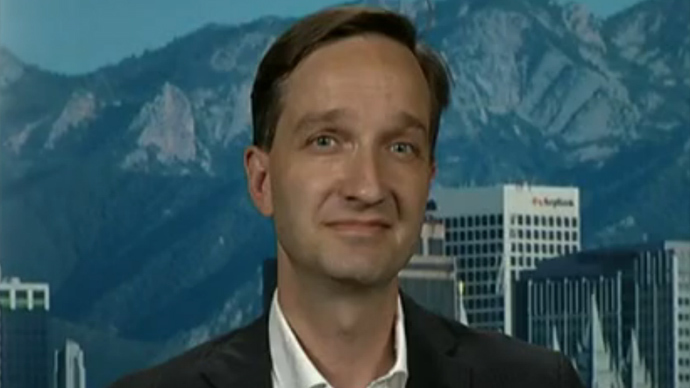
Pete Ashdown
Pete Ashdown
True courage is rare here in the land of the brave, or whatever it is we like to sing about ourselves when commanded to stand and salute the flag at ball games. So when a truly courageous person steps forward, risks all, we need to send him support.

His name is Pete Ashdown, and he is the owner of an ISP firm in Salt Lake City. (Link.) For fifteen years now he’s been refusing to comply with NSA demands for access top his clients. I highlight “fifteen” there because this would take us all the way back to Clinton. Even before the 9/11 false flag attack, NSA had already turned its eyes into our private affairs.

Ashdown is ready to go to jail, but will also comply with legal NSA information requests.

Whether it is a young man resisting a shakedown at a DUI checkpoint, as highlighted in the comments at this post, or a journalist risking her career by questioning the official 9/11 story (if you find one, let me know), we are a country with only a few bright lights in a sea of oppression, thought control, agitprop and fear. I suppose it has always been like this. I imagine the Germans were like this in the 1930’s and later during the Cold War under STASI. I imagine Saudi citizens are under constant surveillance, as are Chinese and Colombians. It is those countries that have the most to fear from their own population who are most extreme in their surveillance efforts.

They ain’t worried about terrorists. Get real. They’re worried about us. It’s sad we give them so little cause for concern.

Shania Twang

I enjoyed the Rolling Stone article about Natalie Maines, former lead singer for the Dixie Chicks. The group was subjected to a severe lashing when Maines uttered aloud a thought crime about the Iraq war during a concert in London. She’s feisty as hell, and has not backed down, which is good to see. (I only urge that she avoid flying on small aircraft in the future.)

This part made me chuckle. I enjoy music but am not subtle or refined. Even so, country musuc has always grated on me. Mostly, I think, it is the 2-4 beat, which doesn’t lend itself to much diversity. Maines had another thought, which rang true:

I just didn’t like how blatant country music was. Nothing seemed poetic or subtle. Nothing could be interpreted two different ways! It’s all very spelled out. James Taylor can write ‘Fire and Rain’ and tell you it’s about a mental institution, this and that – and you listen to it, and you’re trying to decipher it all. And, you know, a country song would be like [sings twangily], ‘I’m in a mental institution!’