The Veg-O-Matic took Butte, Montana by stormI was reading Malcolm Gladwell’s “The Pitchman,” about the Popeil’s, a name that any of us in the Boomer generation know well. Ron Popeil was both an innovator and a salesman, with his success attributable in equal portions to each. His Veg-O-Matic was a huge hit, and in reality a very useful product. The Pocket Fisherman was crap, but as Ron said, intended as a gift, and not to use.
The Pocket Fisherman, a piece of crap, the angler's version of right wing economicsIt is fascinating, as is all of Gladwell’s writing. What kept popping into my mind as I read was that there was not a word about tax structure, disincentives, or politics in the piece. Ron Popeil gets a psychic payoff from his life and work. His best work happened during the 1950’s, when the top tax rate was 91%.
I’m just sayin’ – the right wing has twisted economics into a Randian pretzel. They don’t know jack about people. There is a small percentage that is driven by financial return, nothing more. They are always with us, called by various names, including “Wall Street” and “the financial sector.” They are our facilitators, but not our innovators. They need to be put in a cage, handed green eye shades, but never let out into real sunlight. When they become our masters, when their needs become our driving force, we have … what we have – boom and bust, bubble and pop, and grand inequality of wealth.
____________ Oh-oh: I realized while on the treadmill that this post is classic confirmation bias. Perhaps the Catholic Church can use my services in finding that elusive second miracle for JPII. How easily I fall into it.
My bias is this: That right-wing economics takes that behavior of a small minority of us, sociopaths, and presumes that we all not only should, but want to behave that way. It then seeks to look to government as stifling our natural impulses to behave as they think we should. I am always in search of evidence.
I once had a teacher – an ex-marine nun (believe it!), who shook my young psyche by claiming that the fact that the ancient Greeks and Romans worshiped so many gods was not an outdated practice – that we could find the same thing going on currently with The Lives of the Fathers, Martyrs and Other Principal Saints. Each of these minor gods is worshiped in the same way that the Greeks might have done so with Hermes and Hera – important, but not like Zeus, the big guy.
The search for miracles is confirmation bias on steroids. I wonder if the church employed Natelson and Budge in the process. It’s also comical. If this God of theirs were so powerful, why is he so sneaky about imparting evidence to us?
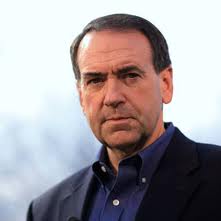
Says that Assange (!) has blood on his handsSarah Palin says that Julian Assange “… is an anti-American operative with blood on his hands,” who should be “pursued with the same urgency we pursue al Qaeda and Taliban leaders.” Read … murdered. Mike Huckabee at least has the decency to call for a trial before executing Assange. Vice President Biden says that Assange is a “high-tech terrorist.” The incendiary word “terrorist” automatically sanctions murder.
First we try him, then we hang himPresident Obama allows for compilation of a list of “high value targets” – people who can be summarily executed on sight. The fact that the list includes American citizens troubles people. The absurdity of limiting outrage only to American citizens escapes people.
Says that Assange (!) is the terrorist hereIn a sane and normal world, Palin and Huckabee are charged, tried, and if convicted, serve time. President Obama is impeached, but not until the clown Biden is first removed, to keep him out of that office.
But this is not a sane world. We are so deranged by the constant onslaught of agitprop that we think of incendiary or illegal violence or threat of violence by American patriots to be acceptable, while the same behavior by official enemies, once “communists” and now “terrorists,” is somehow crazed.
And the scale of violence in our eyes is so small – I mentioned in another post that American pilots commit massacres daily “while texting.” It was hyperbole, but only to point out that we think that our pilots massacring people is normal and acceptable. The fact that we do our murder and mayhem on high and from afar, by fighter jets and B52’s and long-range missiles and by use of drones does not remove us form culpability for our behavior.
And yet, when there is blowback, as with 9/11, it is them! They are the terrorists.
Violence comes home to roost, attitude precedes action, actions follow rhetoric, agitprop inflames psychos to murder, and we’re shocked! Shocked.
Radio is a one-way only mediumLike everyone, I’m sickened by the shootings in Tuscon. The apologists of the right wing are out in force now, distancing themselves from the shooter and attempting to draw equivalencies between far right and center-right, aka “the left.” But Jared Loughner is just an anti-government guy.
There are always a few on the fringe who cannot manage their anger. So set aside the fact that it happens so regularly in this country, and not others. What is going on here?
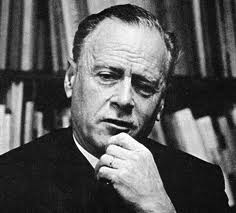
My first impulse today was to go back and reread Marshall McLuhan on the power of radio. McLuhan was a scholar and a fad of the 1960’s – he even made an appearance in Woody Allen’s Annie Hall. His famous assertion was that “media is message,” or that content is not so important as the vehicle that delivers it. He broke down media into “cool” and “hot.” Cool medium requires high participation – say for instance, the television show South Park, with its cutout characters and so few people doing voices, requires us to fill in the details of personality for the characters. That takes real effort on our part.
Marshall McLuhanRadio, according to McLuhan, is a “hot” medium, one that “beat the tribal drum.” The reason is that we cannot interact with it (despite the three or four calls that talk radio hosts allow per show, it is a one-way medium). The host is spreading a message to a large audience, but on the receiving end there is one talker, one listener. It’s an intensely personal experience on the receiving end, all thinking done by the talker, and no response allowed by the listener.
Right wing radio listeners are remote and inaccessible to debate or reason, virtually intellectual slaves to the talk radio host. When he makes them angry, they have nowhere to go with that anger.
…the immediate aspect of radio [is] a private experience. The subliminal depths of radio are charged with the resonating echoes of tribal horns and antique drums. This is inherent in the very nature of this medium, with its power to turn the psyche and society into a single echo chamber. The resonating dimension of radio is unheeded by the scripted writers, with few exceptions. The famous Orson Welles broadcast about the invasion from Mars was a simple demonstration of the all-inclusive, completely involving scope of the auditory image of radio. It was Hitler who gave radio the Orson Welles treatment for real. (McLuhan’s emphasis)
However, McLuhan believed that more advanced societies are less susceptible to the drumbeat of radio.
Highly literate societies, that have long subordinated family life to individualist stress in business and politics, have managed to absorb and to neutralize the radio implosion without revolution. Not so, those communities that have had only brief or superficial experience of literacy. For them, radio is utterly explosive.
In the U.S., the talk radio phenomenon is almost entire exhibited by the far right wing. “Left” talk radio doesn’t travel well or draw much audience. Could this be the reason for something painfully obvious at every Tea Party rally, every Sarah Palin speech, every fundamentalist religious gathering … that these are not literate people? Could the failure of left-wing talk be simply due to the fact that the left side of our narrow spectrum in the U.S. is more literate?
Fr. Charles CoughlinIt is what it is. Radio is a drum beat for a wild animal that needs to be kept in its cage. Since 1987, U.S. talk radio has run free, and the right wing has become angrier and more irrational and more powerful all at once. It is a monopoly – there is no discussion on talk radio – there is only one point of view. In 1949, the aftermath of World War II, and after a fierce right wing radio preacher named Father Charles Edward Coughlin performed much as Rush Limbaugh performs today, The FCC instituted the Fairness Doctrine. It was never a law, only a regulation, and a sensible one. It merely said that more than one point of view had to be carried on public airwaves. It wasn’t just Coughlin – it was all of fascism. The power of radio scared people. The Fairness Doctrine kept the beast in his cage.
There are many, many Jared Loughner’s running around today looking for signs or signals to act up. Indeed they are crazy. Most right wingers are not that – my impression is that they are over-matched. They are angry and looking for someone to be angry at. It’s an easy step for a politician or any other provocateur to channel that anger.
We need, once more, to revisit the wisdom of the past. The FCC in 1949 was way ahead of us.
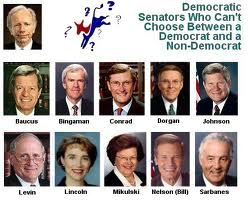
Part of the new right wing majority in the senateI’ve been chuckling about this and scratching my head at the same time, to the point where I am now partially bald – so I’ve discovered. I do not often get to see the back of my head.
But why are the Democrats in the Senate only now talking about fixing the filibuster rules?
Here’s how it shakes out: The Democrats took control of the House and Senate in 2006, but there were two obstacles in place to stop any progressive legislation: the filibuster rule in the senate (which could have been changed), and a Bush veto. Consequently, the House of Representatives was free to do anything of its pleasing, as it had no real power.
The Democrats increased their hold on both House and Senate in 2008, but still allowed the Senate filibuster rule to be used to stop any progressive legislation. Again, the House was free to act as it pleased, as it had no real power.
The word for Democratic behavior in allowing the filibuster rule to stand is “complicity.”
Now that the Republicans have gained control of the House, it is being let back in the game. The filibuster rule in the Senate will be weakened, and Obama, for whatever far-fetched reason his aides can imagine, will sign some pretty nasty legislation. The pathway is being cleared.
There was a time to change the filibuster rule, but it has passed. That it is being done now, when it is too late? Again, the word, I think, is “complicity.”
“The more outrageous the Republicans become, the weaker the left becomes.” Ralph Nader
This line from a longer interview with Nader by Chris Hedges sums up nicely the triangulation phenomenon that we are now caught in. We have right wing Democrats in office who are carrying forward with the corporate agenda, and no organized resistance. The left has been sucked into the Democratic party, and had its balls cut off as a consequence.
But how many times have you heard some Democrat say “Yeah – but look how crazy those Republicans are!”
Like a fox. Right wing craziness is aimed both at its crazy Tea Party wing and at the progressive left. For the TP people, it’s music to soothe the soul. For the lefties, it’s frightening enough to cause a stampede into the Democratic Party.
Republicans are not crazy. They know the impact of their words. The sound effects are measured and calculated to create the effect we are seeing. I have long said that the public pronouncements of politicians do not carry useful information. I am more in tune with Josef Goebbels, JC’s main man, who said words to the effect that everything that is done in public is done for effect.* I cannot find the actual quote, and hope that someone out there possibly reading this can do so.
______________
Here it is, courtesy of Ellul, Propaganda, page x footnote 1: Goebbels said:”We do not talk to say something, but to obtain a certain effect.” And F.C. Bartlett states that the goal of propaganda is not to increase political understanding of events, but to obtain certain results through action.
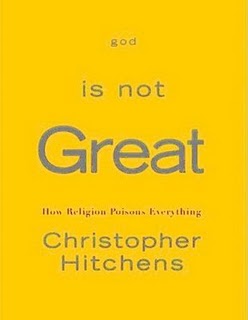
I’ve been spending part of my mornings with Christopher Hitchens’ God is Not Great: How Religion Poisons Everything. I love the guy, and wonder why he spends so much of his excellent mind thrashing at the windmill of religion. But I’ll read whatever he writes about anything of his choosing, as it’s a delight just to sit in his sidecar as he navigates. (He says he’ll leave them alone when they leave him alone. Surely he knows both are impossible.)
Just a couple of his observations – if God rested on the seventh day, what did he do on the eighth? (Never thought to ask.) Religion, he says, is “both the result of and the cause of dangerous sexual repression.” Too true, says this Catholic boy who sheepishly had to confess through a screen to a possible child abuser that he had touched himself to a happy result.
Nothing optional – from homosexuality to adultery – is ever made punishable unless those who do the prohibiting (and exact the fierce punishments) have a repressed desire to participate.
He wonders how the Jewish people ever made it as far as they did before Moses while thinking that “murder, adultery, theft and perjury were permissible.” It must have been quite a mess before the old guy stumbled off the mountain. I did not know (the 8nuns did not tell me!) that the Immaculate Conception was not official church doctrine until 1852, and the problem of there being something about Mary was not solved until 1950, when they discovered her miraculous Assumption into heaven, hymen intact.
The moments I spend with Hitchens in the A.M. are better spent and far more enlightening than those of monks and nuns creeping into chapel. Is it possible that he might be some kind of deity. We’ll see after he succumbs to esophageal cancer … if he returns in a more durable body.
The odds were never in my favorI have been chastised on occasion for having a less-than-universal focus here, as if my little light could actually shine more than a few feet in this vast universe. I do have many thoughts that go beyond the mundane, but also a deep sense of absurdity, as if to sit here and comment on the larger affairs of our country and world could possibly matter to anyone but me. The fact that I have a small forum, and that I get the nominal number of “hits” that a minimally credible blog gets (200-300 daily, most just passing by and who have not read this far), only means that there is some power in the Internet. It has nothing to do with me – it is the vehicle, nothing more, that is on exhibit here.
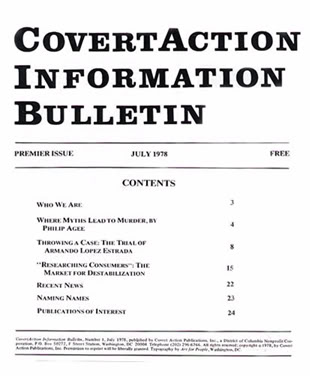
Early pioneers deeply influenced meThere was once a thing called the “alternative press,” and it was a rich source of reading for me – I read all I could of Covert Action Quarterly and so many others long since gone under. I slowly let the subscriptions expire, the last one to go was the Anderson Valley Advertiser, where a very smart man who is also a good writer, Bruce Anderson, did some great work for 2-3,000 readers in pot/wine-infested Boonsville, CA. (Alexander Cockburn, who now manages Counterpunch, allowed his weekly column to be published in AVA for a nominal $25 per week, and advertised himself as a “weekly contributor to the Anderson Valley Advertiser” when he had a weekly column in the Wall Street Journal in the early 90’s. It was, as I see now, an inside joke. AVA still has 2-3,000 subscribers.)
This web site, Piece of Mind, was fashioned on the premise that we are constantly being threatened by hobgoblins. But it has failed to take hold. In a country where propaganda is so sophisticated that none realize it even exists, my point of view will never be anything more than a quirky sideshow. Sort of how I pictured myselfI thought this would be a launching pad to a career in writing, that by this time I would have thousands of readers, but it never developed. Worse yet, I never managed to break out of the narrow Montana community in which I was bred. As a Colorado resident, I have come to realize that Montana blogging is what it is because it is a small state. There is no “Colorado blogging community” as such. That atmosphere can only exist where the patrons are few. By definition, the impact is nil and has no reach, no effect on politics.
It’s been fun – I met some nice people – Ladybug and Bob Garner, and have come to know some more complex people – this guy “Max Bucks” actually wants to be seen as off-kilter. This allows him the freedom to say whatever insulting thing comes to mind. I really like that. Big Swede and Dave Rye are as dense as any two people I have ever met, but I came to like each on his own terms, as they bear no ill will and have sensitive feelings.
Blogging should be an expression of multiculturaism, but some how, it failsThen there is the chorus … the affectations and egos of liberals who imagine themselves enlightened, and Randians and libertarians who just don’t travel well and so cloister and talk among themselves. (Yeah, you, Budge.) Without this medium, blogging, we would never know each other. It’s a trip through the garden of life – many blooms and colors. It is not an outlet that has any effect on the movements of power and politics – that part is silly. (Newspapers don’t have impact either, as they are owned by the very people they should be reporting on. Those folks are silly as well but take themselves so seriously! Any blogger who takes himself seriously ought to quit too.)
It is fun just to butt heads. That’s all this was ever about. And it’s over. I’ve bruised too many egos, and I’m no longer welcome in the right places. I should have known to be gentle – the larger the ego, the quicker the reprisal. But that’s not my style – the larger the ego, the more I am disliked. It was a badge of honor. I take that badge with me into retirement from blogging. I am proud to be disliked by Natelson and Crisp, Budge and Kailey/Kailey, Kemmick and Fleischman, J-whatever-girl … all of the pretension, the demand to be taken seriously as a cover charge for debate … I can’t take it anymore. Too much ego in those places, too little knowledge. I can’t take it anymore!
(Hint: He's fucking with you)Anyway, I’m signing off now. Odd as it may seem, it’s been a pleasure. I really, really enjoyed the debates, tests of skill and feats of strength, the harsh feelings and false sentiments, the massive egos and fake identities that are far more interesting than the actual people behind them. Good bye, and be well.
(If you made it through this tripe, you are one of the three who make blogging worthwhile. Quitting is not an option.)
People have encouraged me in the past to subscribe to the Wall Street Journal for better news coverage than is available from other sources. Investors, after all, need real news. I have subscribed in the past, but it is very hard to keep up with such a large newspaper, and we leave so much unread that it seems like a wasted expense. They tend to pile up, we never get caught up, and eventually give up.
But there are two other sources of news that offer a counter to the highly filtered U.S. outlets.
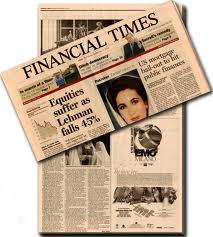
One is the Financial Times, which is delivered to us daily with our Denver Post (which does an excellent job of covering the Denver Broncos, and not much more). FT is a thin newspaper, and carries many news stories that U.S. sources don’t. Just yesterday, for example, it carried a front page story of China’s having developed an anti-aircraft carrier missile that is a “game-changer” in the Pacific, according to prominent U.S. military officials. The only other U.S. sources that covered that story were Stars & Stripes, AOL News, and Business Insider.
FT also had a story about the rising of the minimum wage in Beijing, China, and throughout all of China during 2010 to spur demand and add equality to wealth distribution. The only other U.S. source that I found covering this story was the Wall Street Journal. Minimum wage is frowned on in the U.S., and so doesn’t get much ink.
That’s just one day’s news from one source – two stories of interest in the U.S. not available for general consumption.
Another good source of news is Al Jazeera, seen all over the world, and available in the U.S. on Link TV (Direct TV channel 375, and Dish 9410). In a propaganda system like ours, we are conditioned to automatically disbelieve any statements made by our enemies. Al Jazeera is just another news outlet, but since it has an Arab name, is automatically distrusted here in the land of the free. Fair enough – we should watch it anyway, and apply the same distrust to American news outlets.













 Piece of Mindful