When perceptions cannot be managed …

Little of what is in the news is real news. Most of it are staged events and stage management of actual events. Those who present us with news on TV and in newspapers have many options before them, and decide to focus on some events and ignore the vast majority. That has to be, as media is small and the world is big.

But there are real events that cannot be ignored. There are people in business and government whose job is to monitor real events, and to the degree possible, manage perceptions of those events. When perceptions cannot be managed, they go into “damage control” mode, and if they cannot control damage, the event is said to be “out of hand.”

Out-of-hand events have the power to change public perceptions. With the oil spill in the Gulf, damage control has been, at best, only marginally effective. The Obama people are in the pocket of the oil industry, just as the Bush people before them. Consequently, they are mere spectators. Yet they must appear to be in charge. That calls for on-scene photos, staged confrontations, angry press conferences with oily sand as a backdrop. A staged hug with a fisherman’s wife would be good, as would a little girl and an oily turtle. Little girls really work well.

The best that they have done to date is this:
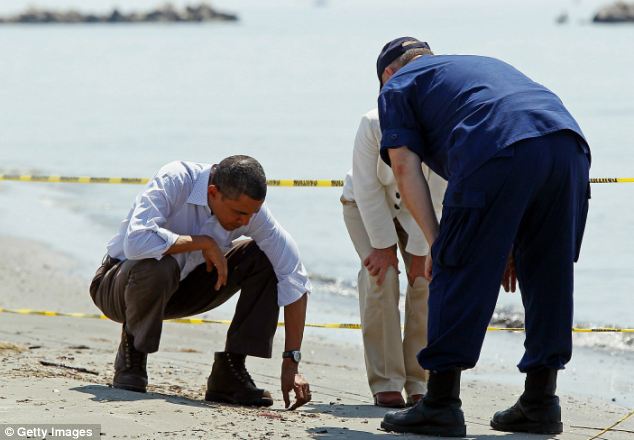
Obama finds cigarette butt

Is that the best they can do? Together with the occasional press report that Obama is “outraged!” his people appear to be rank amateurs.

This could be his Katrina – a PR nightmare. The underlying event is a large national catastrophe, but all of that aside, he has to appear tough and in charge. Fortunately for him, he was not off celebrating someone’s birthday. Still, his people have failed him miserably.

Maybe it is time for a staged distraction event. When 400 marines were killed in Lebanon, Reagan’s people invaded Granada. But the Gulf spill is so big that only a war or new terrorist attack could divert attention. But those things take time – that is, the Pentagon is always ready to go to war anywhere, but the public has to be prepped, and summer is the worst time to launch an advertising campaign.

It’s a perfect storm for Obama – a large and photo-friendly event that cannot be contained … in summer. This is his moment. Either he appears to take charge, or he appears not to be in charge. The cameras wait.

The oil industry in an ongoing development program of deep-water drilling off our coasts. The activity has been mostly unregulated. It was officially sanctioned by the Bush people, and later the Obama people carried on as if the election had changed nothing. Obama himself spread the illusion that he opposed such activity during the campaign, but that was just for perception sake.

That program will be set back a few years. That’s the worst that will happen to the oil industry. British Petroleum’s financial liabilities are limited by law. So is just a matter of riding out the storm before they go back to business as usual.

For the Obama Administration? They might be wishing for a terrorist attack. They are pretty much tapped out on wars at this time.

More adventures in marketing …

I must offer an apology to the lowly minimum wage clerk I encountered last week at the Häagen-Dazs shop at Pearl Street Mall.

For those who do not know Boulder, Colorado, Pearl Street is a magical place. It used to be just a street, but cars are no longer allowed. It is a mall. I have experienced magic when we go there. We park our car on Walnut Street, which is regular pavement, and then walk a block to Pearl. The color of the pavement changes from gray to a pinkish hue, and bricks replace asphalt. I lift my foot from pavement to brick and back, and chant “prices go up, prices go down.”

It works. It is magic.

Anyway, I was looking for something sweet, actually wasting a little time before heading off to endure the grandparently torture of a baseball game among eight-year-old boys. (The best pitchers get hit hardest, as they actually land the ball in the vicinity of the plate.) I found myself on Pearl Street Mall. The Häagen-Dazs store beckoned, and I entered. Right away I was offered a taste of the new almond something-or-other flavor ice cream. It was OK, and the array of flavors was confusing, so I said just give me a little cup of that to go.

And I got a little three ounce up and headed to the register, and the clerk said $5.40 please, and I blurted out “Holy shit!” It just came out, and I was embarrassed, but added “I won’t be darkening these doors again.”

Which is true. But I must apologize to the poor clerk at the Häagen-Dazs store whose job it is to announce to customers that they’ve been seduced by forty-cent ice cream in a $5.00 cup. I imagine that goes on all day, though others probably have an expanded vocabularies and can put it better than me. But she did not flinch as the “holy shit!” left my lips, and I suspect under the veneer she learned to put forward in her two-day training seminar she thought to herself “Got that right.”

Adventures in Marketing …

On a quest for a salty snack the other day, I came across some “Kettle-cooked hand-rubbed spice chips” by Lays. Since I know that anything mass produced will neither be kettle-cooked nor hand-rubbed, I knew that the only true word on the label was “chips.”

In 1981, a bartender bet a customer that he could change the behavior of everyone in the bar by putting a lime in his beer. He won the bet. To this day, thirty years later, people assume that Corona beer is meant to be imbibed with a lime by some ancient tradition or Hispanic ritual. In my experience, Corona without the lime is pretty bad. It’s just a good marketing strategy to move a bad product off them shelves.

I have long been fascinated by how our attitudes and ideas are influenced by marketing. Some time in my twenties, I stopped using deodorant. I don’t smell bad, no one has ever complained. I simply came to realize that the people who made deodorant were selling a false sense of security. And it seemed unnatural to clog up my pores with aluminum chlorohydrate.

As a runner, I often had problems with athlete’s foot and, ahem, fungus in other areas. I spent a lot of money over time on creams, but if I stopped using them, the fungus immediately returned. A kindly doctor gave me the remedy – a hair dryer applied to infected areas daily after showering. It’s free, and effective.

The point is that we have so much that we have to be cajoled and seduced into buying things we don’t need. We have long conquered hunger. We have machines to do most everything except those lowly tasks that we have exported to slave labor in places like China, the Philippines and Vietnam. We produce far more stuff than we need. The marketing dynamics involved in luring us to pay $50 for a branded shirt that can be had for a couple of bucks at the dollar store are intense, imbued in us as youngsters and carried through life.

I get all of that. We’re churning the pot, trying to redirect our hard-earned cash into corporates coffers. We’re consumers, not citizens. Our labor is for one purpose: To buy stuff. So the question I ask is redundant: Why don’t we just relax? We would do just as well working half as hard, and devoting the rest of our time to better pursuits, like reading and volunteer activity, exercise and just hanging out.

We can’t, however. We don’t get to keep the fruits of our labor. Worse than that, we bargain away future labor to 26.99% credit card interest to satisfy immediate impulses. I am so ashamed of us. We allow bankers to elbow their way into our paychecks now and for years to come so that we can have a new shirt, computer, shoes, all incredibly overpriced.

The people who work hardest are our convenience store clerks and gardeners, retail clerks and janitors. We hate our illegals, but do not like paying decent wages. Conservatives love to complain about the leaching class, not knowing that it is much further up the production line than they imagine.

The ultimate expression of the power of that elite leaching class is the slave – these days he is the factory worker who barely subsists on long tortuous hours. Vacation? Benefits? Get real. Slavery by any other name is still slavery, and the people who make our shoes and shirts, computers and baseballs are that – our slaves.

Slavery is the natural byproduct of unregulated markets. But this is 2010, and not 1860. We keep our slaves hidden from view. And call them employees or workers and talk about things like rungs on ladders and stuff. That’s nonsense, but seems to salve our consciences as we go about the business of consuming.

Why only two parties?

In the United States we are locked in to two political parties, and the way we talk about it, one might think that it was ‘designed’ that way. But there is no designer. Our parties – the right wing one and the weak opposing party – are all that we have left after meaningful opposition to corporate power is drowned out, demonized and marginalized.

Most other ‘democratic’ countries (the term only loosely applies to us) have developed at least three powerful factions, sometimes more, and governance is a matter of negotiation where minority parties have a voice because they are often needed to form majorities. If we had a public media and if more voices were allowed to penetrate public consciousness, something similar would happen here.

I imagine that our disaffected non-voters, our progressives and trade unionists would form a powerful coalition resembling the British Labor Party. (A third minority faction would also form, and what we call “Democrats,” stripped of progressives and labor, would be our equivalent of the British Liberal party.)

So we are left to Democrats and Republicans because of opinion management, but it is corporate media that “manages” our ideas. They decide which candidates are “viable,” ignoring any who might threaten entrenched power. They are the image makers, the ones who decide which ideas have traction. They own our TV’s, and TV acts as a gatekeeper for power.

Health care, for instance, was on the public mind for decades, but was only allowed into the political sphere in 2008, and was then used to protect and enhance the power of the health insurance companies. Why then? Why not 2004 or 1956 or 1974? If we had a third party, we would have a public health care system.

Interesting indeed, as those progressives and trade unionists and disaffected voters were fighting for single payer, and then for a public option, but they never seemed to get a voice – they were demonized and marginalized and never got tracked. We got a corporate solution to health care. Weird, eh?

It’s not that we only have two parties. We have at least three. We only recognize two. When there is a movement from the grassroots to get that third party moving, the Democrats step in and work to stop it. Republicans are, oddly, comfortable with third parties. Democrats, on the other hand, have hissy fits and vomit blood at the thought of a Nader stealing their votes.

In the end, as in 2008, the Democrats absorb anything left of them, and render it moot. Democrats crushed single payer. Democrats give us Clinton and then Obama, and all of the right wing accomplishments of the administrations before Democrats are frozen in place. Assisted by corporate media, Democrats prevent the boomerang effect. They seal Republican victories, and act as caretakers until the next Republican Administration takes power.

They also prevent the ascendancy of our Labor Party.

So if at times it appears that I argue from consequence – that I imagine that our system was designed to be as it is – I do not. I merely assert that it is as it is because power does not allow it to be anything else. It is, in the end, all that is left after popular movements are removed from politics.

Settle your tax debt for pennies on the dollar!

As a tax guy I sometimes encounter people on the edges of civilization who want to rejoin us. They are deeply in tax debt. They hide away as the debt builds up. Tax debt is almost as bad as credit card interest, but unlike the credit card companies, the government does offer a way out. It’s called “offer in compromise,” or “OIC.”

I’ve done a few of those, but I don’t seek them out. The process is long and hard, and if the taxpayers are young and have income potential, the IRS OIC people will indeed behave like credit card companies. They can be assholes, and will lock them into installment arrangements where interest and penalties continue to accrue while payments just barely eat away at the underlying burden. They are better off in the underground economy.

On the edges of this fray are sociopaths, the predators who dominate our society. These are the people who slap us around with their invisible hands. These are the “entrepreneurs” that right wing economists deeply admire. If you listen to talk radio at all, you will hear ads for companies that will settle your tax debt for “pennies on the dollar.” IRS warns people to stay away from these Shylocks, but when people are scared and overwhelmed, the promises have far more appeal than common sense should allow.

Imagine that you are walking in the woods, enjoying the smells and plants and solitude, and then suddenly you realize you are being watched, and see a set of cold eyes. The hair on your neck stands up, a shiver goes up your spine, and fight or flight sets in. You have been stalked, and are in grave danger. You may soon die.

These predators are many of our “entrepreneurs”. They are not inventors or innovators, basement scientists or garage mechanics. They are sociopaths – people without consciences, people whose only joy in life is the hunt. They stalk us. Their greatest joy, maybe their only joy, is fresh kill.

In the business world they are legion. We admire the hell out of them. Donald Trump is an icon who even pitches his cold-bloodedness on a TV show where he delights in firing people. We’re supposed to admire the coldness, the brutality of that world. But we’re not like that, 96% of us. We like to read about Trump (and Ted Bundy), but we don’t want to be them.

With tax outlaws who want to rejoin society, the predators came up with the “pennies on the dollar” radio pitch. They urge people in tax debt to call them. What they really want is $5,000. They promise nothing. Usually, when they are done, the poor schmuck who answered the ad is 1) still in tax debt, and 2) $5,000 deeper in other debt.

Because I knew someone in Montana who knew someone in a small Colorado town who knew someone who had not filed a tax return in four years, I am dealing now with an OIC client. We have filed all his returns, and attempted to isolate all of his tax debt in his corporation to give him the “fold-the-tent” option, leaving his family free and clear. It’s taken many hours, many long phone conversations. But we are nearly there.

Public liens have been filed against his corporation, and predators watch these filings closely, looking for prey. He started getting the phone calls. The sales pitches start, and they seek to undermine me, telling him that I am going about it all wrong and that they have the key to his salvation, the end to his worries and early-morning awakenings.

All they want is $5,000 on the OIC end, and another $10,000 in legal fees. They want it up front. They want him to sell assets or borrow on a credit card or get a loan from a family member – figure out some way to pay them.

I have warned him to stay away from these people, that they only want that one-time cash hit, and will in fact only make his problems worse.

He’s gone into hiding now. I am afraid he is going to swallow the hook and will soon be fresh kill. The only thing that might save him is that he might not be able to get that up-front money. That’s my hope.

I’m not a saint. I do bad things, but unlike sociopaths, I feel bad when I do bad things. I work for money. Like the guy who fixes my car or the one who just fixed our front doorway, I take pride in offering value for pay. We are not geniuses, none of us who do these things, accounting and mechanics and carpentry. We just learned to specialize as a means of paying our way.

But I get frustrated with it all at the same time. It is outrageous that H&R Block charges $160 for a 1040EZ. It is outrageous that people have to pay $20 to “e-file”a return, as IRS ought to make this free and accessible to everyone. It is outrageous that IRS does not offer a means by which ordinary people can approach them have have their tax returns prepared for them … at “taxpayer” expense. The whole notion that professional tax advice and service is roped off and reserved for private sector business models is perverse.

And it is outrageous that IRS does not remove the predators from the OIC process. They ought to draw people in by offering free help to get them caught up, waiving penalties and forgiving tax when it is apparent that, no matter the human failing involved, the tax will simply overwhelm the taxpayer.

Enough. Prey become dinner when they are not cautious, and have no one to blame. But I refuse to buy into the meme that predators are serving some useful purpose in interdependent human society. They only prosper because they pretend to be like regular people – they mimic us. But they are not like regular people, and a society that glorifies them is a sick society.

We are a sick society. We are unique that way. We breed sociopaths with our Atlas Shrugged mentality. I was not surprised to learn that 4% of us are like that. But I was surprised to learn that it is not so in other countries – usually less than 1%.

We are a unique country.

Bglhmp

There is a company whose name used to be “Blackwater.” It is the ultimate expression of the American way – death merchants. The U.S. military has been turning more towards professional soldiers in the past couple of decades, and Blackwater is a company that hires mercenaries (usually with prior training at government expense) and rents them to the Pentagon.

Blackwater deservedly has an ugly public image as professional killers and looters of the public treasury. It’s founder, Eric Prince, is a rabid fundamentalist Christian who makes death an even more painful experience by lacing it with self-righteousness. The “Blackwater” brand was sullied even further by the publication of Jeremy Scahill’s book by that name.

Blackwater consulted a public relations firm about its image problem and decided to change its name. It is now “Xe.” It’s a good name, as it is unpronounceable and does not lodge in the memory the way “Blackwater”does. In this manner, Blackwater is trying to remove itself from the public mind so it can go on about its bloody business without the shackles of negative publicity.

In other news, James Dobson’s political lobby, Focus on the Family Action, has changed its name to Bglhmp.

That’s not true. I made that up. They are now “CitizenLink.”They are apparently trying to de-link from the Colorado Springs nutbase.

Shit versus Shinola

I am a Cincinnati Reds fan. They are in first place right now and playing well. We Reds fans are given that pleasure in the second year after each leap year, and only during the month of May.

The question is, why do I care about this team? I am “branded” to them, that is, I have an emotional loyalty that transcends reason.

In my case, it goes way back to when I was first married, and was developing resentments toward my first wife. She was a rabid New York Mets fan, and the Mets and Reds played each other that year for the right to go to the World Series. The Mets won, but it was an electric contest with close games and a fight between Buddy Harrelson and Pete Rose. Later Rose hit a home run and circled the bases with his fist defiantly in the air. I liked that guy, and the team was a winner – they would become the team of the 70’s, with two World Series (including 1975, a classic). But more than that, they satisfied my need to counter my wife’s extremely annoying devotion to the Mets. They became my subconscious defiance of that woman.

Here it is 2010, and the brand sticks. But I don’t care, as I really enjoy baseball now without any lingering resentments towards people from the long ago. And I have suffered with this team. I cannot re-brand. I should be a Rockies fan now, living in Colorado. It’s not happening.

I have watched others go through similar branding with other sports franchises, as with the Red Sox, Cardinals, and of course, Yankees. Ever notice how, in a sports bar, there is always a larger following for teams that have recently won the Superbowl? We’re quite pathetic, aren’t we, living our miserable little lives and validating ourselves via athletes. These guys have but one loyalty – their teammates. They can play in any city, wear any uniform. Their bonding is with the ones they live with in the trenches.

There’s an interesting book that’s been out for a few years called “Buyology“, by Martin Lindstrom. This is not a book review – Lindstrom merely confirms what I already knew – marketers study us intensely. Most products we buy are crap. Advertising seeks to move this crap off shelves by any effective means. “Brands” are emotional attachments. Most advertising fails – there’s just too much of it. Those who do manage some success are those penetrate our conscious barriers and plant their emotional images. They “brand” us.

Two examples: Burger King created “The King”, a creepy archetype who can be seen peering through windows, just staring at us. It’s Jungian. The beauty of it is that it takes no great mental leap to tie the image to the product. “The King” and Burger King are one in our minds.

The other is Apple Computer with their “Mac” and Justin Long and John Hodgman ads – a nice, likable and very cool guy against an equally likable but stodgy old fart. Two images for two companies. Does anyone not think Apple is a cool company?

There’s so much crap out there – so many Chinese plastic products that we don’t need. Our food is and processed and reprocessed primordial goo with flavor and color added to make it resemble something edible. Advertisers are challenged to market these products by converting them from crap into something emotionally fulfilling.

The Obama campaign won the coveted Advertising Age Marketer of the year award in 2008. Swing voters were fed up with the Bush brand, and so were offered a new one. Corporate money, sensing the sea change, left the Republicans and went to the other party. The hope/change/yes-we-can advertising was brilliant and worked on me and everyone I know on the Democratic/progressive/left. They gave us blanks and allowed us to fill them in with our own angst and yearning. I saw it in the faces of the people in Grant Park that evening in November of 2008 – the tears and smiles and wish fulfillment that the campaign had produced.

I’m lovin’ it.

It was all marketing, of course. Like processed food, Obama is a soulless substance with flavor and color added (no racial inference intended). He has taken office and carried on with all of the important polices of the Bush Administration. He’s New Coke – the old recipe with more sugar, but with a better marketing strategy.

The lesson I draw from this is not that Obama is disingenuous or that we were snookered by Democrats. That plays on a level that is so far beneath real politics that it is naive. The lesson is this: Political campaigns have no bearing on public policy. They merely fill our time and satisfy our democratic pretensions.

Public opinion is an animal all by itself. Leaders cannot pay much attention to it, though they do fear it. The fear leads to sophisticated management techniques. And for that the leadership elite call upon the advertising and public relations industries and all of their skills. The whole notion that we are either ‘D’ or ‘R’ is a management technique, nothing more. The two attract different mainstream personality types – authoritarians on one side, nurturers on the other. Public policy from either is virtually identical once election cycles end. There are two corrals, and public opinion is effectively neutralized by herding us to one or the other.

Oh yes … it is done with great passion. We take tremendous personal validation when our team wins, like Pete Rose circling the bases, fist high.

The blogs are heating up now with campaigns and candidates. This is our preoccupation and will absorb most of our energy in the coming months. It will really heat up in September, since marketers know not to run new ad campaigns in summer. They will be looking to create emotional bonds between voter and candidate.

When it’s over, the ad people will meet and have panel discussions and review the fifteen and thirty-second spots, discussing why each succeeded or failed. Successful advertisers will have more clients later on.

The American public lacks education, time and information. Without those elements, there can be no democratic governance. There will just be advertising.

Obama’s beard

Given all that we have seen from Obama so far, it is amusing that so many Democrats and progressives still imagine that he is hiding his little liberal light under a bushel basket.

Elena Kagen is an unknown quantity, perfect for this bearded right winger. I cannot imagine that she harbors any progressive views, otherwise she would never darken his door. But here we go again – Democrats will defend her, she will be confirmed, and the Supreme Court will move even farther to the right.

It’s a brilliant system. Right wingers, no matter how extreme, have easy access to the court with Democrat support. It was not Bush that gave us Alito and Roberts so much as weaselly Democrats, who could not muster any opposition.

However, when it comes to appointment of a progressive voice to counter the extremists of the right who now run the court, the slightest obstacle, the slightest indication that there will be a fight makes them scurry like cock roaches when the light is turned on.

It is no accident. They are not cowards. They are not weak. They are simply not with us. They run for office masquerading as liberals to prevent liberals from holding office.

Elena Kagen, closet liberal. Yeah. Right. I have said on occasion that one reason to vote for Democrats is that they appoint slightly better judges. Kagen may indeed be better than Alito. We don’t know that. All we can do is hope, and that is all we can ever hope to get from Democrats -maybe, just maybe this person harbors some progressive views.

Don’t bet on it.

Things that Sarah Palin does not know about …

Here’s a game to play – it’s not original. There’s this kid, Justin Beiber, who I did not know existed before listening to a podcast today, and he was interviewed in New Zealand, and he was asked if he knew his name meant “basketball” in German. (?) And not only did he not know that, but he did not understand the word “German.”

So let’s play a game called “Things that Sarah Palin doesn’t know about.”

I’ll start, and please make your additions:

The Siberian Coast
Oil and gas
Use of the fruit fly in scientific research
Magazines
Newspapers
The Middle East
Afghanistan
Pakistan
The other ‘stans’
Advanced degrees
The history of the Boston Tea Party
Canadian health care
Law

She is learning U.S. geography, and a bit about fame. And as always, with Palin, it is not that she does not know things. That is mere ignorance and is easily remedied. It is that she does not know she does not know things. That is stupidity.

The ultimate game

Trader 1: “They’re fucking taking all the money back from you guys? All the money you guys stole from those poor grandmothers in California?”

Trader 1: “Yeah, Grandma Millie man. But she’s the one who couldn’t figure out how to fucking vote on the butterfly ballot.”

[Laughing from both sides]

Trader 1: “Yeah, now she wants her fucking money back for all the power you’ve charged right up, jammed right up her ass for fucking $250 a megawatt hour.”

[Harder Laughing]

The above exchange, exposed during the contrived energy crisis in California in 2000 and 2001, came to mind late this last week as I watched the stock market inexplicably drop 900 points and then rebound. There are several explanations going through my mind – some more reasonable:

1. The drop was deliberately triggered with the idea that Wall Street traders would profit from certain stocks they had shorted. (This is unlikely since, while it would be possible to trigger a crisis, it would be impossible to direct the outcome in the chaos that followed.)

2. The drop was deliberately triggered with the idea that sharp traders would intuitively know how to play it for maximum gain.

3. The event was spontaneous, and sharp traders intuitively knew how to play it for maximum gain.

4. The event was spontaneous, a few people made a fortune, a lot of people lost.

5. The event was spontaneous, traders were taken by surprise, and chaos, bad and good fortune alike were spread randomly across the spectrum.

I do not know. I suspect that #1 and #5 are equally unlikely. As with every mystery in life, the “side” information, or “unknown unknowns,” as Rumsfeld called them, would illuminate the picture and expose whatever malfeasance was going on. And, since this is the US of A, there will be no meaningful investigation, and we will never, ever, know.

The Enron traders came to mind because most of us are so naive as to suffer from the illusion that powerful people are just like us, only smarter. They have lives and families and children and, of course, consciences. And yet the two Enron traders exhibited exactly the opposite – there is no apparent functioning conscience in either. That’s why they held the jobs they held – bored with mundane everyday life, they sought out the excitement of the game, the trading, the manipulation.

Even the names they gave their various trading schemes … “Fat Boy”, “Death Star”, “Forney Perpetual Loop”, “Ricochet”, “Ping Pong”, “Black Widow”, “Big Foot”, “Red Congo”, “Cong Catcher” and “Get Shorty” … indicate a juvenile fascination with gaming. They are bored.

They are sociopaths. The lives that other 96% of us lead have no interest for them. They don’t care about families and lovers and pets, though they are adept at mimicry. They alleviate the tedium by gaming the rest of us.

Maybe it is only the money, but I think accumulation of money is only a side benefit, as at a certain point these people have enough, and yet never stop.

And this is why our society functions as it does. This is why we are gamed into wars, why we kill millions of people with fancy weaponry from afar, why we are so interested in the Great Game again playing out in Afghanistan. Embedded among us, masked as regular people, are sociopaths – people without conscience.

Some are painfully obvious and easily seen – Cheney and Bush and Rumsfeld, Geithner and Emanuel, and the two traders above.

But most are deeply embedded and working their way around us, scheming, running small and large businesses alike, doing things they could care less about, like selling Internet service in a small town or doing large IPO’s that will eventually tank … whatever the game of the moment is.

Sociopaths dominate our lives. And yet, they don’t care about us. Not in the least. To them we are nothing more than Grandma Millie, and their job is to jam things up Grandma Millie’s ass. They don’t hate Grandma Millie. They don’t love her. They are incapable of either. They are merely doing what they enjoy doing – the only thing that motivates them- the game.

So when I see the stock market inexplicably plunge 900 points, pardon me if I don’t buy official stories about it. Wall Street is rife with sociopaths – it’s Mecca for money Muslims, and the ultimate game.

PS: Allowing sociopaths free run is the modern-day interpretation of Adam Smith’s “invisible hand.” It is the intellectual class acting in service of the financial class that creates these elaborate justifications for their behavior. The price is right.