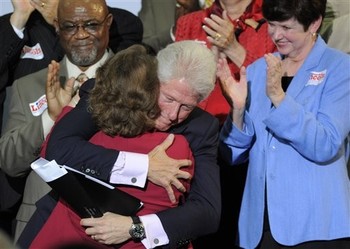
Fredo, you broke my heart …

It is discouraging – after writing yesterday about how Dennis Kucinich was the lone wolf, one of the few who could stand up to power, he folded. He’s on board the Obama train now. Prepare now for some cowboy foreplay-“Brace yerself honey.” They are ramming this bill through.

This is a huge victory for Obama and the DLC Dems – they are rubbing our faces in it, teabagging us, letting us know that there is no place for progressives in their party. They will take a huge drubbing at the polls this fall because millions of us just won’t have the energy to vote for people so unprincipled. I suspect that matters less to them than the mere fact that they defeat any nascent progressive movement in this land.

This gives lie to the Democratic fall-back that the votes just aren’t there for true health care reform. The votes are there, and the means to get those votes has always been there. However, Obama and the Democratic Party leadership have never wanted reform. The bill they are passing, a corporate-written bill ushered through in a scripted process, has always been what they were after. And they are persuasive and powerful. No doubt Kucinich was reminded that he can be challenged in the primaries, that big money will go after him, that he would receive no support from the party. Maybe he’s been wiretapped, maybe he’s got a skeleton. There were probably some positive enticements too. Obama can be persuasive. Yet never once – never once! – has he used those powers in favor of true reform.

It’s disgraceful, discouraging. Kucinich was a man of honor in defeat. Now he’s just another mealy-mouthed Democrat. So his defeat at the polls, as with all the others, would be of no consequence.

As they say, a man who places faith in politicians is doomed to disappointment. Damned if I didn’t have faith in him.

The good news is this: Obama appointee and Wall Street/health insurance-funded Senator Michael Bennet was defeated in the caucuses last night here in Colorado by Andrew Romanoff, who appears to be somewhat progressive. In an obnoxious and heavy-handed move last month, Obama elected to interfere in a local primary in support of Bennet. The results last night are a slap to Obama, and a message to Bennet that if he wants to win, he had better hide his funding sources.

All in all, not a good day. Power wins a big one, loses a small one. No doubt Bennet’s people right now are crafting ads about how he’s a man of the people, and Kucinich is putting together a press conference to somehow salvage his manhood.
————————–
PS: I suggest that anyone who calls or emails Kucinich to complain include the words “I know it was you, Fredo. You broke my heart.

Riding the Power Train

Some time ago, maybe a year ago, a group 80+ of House “progressives” took a stand on behalf of the American public regarding health care. They said that they would not support any bill that did not contain a public option. Nancy Pelosi laughed out loud at the time – she (supposedly a progressive herself) knew that it was an expression of weakness, that they would be destroyed. The power they were up against was simply too much for them.

The Health Care “Reform” debate has been an impressive demonstration of power. Every one of those progressives caved but one: Dennis Kucinich still stands tall, but alone. Here is something really, really interesting – Marcus Molitas of Daily Kos says that Kucinich – Kucinich!!! is one who is now in need of a primary opponent.*

It is a good time again to examine, if only with a surface glance or two, the nature of power. The fact that 86 “progressives” folded their tents is not just a victory for the insurance companies and the White House – it is a not even just a staggering victory. It is shock and awe.

So let’s examine it further. How does one man get another man to become his servant?

In employment, it’s the paycheck. But the power goes deeper than that – the employee might be burdened by mortgages, kids, student loans and the inability to get health insurance somewhere else. Further, few employees are of such caliber that there is any meaningful competition for their services, so that a mere job-jump is not an option. Even if the employee gets so fed up that he makes that jump, he will face a period of unemployment, and with that will come inability to pay bills, loss of credit standing, debt, loss of social standing. (And, his résumé will be tainted if he is perceived as rebellious.)

So for most people, the power of the boss over the employee is complete and total.

Transfer this relationship to that of the office holder and the (generic) “lobbyist.” The lobbyist needs leverage. Where does he find it?

Money is part of it, and is a two-edged sword. Money given to an office holder is useful – he can use it to buy TV ads and get reelected. TV is the only pathway to the voter, who is generally not paying attention. But it is more than that, as the office holder must assume that any money he does not take will go to an opponent. So the power of money is magnified by the ability of the lobbyist to leverage it by offering it to an opponent too.

If it were only money, we would not be in such trouble, because the “lobbyist” has a weakness. He is up against other lobbyists, and while there is seldom significant differences on large objectives – wars, subsidies, tax breaks and the like, there can be competing objectives, so that the office holder can at times leverage one lobbyist against another.

So the lobbyist needs more than just money, though money is powerful and mostly legal. There are other legal ways of making the office holder behave.

One is the fact that most of our “mainstream” media is in fact owned and controlled by the elite moneyed sectors who hire the lobbyists. Office holders need access to this media to be considered credible. Bad actors like Kucinich or Bernie Sanders will never appear on a Sunday talk show. It is well-understood among office holders that a stint on Democracy Now!, the only true news show around, will not cement voter approval – and might even stigmatize them.

So lobbyists have further control over office holders by controlling, in a general sense (there is no one lever to pull, no one lever-puller), access to favorable media. Further, negative press is a weapon – if an office holder stumbles over his words and accidentally says something that is true, or gets a DUI, becomes confrontational or gets out of line, negative editorials will appear in his home district, footage might leak to YouTube – it is somewhat disheveled and disorganized, but office holders have to be careful never to say anything in affront to lobbyists for fear of bad PR.

But even that is not enough. There are yet other legal ways of controlling the office holder. There is so much money floating around this country and in DC that an office holder of low scruples can avail himself of it in many ways. He can accept lucrative employment after leaving office, as, for instance, former South Dakota senate minority leader Tom Daschle becoming a health insurance lobbyist. (Chris Dodd will be interesting to watch – even after announcing his resignation, he is still working on behalf of Wall Street lobbyists. Does lucrative employment await?)

There are also employment opportunities for family members, as with Joe’s son, Beau Biden, working for MNBA back in Delaware, and Evan Bayh’s wife drawing lucrative salaries from health insurance companies … if we had investigative journalists, it would be interesting to do some research on employment of family members in Washington.

In fact, most loyal office holders, even the lowly Conrad Burns, can turn to a career in lobbying after leaving office, and rewards will be there for the rest of their useful lives.

All of that is, unfortunately, legal. But there is yet more. During the Bush years we learned of the prevalence of the wire tap – certainly not new (nor has it been discontinued under Obama). Most members of the media had their phones tapped by NSA or other agencies. The same is most likely true of most members of Congress. If such a weapon were available, and we know it is, how could it not be used?

No matter what it is, whether tryst with a secretary or a drunken party in the Bahamas, somebody in DC knows about it, and such information will be presented to the office holder at some critical juncture.

If only it stopped there. But there is also “sheepdipping”, aka “ABSCAMming”, where an office holder can be made to look guilty or lured into a compromising situation. This happened to Gary Hart, and many years before, Wilbur Mills. John Edwards might be a victim, though he certainly merits no sympathy. Most recently, former UN weapons inspector Scott Ritter, and before him, New York Governor Elliot Spitzer were “exposed.” The question that is not asked is “How many are culpable, but not exposed?”

These men were being watched – people were looking for dirt, and they found it. And even if the dirt does not turn up naturally, it can be planted. Any potential hire for an office holder can present a threat – she could be the next Donna Rice, Monica, or Linda Tripp.

So the control over our elected officials appears almost complete and total. A man has to be pure and innocent to be immune from such pressures. He has to forgo corporate money and lead a squeaky-clean life. Such a man is Bernie Sanders ….. but wait!

Sanders, Vermont’s socialist senator, seems a rogue, a man able to walk about freely and speak his mind. He’s not hobbled by the Democratic Party, and doesn’t take corporate money, so the regular levers don’t work on him. Yet, when the Senate Health “Reform” bill, written by the health insurance lobbyists, needed 60 votes to get out of the senate, he provided the 60th vote.

We had been treated to spectacles before where certain senators like Joe Lieberman and Ben Nelson used their “60th vote” status to leverage massive changes in the bill, preventing a public option, for instance. Senator Sanders, the 60th vote for that bill, had incredible power to command changes favorable to ordinary citizens.

And he did not do so. He did not use his power, meaning he did not have power.

What’s up with that, Bernie? Skeletons in your closet?
—————–
*This is not hard to understand, on further reflection. Molitas made that statement while be interviewed on a cable news show. He would not have access to such forums if he held unworthy views. He has succumbed, and is probably a passenger on the ego train. He’s apparently been compromised in some fashion.

Word games

The legendary Civil War-era reporter Simpson B. Ashley played poker with plantation owners late one night, when they were a bit liquored up and guards were down. They were being pilloried and demonized in the Northern press, and needed to fix up their image. According to Ashley, they had hired a writer, Mary Chesnut, to re-define slavery in such a way that it did not seem like such a bad thing in the mind of the public.

Slavery had been well-defined by that time – it was simply “forced labour”, using the British spelling. Chesnut spent many sleepless nights trying to get around such a blunt-force concept so easily understood and used to damn her clients. At last she had it. She presented it to the plantation owners at a meeting in July, 1858, in Richmond. Slavery, she said, should henceforth be defined as “unlawful forced labour.

It was a Eureka! moment, though that expression had not yet some into use. What the plantation owners were doing was in fact not slavery, because it was legal.
——————-

Simpson B. Ashley is a real person, but he’s too young to read this. I just made all of that up. Yesterday I listened to a radio broadcast where the participants were experienced angst and frustration in trying to come up with a definition of “terrorism.” “Why is it so hard?”, mused David Sirota, the host.

It’s not hard at all, just as slavery is not hard to define. Here’s the definition:

The calculated use of violence or threat of violence to inculcate fear; intended to coerce or to intimidate governments or societies in the pursuit of goals that are generally political, religious, or ideological.

That is not at all hard to understand, and from that definition it is easy to see that the biggest purveyor of terrorism on this planet is the United States Government, followed closely by that of Israel. But such a definition yields what one might call the “slave owner’s dilemma”: A straightforward and honest definition makes us look like terrorists. Hence the angst, the intellectual quandary faced by Sirota and callers yesterday.

He need not have struggled so. The Pentagon long ago solved this quandary. Here is the “official” definition of terrorism:

The calculated use of unlawful violence or threat of unlawful violence to inculcate fear; intended to coerce or to intimidate governments or societies in the pursuit of goals that are generally political, religious, or ideological.

We’re officially off the hook. When we do it, it’s lawful.

A mind game

I was having a debate with my mother many years ago about Iraq and Saddam Hussein. This was during the time of the sanctions, when thousands of kids over there were dying each month at the hands of the Clinton Administration. During the course of that debate I tried to get across the point that even though Hussein was not a desirable person, that we did not offer the Iraqis a viable alternative, and had in fact had deliberately put Saddam back in power after the 1991 U.S. attack on that country. As an aside, I mentioned a story, possibly apocryphal, about Saddam in a staff meeting one day. He got upset with one of the staff members and asked him to step outside the room. He shot and killed him, and then returned to the meeting.

Some time later my mother and I returned to the conversation, and she repeated the story about the shooting. I thought that was interesting as in all of the debate that we endured, that was the only thing that registered with her. Everything else bounced off the surface.

Mom was a smart person and has long since gone under to Alzheimer’s. I mean no disrespect here. It’s the psychological phenomenon that makes me curious. In my years of debating on the Internet, I notice that there are certain “facts” which do not penetrate consciousness. They don’t compute, and hence the mind merely sets them aside. Osama bin Laden is dead, has been for years. The U.S. keeps him “alive” because he’s useful in scaring the American people. It is as if a speaker is speaking and no words leave the mouth.

Anyway, I just embedded three thoughts in the above paragraphs that will not compute with most people. I am wondering, without going back and re-reading, can you tell me what they were? What did those words say that did not penetrate? I’ll bet you remember the story about Saddam shooting the guy. It’s not one of the three.

Stepping out of the parade …

I am deep in the heart of taxes these days. While working, I often have podcasts or radio shows on in the background, but seldom really hear what is going on. However, yesterday Chris Hedges managed to catch my attention.

The subject was whether or not progressives ought to leave the Democratic Party. Hedges says yes, that in fact we should have left in 1994 when Bill Clinton passed NAFTA. The radio hosts were a bit perplexed, as leaving the party seems to cut off the only means by which we can affect positive change – elective office.

As usual, Hedges offered deeper insight. Lefties, he said, cannot hold the reins of power. It is not our role. If we go that route, we simply become the office holders and are bound to carry forth the corporate agenda. That is, after all, the price of attaining office. Those who do buck that system are quickly jettisoned or marginalized.

Those who seek power are not, by definition, progressives. That is not our nature. Our role in this system is to buck this system from the outside. We seek to stop power in its tracks. And in fact a brief glance at our history shows this to be the normal course of events. The movements that ended slavery and child labor, formed unions and started the nascent movement to preserve our habitat – yada yada – none of this came about because we had people in elected office to get things going.

Leaving the Democratic Party is no more foolish or counterproductive that stepping out of a parade. We cannot stop it by being in it. We need to be somewhere else, doing other things, while that pointless march goes forward. Being a Democrat is not a useful activity. We are the parade stoppers – not the marchers.

Exclusion from the briar patch

My thanks to Raj Patel for adding some clarity to all of this madness about us about “free markets.” The idea is like a virus, or maybe a parasite, as markets may yet destroy their host … our habitat.

Patel introduced me to the concept of “exclusion,” probably well-known to anyone in Econ 101. But as he describes it, exclusion is the nature of the marketplace itself – without it, we have only commons.

Say, for example, a town exists around a well, and all of the townspeople depend on it for water. Suppose that the local merchant ropes off the area, sets up guards, gets a court order behind him, and prevents people from using the well without paying him. The well has become his “property”, and the towns people, now excluded, are “free” to engage in commerce to get water.

Before they lost access to the well, they were freer than after it was excluded from the commons. But in the Orwellian parlance of our time, that is actually supposed to be a net gain in personal freedom.

In health, insurance companies have roped off medical care to limit access, excluding the poor and already sick and charging everyone else. As a result, we are now subject to huge fees for common services, and insurers make money off of us by the simple means of placement, like the merchant and the well. They “own” what was formerly our commons, access to health care.

Again, the free marketers call this freedom. They stand logic on its head. Exclusion is at the heart of servitude. Governments, which do not exclude people from services, but rather collect taxes and disperse them without discrimination, offer more freedom than markets. But the notion that governments enslave us while markets free us, the curse of our times, is dominant.
————————-

I was listening to Dr. Marcia Angell interviewed by Bill Moyers this morning. Moyers, who is soon to retire, did another excellent show on health care. Angell wondered out loud whether Anthem Blue Cross, which is raising its rates by as much as 39% in California, is gaming us.

She calls it the “briar patch” game, as in “please don’t throw us in there.” In the scenario, Anthem, oblivious to public hatred and criticism, is rubbing our face in rate increases as a way of angering us to the point where we turn to the government to pass the health care “reform” bill.

That would be a good deal for Anthem, as the bill that is on the table, the one that Obama is (finally) fighting for, will bring Anthem millions of new clients, billions in subsidies, and with no public option, no threat of competition. All wiithout cost controls.

Who knows. We are practically owned at this point by the public relations industry – the whole health care “reform” process has been a game. This might be the ninth inning. Key Democrats are being forced out of Congress, others are surely feel the heat. Dennis Kucinich, a holdout, will surely have to endure corporate attacks in his district in the wake of Citizens United.

But it’s hard to know. Anthem is raking it in in our current system, so can’t be hurt either way.

Welcome aboard …

Just a reminder:

The whole aim of practical politics is to keep the populace alarmed (and hence clamorous to be led to safety) by menacing it with an endless series of hobgoblins, all of them imaginary. -H.L. Mencken

Steve and I looked high and low for a header for our new blog some years ago, and settled on that one … it is timeless and true. There is no “War on Terror”, for instance, and if we wanted to we could all just get on airplanes and fly, and nothing bad would happen. The “shoe” and “underwear” bombers were probably stupid people who were conned for political purposes into futile acts. There was never a threat that they could actually blow up a plane.

The chances of being mugged or burglarized are fairly slim, and oddly, we are safer in big cities than small ones, since numbers provide good odds. Shit does happen, but it is random. The odds are that your neighbors are nice.

Young people today are like young people have always been.

There never have been two parties, never really. Liberals have always been malleable, and right wingers have for years masqueraded as Democrats. The idea of “gradualism” is not even an idea, but an excuse for inaction.

Aspirin doesn’t work on pain, coffee doesn’t hurt you, living to be 90 is overrated, especially if your brain is not active. Viagra is not a good idea, as women tire of sex in their older years. It only makes men want what is not desired by their partners.

Drinking too much is not good, but so is not drinking at all. Smoking is both openly discouraged and and sublimely encouraged at once (it’s actually nice that you die shortly after your working years, as you are less a burden). Tobacco companies need young smokers, and so aggressively pursue them, but very subtly.

Our professions are not that difficult, and easily learned. Other people do our stuff pretty well after a few weeks or months except for law, which really is difficult. (Lawyers have constructed a large set of illogical rules which can only be memorized by rote). Doctors are mystified mythologized, and they like it that way.

Our kids mostly don’t think about us. Most exceptional kids turn out pretty ordinary. We all think we are special though we don’t say so.

Religion is nice and stupid all at once, and those who realize it is stupid and still practice it know more than those of us who are too smart to practice it.

Movies are mostly bad and quickly forgotten.

There is a level of discourse among smart people that bypasses me. They are talking about concepts I do not grasp, and so I do not even notice the things they mean. This is the problem I have when I talk about propaganda, as most people are unfamiliar with it and do not think it exists, and so do not pay attention to it. Nothing penetrates the mind controlled by it – one cannot even get its attention.

Scientists don’t get politics, which is why the global warming deniers won the public mind. Scientists have to be honest, while the deniers do not, and are not.

Most businesses are simply trying to get stupid people to buy useless products. Advertising has two purposes: 1) to make us unhappy so that 2) we change our behavior.

Family gatherings are tense, but what choice do we have? We mostly imitate emotions all day long- the real ones come out at sporting events.

We are really lucky if we are married to a friend and lover both. It’s hard to stay in love, but it helps if your partner stays physically attractive. Most don’t.

Everyone is insecure about money, especially those who have more than they need.

Meetings are pointless and boring. Blogs are only interesting if they say something different. Most don’t. I live in fear that 1) I don’t say anything new or different and that 2) I am, as usual, the last one to know that.

And neck ties – there is something going on there, something in our subconscious that makes us hang a perfectly useless piece of cloth around our necks. I get that the Pope’s hat or a king’s crown is a penis symbol, that a tailored suit conveys a sense of power, that a motorcycle is power between the legs otherwise lacking, that a Hummer screams small penis … I get all that. But neck ties … I’ll get back to you.

The origins of the two-party system

If ever I come across an old National Geographic, I am most interested not in the stories, but rather the advertisements. They give me insight into what people were seeing and thinking more than any writing. In my wildest dreams, I have descended back in time, back into 1968 or 1960, and tasted the hamburgers and listened to the sights and sounds. Just as everything around us now is brand new and modern, so was it then. Progress is nothing but an illusion. (Carole at Missouaplois showed a YouTube of a film taken from inside a car driving around Missoula in 1968 – fascinating – the other cars, the signs and businesses. I think I saw my girlfriend’s VW bug.)

So I am reading now, for the third time, a book from 1965 called “Propaganda, The Formation of Men’s Attitudes”, by Jacques Ellul. It is a gold mine, and every trip down the shaft brings up new nuggets. Ellul was himself detached from propaganda, and so was able to give a dispassionate description of the art/science from its early formal incarnation during the time of Napoleon to the highly sophisticated versions he saw around at that time – Chinese, American, French, Soviet. These were the countries that were actively engaged in deliberate propaganda at that time.

Since that time, it has only gotten worse.

In Ellul’s time, the most sophisticated propaganda was Soviet, as seen by the attempts by them and the Americans to bring Vietnam into their respective systems. So successful were the Communists that even South Vietnam, supposedly the American puddle and subject to American propaganda, wanted Ho Chi Minh as its leader. In the end, the Americans had no choice but to attack the country, kill those infected the the disease, and leave it wasted as an example to the rest of the world of what happens to those who go their own way. Where propaganda fails, brute force must take its place.

Others have written about various specific propaganda campaigns, like those that led the American public in to the great wars of the 20th century, or more recently our Iraq and Afghanistan campaigns. Ellul takes it much deeper, talking about the destruction of the individual and the intellect, the need that people feel for propaganda, how it fills their voids, provides meaning, about how without it they are lost.

As I look at our two-party structure, the Tea Party movement, the submissive media, our very baseline notions that private property and capitalism are natural systems, that absurd notion that advertising is a neutral force that merely dispenses information … I realize that we are so deep in it, so deeply indoctrinated, that our daily lives have lost most meaning. We work and we shop. We are political eunuchs incapable of changing either our leadership, way of life, or our form of government. We are as regimented and enslaved as any population in modern history, more so than the Soviets who, one might notice, actually broke their chains. (Soviet propaganda lost its allure as people living in those countries realized that they were materially disadvantaged compared to their western counterparts. This was simply a product of natural subterfuge brought about by improvements in electronic communication. The U.S. never intended, never wanted the Soviet Union to fail. Isn’t it amazing that once they awoke, their horrible and oppressive communist governments simply dissolved? It seems impossible that such a thing could happen under our bubble.)

Here is today’s nugget, one that I overlooked in my first two passes through this book, as the two-party system was not much on my mind than in past readings.

A party or a bloc of parties almost as powerful as the would-be runaway party starts big propaganda before it is pushed to the wall. This is the case in the United States, and might be in France if the regrouping of the Right should become stabilized. In that situation one would necessarily have, for financial reasons, a democracy reduced to two parties, it being inconceivable that a larger number of parties would have sufficient means to make such propaganda. This would lead to a bipartite structure, not for reasons of doctrine or tradition, but for technical propaganda reasons. This implies the exclusion of new parties in the future. Not only are second parties progressively eliminated, but it becomes impossible to organize new political groups with any chance at all of making them heard; in the midst of the concerted power of the forces at work, it becomes increasingly difficult to establish a new program. On the other hand, such a group would need, from the beginning, a great deal of money, many members, and great power. Under such conditions, a new party could only be born as Athena emerging fully grown from Zeus’ forehead. A political organism would have to collect money for a long time in advance, to have bought propaganda instruments, and untied its members before it made its appearance as a party capable of resisting the pressures of those who possess the “media.”*

Not just the mere organization of a new party is becoming increasingly difficult – so is expression of a new political idea or doctrine. Ideas no longer exist except through the media of information. When the latter are in the hands of the existing parties, no truly revolutionary or new doctrine has any chance of expressing itself, i.e, of existing. Yet innovation was one of the principle characteristics of democracy. Now, because nobody wants it any longer, it tends to disappear.

One can say that propaganda almost inevitably leads to a two-party system. Not only would it be very difficult for several parties to be rich enough to support such expensive campaigns of propaganda, but also propaganda tends to schematize public opinion. Where there is propaganda, we find fewer and fewer nuances and refinements of detail or doctrine. Rather, opinions are more incisive; there is only black and white, yes and no. Such a state of public opinion leads directly to a two-party systems and disappearance of a multi-party system.

The effects of propaganda can also be clearly seen in view of what Duvenger calls the party with the majority mandate and the party without that mandate, which originally should command an absolute majority in parliament, is normally the one that has been created by propaganda. Propaganda’s principal trumps then slip out of the hands of the other parties. All the latter can do then is make demagogic propaganda, i.e., a false propaganda that is purely artificial, considering what we have said about the relationship between propaganda and reality. (In other words, the party out of power must pick an artificial issue.)

In that case, we find ourselves faced with two completely contradictory propagandas. On one side is a propaganda powerful in media and techniques, but limited in its ends and modes of expression, a propaganda strictly integrated into a given social group, conformist and statist. On the other is a propaganda weak in regard to media and techniques, but excessive in its ends and expressions, a propaganda aimed against the existing order, against the State, against prevailing group standards. (Emphasis added)

In other words, the Republicans, out of power, tend to go extreme on us as a means of regaining power, while the Democrats, out of power, appeal to more progressive roots, also perceived as extreme by the other side. Neither has any implications regarding how each parties governs once in power.

We cannot avoid propaganda, we are all subject to it. To the degree we think ourselves immune, we are its slaves. To be aware of it is to be free of it to some degree. And, of course, just like a teen horror movie, in backing away from it, we fail to notice that it is lurking behind us too.

But most important is this: propaganda, while seemingly tied to various ideologies, is apolitical. It is solely structured to control the behaviors of men and women in large societies. In our case, neither our Democrats or Republicans represent an ideology of any coherence, but rather only seek to organize voting blocs based on various sales pitches aimed at various interest groups. Once elected, each party governs in the same manner, following the dictates of the powerful forces of finance and industry.

Most interesting to me is this: “Propaganda,” per se, is not taught in our universities, and yet skilled practitioners emerge as if deeply trained in the art. It appears to be a protégé system. Goebbels did not study it, nor did Bernays or Rove, yet each was/is highly skilled. Go figure.

———————————
*This is perhaps why Nader’s most recent book it titled “Only the Super-rich Can Save Us,” why only extremely rich men like H. Ross Perot or Michael Bloomberg can ignore the two-party structure.

They actually know what they want and how to get it …

Liberals and progressives fail to understand two things: 1) The Administration and the Democratic leadership is not “weak.” It is simply compromised and corporate. The apparent weakness is simply a perception management tool to avoid giving progressives and liberals what they want; and 2) the nature of power.

The health care bill is a horrible bill, a massive gift to the greed and avarice set that run the health insurance industry. Republicans could not pass such a bill, as Democratic opposition would gel and prevent passage. Because the bill is being pushed by Democrats, liberals and progressives are frozen in their footsteps, their herd instincts overriding their intellects.

This from Eric Massa, D-NY, who will now step down from office, clearing the way for passage of the bill:

“Mine is now the deciding vote on the health care bill, and this administration and this House leadership have said, quote-unquote, they will stop at nothing to pass this health care bill. And now they’ve gotten rid of me and it will pass. You connect the dots.”

Thoughts from 20,000 feet above …

Has this ever happened to you? You have some habit, some peccadillo, that you think makes you different from other people. And then you are reading this or that and find out that it isn’t just you … it’s everyone. Like me wearing the same shirt three or four days in a row to cut down on laundry. What a nice guy I am! What a good husband!

And then I find out that almost all married guys do that.

Advertisers know this about us. They know that we like to think we are unique. Hell, they know everything about us. That’s why advertising works. They know more about us than we know about ourselves.

So here is what is unique about me: I am self-employed. The people I do work for don’t own me. So I am free.

This happened in 1986, when I was 36. I’m almost 60 now. I didn’t plan it – my boss, Mary Alice Fortin, could not stand me almost as much as I could not stand her. I had five kids to feed, so she did me a favor – she cut me loose, but she gave me a big client to get me over the hump, the Mayo Clinic. They are big and sophisticated, and they surely did not need a land grant BS like me, but they allowed me to oversee the oil and gas properties that she had given them. This allowed me to pay the bills while I developed a practice of my own. I owe my freedom to that lady who disliked me so much, and before she left Montana, I told her so and thanked her. We never spoke again, and continued to dislike each other.

I didn’t know what I had. I didn’t understand anything. My very first day of self-employment, April 1, 1986, I got up, showered, shaved, put on a jacket and tie and went to my little office and just sat there. I had a computer, I had a client, and I had time. I thought that I must still behave as an employed person would, punching a time clock, being diligent … work work work.

It did not go smoothly, I depended far too much on Mayo, but did manage to find other clients, one big, most small. In essence, I was simply lucky. There were many times when I scoured the want ads looking for a suitable job. But the truth was that I had been cut loose. I was no longer part of the employment world. The thought of employment – the security of a paycheck and health insurance, was alluring and depressing all at once.

In short order after April 1, 1986, I lost my political bearings, abandoning the right wing. My wife divorced me, and hard as that was, it had to happen. And I left the Catholic Church, taking my kids with me.

I won’t bore you further. The question is, am I unique? If all of my other experiences in life are any gauge, the answer is no. I am more like everyone than everyone. Anyone in my shoes, give anyone that kind of freedom, would finally develop into a fuller, richer, happier person.

So I write stuff here that is kind of a meandering and long shot across the bow of people who are still mired in employment, and, as with the post below, it can be harsh. I criticize people who behave exactly as I behaved as an employed person. I was harder to get along with than most, but I do not kid myself. I had my mind right. They broke me, as Luke would say. I believed as I must believe to maintain my existence.

So, after the nasty exchange below, I say to Mr. Kemmick, and from long ago, Mr. Crisp, that I don’t envy you your position. I know how hard it is. I know what it is to be bought. That sounds, I know, like a resounding backhanded slap. It is, and it isn’t. It just is. That’s the way most of us live.

Anyway, I’m done for the week, and we have fun stuff to do, and dammit it, if it keeps on being fun, we’ll just keep right on doing it through Monday … Tuesday …. here’s something I didn’t realize when I was employed. We don’t need to work so long and hard as we do. That too is a control mechanism. Too much free time is not a good thing for the servant of wealth …

My final thought on passage into yet more delightful freedom:

By the way, if there is such a thing as karma, now would be the time.