Following Annie’s advice

We have upstairs three rooms, each inordinately large: a bathroom, walk-in closet, and bedroom. They are what I would consider artifacts, which I define as something unintended and left over from other intended activities. This house in original from was much like a toaster, two floors, small footprint, and by world standards fully adequate for its intended purpose.

The former owners, however, wanted something bigger and better. They did not want this in order to live in a bigger house – they wanted to be able to sell it so that they could buy a place with land. The woman who was partnered with a man in the construction business wanted to raise horses, utterly impossible here, as it is a steep wooded hillside. So they popped out the north side of the building, and doubled the size of the structure, creating a lovely living and dining area, and two “offices” on our main floor, each qualifying as a bedroom were it to be used for that purpose. In the basement, they created two large areas of no particular purpose, and two small rooms, one qualifying as a bedroom, the other not (no closet). 

Continue reading “Following Annie’s advice”

Asch to Quora, experiment to sad reality

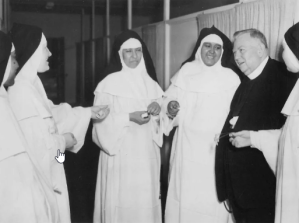
When I was a child in Catholic grade school, I was an altar boy. It was a big deal to my deeply indoctrinated mind, wearing girly frocks and lighting candles and ringing bells. Our pastor, Father Neville once took trouble after a morning mass to advise me that I was not my brother Steve, that I was not measuring up. Asshole. That really stung and in no way did it move me forward, especially not beyond Catholicism, as it should have.

One morning during a weekday mass we had to attend, my class sat in the balcony of the church, Little Flower, to this day still on 2nd Avenue South in Billings, Montana. It caters to the Hispanic community, and is quite charming. As an altar boy I knew the drills, when to stand, when to kneel and sit. We came to a part of the mass where we insiders knew it was time to stand, and yet my whole class just sat there, so I mustered all my courage and stood up, all alone, to snickers and oddball looks from our nun/teacher, sister Iforget.

I was demonstrating the courage of nonconformity in the most conformist way possible, by adhering to the altar boy code.

Continue reading “Asch to Quora, experiment to sad reality”

Eurhythmy

The word above, “eurhythmy” is a solution to a clue in an anacrostic I completed yesterday. It is a new word for me.

In case you’ve not done an anacrostic, sometimes called just acrostic, it is like a crossword puzzle with the following complications:

  • The ultimate solution is a quotation from a published work. All of the letters are numbered one to however many (170 in this case).
  • There are clues to solve, and solution to each clue is spelled out on blanks, under which are numbers that correspond to the quotation, so that those letters are moved above.
  • The first letter to the clues will spell out the author of the quote and name of the work.
  • There is a lot of back and forth between quotation and clues, otherwise I think the puzzle would be insoluble.

Continue reading “Eurhythmy”

Anyone care to check it out?

I’ve done all I am going to do. It has to do with the fatal shooting of two Democrats in Minnesota, State Representative Melissa Hortman and her husband, Mark, and the wounding of State Senator John Hoffman and his wife, Yvette, on June 14th, four days prior to this writing. The shooter is identified as Vance Luther Boelter, born in 1967.

Police received a call from the daughter of the Hoffman’s at 2:06 AM. They encountered Boelter in a parked car at 2:36 AM. They arrived at the Hoffman house at 3:35 AM.

Continue reading “Anyone care to check it out?”

On writing about staring into the abyss

I wrote the post below after having mulled on it for some time, and not exactly sure where I would take it. As always, with writing, I am surprised at the outcome.

However, and completely unanticipated, writing that piece generated bouts of depression. I was reminded of my childhood, my dysfunctional family, and living in the shadow of a super achiever.

Continue reading “On writing about staring into the abyss”

On staring into the abyss

I had an older brother, Steve (1943-2011) whom I idolized. I had no choice really, but I really did idolize him. Steve was one of those rare birds who was genuinely nice and smart, and who was a hard worker too. In other words, it would do no good to resent him, even as I, the younger brother (he was seven years older), was known by everyone we knew in common as “Steve’s kid brother”. Either Steve’s virtues fell upon me too, or not, but nowhere in the world I grew up in was there anything but love and admiration for my older brother.

Steve had “the calling”, meaning priesthood in our very Catholic family. When he announced late in his senior year of high school that he would enter the seminary in the fall, my parents’ hearts swelled with pride. Steve was not an ordinary human – once he got a traffic citation for a rolling stop, and Mom said “That will never happen again.” It was as if the parent-child relationship had reversed, as both Mom and Dad would look to Steve for advice as their other three sons struggled in life and passage into maturity.

Continue reading “On staring into the abyss”

Coffee without milk, anyone?

It has come to my attention that some things I think uproariously funny are not at all funny to others. A couple of recent examples:

Sarah Silverman said this as part of her standup act a long while ago. I repeated it once when seated at a table next to a gay relative, openly so and married to another gay man. It was somewhat uncomfortable, not because he as gay, as we’ve all gotten over that. It was because he seemed above it all, the gathering we were at, the drinking and family tensions. So I decided to take a chance, and repeat the Silverman line to him.

Continue reading “Coffee without milk, anyone?”

Blog notes …

I have decided, partly due to lack of reader response, but also due to my own “enough!” feeling, not to write about Climate Change anymore. There is nothing new to learn there. It’s a psyop run by dishonest people, or worse yet, people who mind-meld to be in the right camp. They only want to make a living, and I understand that, so that I take it as a larger statement on the human condition. Like Diogenes, we must all carry lanterns.

I do follow blogs, and the one I have come to like the most is Climate, Etc., run by Judith Curry. She does not write much herself, but when she does it packs a punch. I refer you to that blog’s three most recent articles:

Continue reading “Blog notes …”

Two Books: “Unreliable” by Csaba Szabo, and “Unreadable” by Dr. Mark Bailey

The following is taken from Dwight Eisenhower’s farewell address to the nation, the one in which he warned us of the “military-industrial complex” that has long since engulfed us. These words are about science.

Akin to, and largely responsible for the sweeping changes in our industrial-military posture, has been the technological revolution during recent decades.

In this revolution, research has become central; it also becomes more formalized, complex, and costly. A steadily increasing share is conducted for, by, or at the direction of, the Federal government.

Today, the solitary inventor, tinkering in his shop, has been over shadowed by task forces of scientists in laboratories and testing fields. In the same fashion, the free university, historically the fountainhead of free ideas and scientific discovery, has experienced a revolution in the conduct of research. Partly because of the huge costs involved, a government contract becomes virtually a substitute for intellectual curiosity. For every old blackboard there are now hundreds of new electronic computers.

The prospect of domination of the nation’s scholars by Federal employment, project allocations, and the power of money is ever present and is gravely to be regarded.

Continue reading “Two Books: “Unreliable” by Csaba Szabo, and “Unreadable” by Dr. Mark Bailey”

Skip the sunscreen. Wear blinders.

Below the fold you will find what was said to be Kurt Vonnegut’s 1997 commencement address to undergrads at MIT. It begins, after an opening quote, with the words “Wear sunscreen.” It closes with “But trust me on the sunscreen.” It is clever and even contains good advice, like “Do one thing every day that scares you” and “Keep your old love letters, throw away your bank statements.”

The original piece, published in June of 1997 in the Chicago Tribune, was unsigned. Mary Schmich of the Tribune later claimed authorship. The whole thing was weird, as the piece went viral as a real Vonnegut commencement address. It seemed unprofessional to allow it to go unsigned and to print it without Vonnegut’s approval. The Tribune is a high profile outlet, so that practical jokes are beneath it. But only later did we learn that Vonnegut had never spoken at MIT. Schmich then tried to contact him to explain the situation, and when they finally spoke he said it was “spooky.”

“Two questions: Why use Vonnegut? And why sunscreen?

Continue reading “Skip the sunscreen. Wear blinders.”