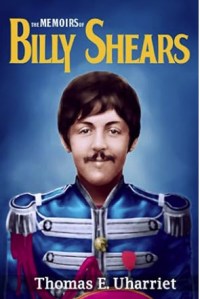
The Memoirs of Billy Shears, Part II

I am reading this book on the presumption that no one else I know will do so. I’ve worked my way up to page 150, and when i say “worked” I mean less than that, as it is both interesting and annoying. It covers the history of the Beatles from a fan’s perspective, one that idolized them and believed in certain aspects of the group that I’ll list below. It’s annoying in that in order for me to believe every word of it, I would have to be quite stupid or, as with a good movie, offer up willing suspension of disbelief. There is no “Billy Shears,” there was no death of the original Paul, and no replacement. There were two Paul’s, identical twins, from the beginning.

In the fall of 1969 radio disc jockey Russell Gibb, WKNR-FM in Detroit, received a phone call from “Tom,” who told him that Paul McCartney had died and had been replaced in 1966 by a lookalike. Thus began a cottage industry that continues to this day, now called “PID”, or Paul is Dead. It is continually churned, new clues added now and then.

It is misdirection, designed to get us asking the wrong question. Paul McCartney was indeed replaced by a virtual lookalike, and I know who the replacement is. It was not hard to discover. If I could do it, so too could all of the sleuths (including Mike Williams, the “Sage of Quay”) who make those PID YouTubes and run those PID web pages.  Why don’t they? It is, I suspect, because they are tasked with keeping the mythology alive. They are disinformation agents.

Continue reading “The Memoirs of Billy Shears, Part II”

The Horse is Dead

The 1960s were a breeding ground for psychological operations—whether it was the Cuban Missile Crisis, the assassinations of JFK, RFK, and MLK, the Manson family saga, or the Kent State massacre. These events shaped a generation, but it wasn’t until the 1990s that the architects of mass perception found their perfect formula.

Initially, I set out to catalog the most infamous psyops of the 1990s, highlighting their patterns and implications. But in the end, I’ve succumbed to the sheer futility of it all. As one astute commenter noted, perhaps the better course is to forget—to untangle oneself from these constructed narratives and move forward.

Still, for the sake of posterity, here are some of the most notable psychological operations of the 1990s, ranked in no particular order:

  • The Simpson Trials (1995) – A media circus that turned a double homicide into the ultimate courtroom spectacle, setting the standard for sensationalist legal coverage.
  • Lorena Bobbitt (1993) – A domestic abuse case twisted into tabloid gold, shifting public discourse on gender and violence in ways both grotesque and performative.
  • Y2K (1999) – A manufactured panic that convinced millions the world might end at the stroke of midnight on January 1, 2000.
  • The Gulf War (1990) – A conflict sold with precision-marketed propaganda, complete with staged testimonies and made-for-TV missile footage.
  • Nancy Kerrigan/Tonya Harding (1994) – A bizarre, soap-opera-style scandal that turned figure skating into a battleground of class warfare and villainous narratives.
  • The Waco Siege (1993) – A tragic standoff that played out like a scripted horror, setting the stage for future debates on government overreach.
  • The Oklahoma City Bombing (1995) – A national tragedy that reinforced domestic terrorism as a dominant fear in the American consciousness.
  • The Monica Lewinsky Scandal (1998) – A presidency consumed by sex, scandal, and the relentless 24-hour news cycle.
  • The Columbine Massacre (1999) – A defining moment for media-fueled moral panic, spawning myths and policy shifts that still linger today.
  • Long Island Lolita (1992) – A lurid crime that became a spectacle of tabloid excess, reducing real-life violence to daytime talk-show fodder.
  • Olympic Park Bombing (1996) – A moment of terror at the Atlanta Olympics that ignited debates on security, civil liberties, and the dangers of trial-by-media.

Ultimately, my humble suggestion is this: expunge these events from your mind and experience. They were never meant to inform, only to distract. Even as I list them here, I recognize the irony. But perhaps acknowledging the game is the first step toward moving beyond it.

Now, back to real life.

Vandalism as a worthy cause

The above 1821 painting is called The Hay Wain, by John Constable, a British artist. I have deliberately kept the reproduction above small to preserve some of the integrity, but of course computer screens do not begin to be faithful to originals, much less iPads or, God forbid, iPhones. I would love to be able to stand in front of it. It is kept at the National Gallery in London.

In July of 2022 this painting was vandalized, a triptych overlaid placing modern civilization atop, and the vandals gluing themselves to the painting. The vandalism was done by a group called Just Stop Oil, the subject of this post, but first more about the article I am citing from, a work by Fred Bauer. It is called Vandals of Civilization, and is in the March, 2025 edition of National Review. Unless you buy the magazine from a newsstand, or subscribe, you’ll not have access. I am a longtime subscriber to NR, since my youth with an extended interruption … I read it in my early 20s and forward, and now read it with a far more skeptical eye. So much of it is good, so much less so in my view, but the people there always adhering to the principles of its founder, William F. Buckley, Jr., a man I deeply admired.

Continue reading “Vandalism as a worthy cause”

Woke is Broke

What does it really mean to be “woke,” and how can you tell if you’ve experienced it? Can you even spot it in others? Awakening isn’t something that happens overnight. It’s not a quick fix, a flashy moment, or some energy rush up your spine. Ironically, people who loudly claim to be “awakened” often miss the point entirely. True awakening is more like peeling back layers—each realization uncovers more to understand.

Being truly “woke” isn’t about acting superior or forcing your views on others. It’s about living in a way that encourages understanding and inspires change. An awakened person doesn’t preach—they show through their actions and mindset. Real growth comes from stepping into the unknown, planting seeds of insight, and embodying the changes you want to see. Judging others or locking yourself into one way of thinking? That’s not awakening. True wokeness is about living fully and engaging with the world, not shutting it out.

Instead of pushing your beliefs onto others, stay present and open to learning from different perspectives. We’re all students and teachers for each other. Awakening isn’t about isolating yourself or critiquing everyone else; it’s about embodying the values you talk about. If you’re seeking genuine awakening, remember it’s rooted in love, connection, and growth. Ask yourself: are you here to lift others up and support them, or are you just enjoying the feeling of being “better” than them? Awakening means connecting with something beyond our senses and living that truth every day.

Case in point: What was supposed to be a simple birthday treat devolved into the latest flashpoint after “The View” co-host Whoopi Goldberg implied that a New York bakery refused to take her order because of her liberal politics. It’s an accusation that the bakery has denied. Now, the store is claiming that an influx of orders has flooded its phone lines as local residents show their support for the small business.

I can’t help but wonder what cut Goldberg got from the spike in sales, all thanks to the free nationwide promotion.

Deniers

We can never be sure that the opinion we are endeavoring to to stifle is a false opinion; and if we were sure, stifling it would still be an evil. All silencing of discussion is an assumption of infallibility. (John Stuart Mill)*

I was raised Catholic and maintained that faith until age 38, that is, 1988. You may think me a fool for holding on that long, but they got me when I was a kid. As the old priest said, give him to me as a child, I will have him for life. My first twelve years of education were Catholic.

We were taught about papal infallibility, that is, when the Pope speaks on matters of faith and morals, he is guided by the Holy Spirit, therefore cannot be wrong. He is said to be speaking ex cathedra.** 

Continue reading “Deniers”