A Leftish Analysis of Media Bias

I haven’t writing much lately and see no inspiration on the horizon. I went back to the early days of this blog thinking I’d be a tad embarrassed at things written back then, but I am not. This is a November 2006 piece, three months into blogging, that still resonates. If the comment section comes through with the article, that too is a good thing.
______________________________________

The press was protected so that it could bare the secrets of the government and inform the people. Only a free and unrestrained press can effectively expose deception in government. And paramount among the responsibilities of a free press is the duty to prevent any part of the government from deceiving the people. (Justice Hugo L. Black)

I just fired up my computer this morning and encountered a new error message. A program that I did not know existed was not functioning properly, it said. It would have be shut down. It did shut it down, I assume, and the computer seems to be working fine without it.

Ah – a metaphor! That’s a problem with my thinking – everything can mean something else. It’s not necessarily wrong-headed thinking. It’s just annoying to people for whom metaphors convey little information. But I sat down to write about Ed Kemmick’s Sunday City Lights piece defending against press bias, so it seemed appropriate. A left wing analysis of the American press invariably rests on the assumption that there are background, or memory-resident programs running in the minds of all publishers, editors and reporters.

It’s not meant as an insult but is often taken as one. A left analysis of the press attempts to eliminate the need prejudice on the part of reporters as an explanation for bad reporting. This is a far cry from those on the right who say that there is a liberal bias, and that it is deliberate. A left analysis attempts to explain bias as a natural byproduct of ownership, advertising, sensitivity to critics, and source of information.

  • The American media (and this analysis applies on big and small scale, News Corporation and Lee Enterprises), is owned by corporations who tend to be conservative. Overwhelmingly.
  • The American media depends for sustenance on advertisers who tend to be conservative. Overwhelmingly. (Don’t believe that? Try getting Air America on the air anywhere, even Missoula. Even though there is a market niche larger than many of the splintered right wing segments, there are not enough advertisers willing to sponsor left-of-center programming.)
  • The American media stands in the proverbial mighty wind of right wing flak about supposed liberal bias. They react defensively.
  • The American media gets its information, to a very large degree, from ‘inside’ government and corporate sources, and depends on favorable treatment of those sources for continued access.

That’s a left-wing analysis. I think it stands up well to criticism because it lets ordinary people off the hook. Yes, you have integrity, work your craft, and do much good work. But no, you can’t see the forest for the trees.

Kemmick is a tree in the forest. He judges the integrity of the profession as a whole based on his own.

It seems like a hundred years ago that I was a reporter in Anaconda, and back then the only accusations of bias thrown at me had nothing to do with politics. In Anaconda, where it seemed that everybody was related to everybody else, or at least had known one another all their lives, reporting on matters of public interest was rarely simple.

I would be accused of writing a story so as to favor some faction whose existence I was unaware of, or of taking sides in a feud stretching back generations between people I didn’t know. In that town, where everybody was in one camp or another on all important debates, the idea that I was truly an outsider with no bones to pick was inconceivable.

Funny he should mention Anaconda, as in Anaconda company. Who would say that the Montana press was unbiased when that company owned most of the major outlets, back before Kemmick’s time. Did reporters have less integrity back then? It must have been hard for a journalist back in those days to punch out copy, knowing that inevitably it would be vetted by an editor with an eye on the publisher who was enforcing the will of the owner.

The journalist internalizes the conflict, it becomes memory-resident. Only rarely does the conflict peskily rise to the surface. That’s a left analysis, which Kemmick dismisses:

It’s more difficult to deal with the current pervasive belief that nobody in what is known as the mainstream media can be trusted. We are accused of masquerading as unbiased reporters while promoting a left-wing agenda – unless the critic happens to lean toward the left, in which case we are written off as servants of the status quo, lackeys promoting the interests of the powers-that-be.

Journalists get annoyed by left wing criticism of the press. Criticism from the right is generally anecdotal, and each anecdote can be refuted. Rightish criticism says that editors and publishers must be left-wing liberals, which simply doesn’t stand up in the light of day. But the leftish ragging accuses reporters of being lackeys, though unknowingly. It attempts to expose the memory-resident programs in operation. It’s personal.

Ben Bagdikian summed up the problem of media nicely back in 1982, when large-scale consolidation was just underway:

The new owning corporations of our media generally insist that they do not interfere in the editorial product. All they do is appoint the publisher, the editor, the business manager and determine the budget. If I wanted control of public information, that is all I would want. I would not want to decide on every story every day or say “yes” or “no” to every manuscript that came over the transom. I would rather appoint leaders who understand clearly who hired them and who can fire them, who pays their salaries and decides on their stock options. I would then leave it to them.

That’s a big treatment of the subject, and in the end, Kemmick’s City Lights piece doesn’t do it any justice. He falls back inside the gates of the city, and defends the question that was not asked.

Any thinking person will have beliefs and opinions, but a good reporter will bend over backward to prevent those beliefs and opinions from slanting a story. That is much different from failing to acknowledge those beliefs, or simply giving into them and becoming a partisan hack. Good reporters, trained in skepticism and objectivity, can still serve an important public function.

It’s all about the individual reporter and how he carries on his craft. There’s no larger questions to be answered.

What I mean by objectivity is that the reporter stays out of what he writes, not that he slavishly presents two “sides” to every story. If we report that a petroleum geologist has located oil in a formation 150 million years old, we are not obligated to tack on a disclaimer saying, “Many people, however, believe that the Earth is only a few thousand years old.”

What I mean by being fair and objective is presenting facts without comment and conveying the words and thoughts of other people as they would want them to be conveyed. That is not an easy thing to do, but I think we should continue to demand that reporters at least try.

Reporting then is nothing more than he-said-she-said. Critics on the left call this stenography.

When the government wanted us to go to war in Iraq, they said alot of stuff. It was all duly reported, without editorial bias. When that stuff turned out to be false, we were stuck with a decimated country and hundreds of thousands of dead Iraqis, and a press that appeared to be comprised of lackeys. But never did they fail to report on what he and she said (except for that odd case of the Downing Street memo). They only failed to analyze, failed to suspect lies, shelved intuition and did not confront power. They went along, and hid behind the mask of objectivity.

And that, in the end, summarizes the problem the left has with the media: They use objectivity as an excuse to avoid probing for truth. In the end, as with Iraq, they fail us miserably. But they do so while honoring the hallowed traditions of journalism.

If paramount among the responsibilities of a free press is the duty to prevent any part of the government from deceiving the people, they aren’t doing their job, and should be replaced. The question answered in Kemmick’s piece is not the question asked. It’s not about reporting both sides and walking away. It’s about how to build an accountable media.

A bad year for Malaysian Airlines

One has to be very careful with information such as this … a former Ukrainian soldier has taken refuge in Russia and claims that a Ukrainian fighter jet shot down the Malaysian Airlines aircraft on July 17, killing all 298 on board. While Voltaire reporters are doing their best to vet the soldier and cross-reference and verify his statements, it should be noted that Western intelligence agencies are experts in the disinformation game, and he could be a plant who will later be discredited by Western sources. That’s an old intelligence/propaganda game.

Nonetheless, read for yourself, judge for yourself.

There were actually two Malaysian jets lost last year, and the first, Flight 370, disappeared over the Pacific on March 8th of this year. News media reports that it simply vanished, that technology did not exist to track it to its final destination did not exist, are simply not believable. A French former airline director, Marc Dugain, has claimed that the US military may have shot down that airliner and covered it up. The aircraft was last seen in the vicinity of Diego Garcia, a US/British base in the Indian Ocean that is equipped with very sophisticated weaponry and tracking equipment.

Again, you’re on your own. Here’s the link.

Catching us asleep

SK directed us all to a link, 6 Brainwashing Techniques They’re Using On You Right Now on another blog last week. These are the six techniques listed:

  • #6. Chanting Slogans.
  • #5. Slipping Bullshit Into Your Subconscious
  • #4. Controlling What You Watch and Read
  • #3. Keeping You In Line With Shame
  • #2. Black and White Choices
  • #1. “Us vs. Them”

There’s enough there for all of us, so I won’t offer that these techniques work on some of us better than others. #4, for example, translates into “I read only sources I trust.” #5 is about the power of suggestion, or implanting ideas in our minds via back door channels.

We’re all manipulated by media in one form or another. It is when we reach a point of hubris (the state of being of the typical American journalist) that we are most vulnerable.

The author of the piece, David Wong, likely feels that he’s above the battle because he is able to spot these manipulations. He’s not. He’s been taken down via #5, though he’d be the last to know that. He should have listed the following:

  • #7. “Maybe they get to you, but not to me.”

The advent of the search engine

Years ago I was engaged in a boys club of sorts, an exclusive Yahoo email address wherein four or five people engaged in thoughtful discussions – I’ve lost track of all of them, and was overshadowed by some tall intellects anyway. My only remaining connection there is a link to the right to a blog called “Sohum Parlance,” where Erik Kirk still plods along.

Sometime in those discussions I discovered that by association of various phrases, I could easily explore any topic on a search engine, thereby giving me an advantage over the others. I quickly learned that they had the same advantage, so that even with Google at my side (there were several available and Google was not the most used), I was still outgunned.

Worse yet, they easily spotted anything I said that was the result of a casual search engine query. Days would go by as my visits to that address became less frequent – it was just too much work. Each session would take at least an hour, as the comments strings were long and involved. Importantly, I was exposed to people of high intellect who brought different world views to my attention, most importantly that of the high-minded right-winger. This was Jim Versluys of Houston, who exposed me to what I regarded as heartless analysis of US foreign policy stripped of any pretenses of democracy or humanity. In the face of such a powerful force, my soft-hearted liberalism shriveled.

For instance, the photos below are of the infamous “Turkey Shoot,” or “Highway of Death” after the first US attack on Iraq in 1991. General Schwarzkopf gave the Iraqis permission to withdraw from Kuwait, and once they did, US bombers cut off the head and tail of the convoy, and destroyed everything and slaughtered everyone in between.

Reporters commented that fighter pilots, able to fire on an easy target without fear of flak, often had erections when returning from sorties. They were told that such a physical manifestation was a result of their deep “patriotism.” I wrote about the duplicity and barbarity of the event, and Jim laughed. It was simply standard practice in war, he said, to get the enemy to expose himself so you can destroy him.

Turkey shootTL003576

I had to cede that argument, as there was no moral high ground, that is, the moral high ground was not something anyone cared about. It was simply an overlap of two worlds, mine of ethics and humanity, his of cold and cruel Machiavellian means to ends. He was impermeable to any soft reasoning, in fact laughed at it.

It was a good exchange, well worth the psychic pain such intellectual battering gave me. I saw the world from another viewpoint. It was cold and ugly, and I wanted no part of it, but I had to acknowledge its existence with or without my approval. It is there. It is how countries behave. It is how the military functions.

The Internet allowed me to know the gentlemen of that caliber, and to gain some self-awareness by doing combat with them. I didn’t win but I learned about how the other side thinks. It is good to know about them. I cannot be part of their world. It is too cold, but don’t get me wrong: It is not Sparta. These gentlemen appreciate the finer things of life, including art and humor. They are not thugs. They are simply men of the world.

I suppose it was inevitable that the Internet would degrade with such easy access. These past few days I’ve been engaged with Larry Kurtz and Big Swede, trying to pin them down, see what makes them tick. Where one time, long before it became the “Google” we know, I tried using a search engine to score some points with true intellectuals, I now see that The Google also operates as a flashlight for people who cannot read. Stripped of the search engine, neither Swede nor Kurtz have an ounce of native intelligence. They are also too typical of what the Internet as viewed through the blogs has become – a food fight among low brows and retards.

So many have left the blogging game, only a few left of maybe a score eight years ago. Those that stand have to put up with the likes of these two and Norma. I’m not issuing ultimatums or threatening to change anything, as my own desire to write drives me to carry on here. I am just offering some hard and cold analysis: Stupid people make blogging a chore. I am being careful here to avoid using names in the last paragraph so that the objects of scorn don’t know they are being talked about. What follows is a close to the opening paragraph that will assure us that the two in question do not see they are the object of hard and cold analysis.

I heard from Jim on occasion over the years, but lost track of him. No doubt he’s still kicking somewhere down in Houston, engaged in lively debate among people of his caliber intellect. I should Google him and see what he’s up to. But I cannot get drawn into debate with him, as he has a way of absorbing all of the light in a room into himself, as a black hole does. I need some light for myself. I cannot be in the same room with him, as I drown in his darkness.

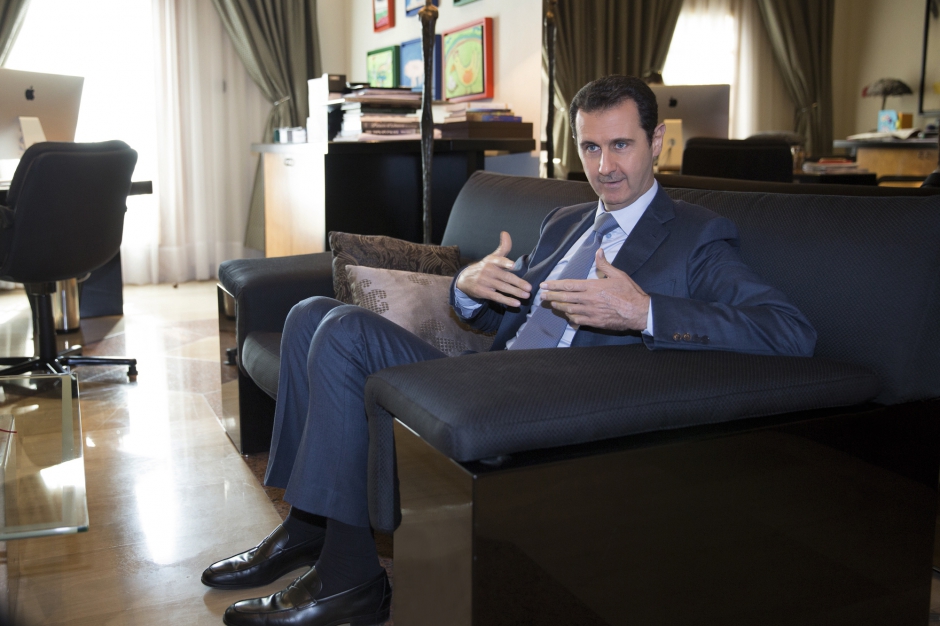
Paris Match Interviews Bashar Al-Assad

Syrian President Assad
One of the main features of American news is its ability to demonize any enemy of choice, making them into grotesque characters with blood dripping off their fingers. It helps if they object of the demonization has a mustache. It also helps if the object of demonization says a thing or two that can be wildly misinterpreted, such as Mahmoud Ahmadinejad’s never-uttered desire to “wipe Israel off the map.” Syrian President Bashar Al-Assad has been most uncooperative in this regard. He’s a reasonable man who dresses in western attire and speaks in measured tone.

Consequently, I doubt that an interview with Paris Match, transcribed and reprinted in English here, will get much traction here in the land of the free. The interviewer, Régis Le Sommier, is hostile and confrontational, repeating every item of Western propaganda as if it were factual. Assad parries with him, never loses his cool, and strikes a tone of utter resignation to the preservation of the State of Syria in the face of Western-sponsored terror emanating mostly from France and Turkey.

Here are a few snippets:

Paris Match: Mr. President, three years into this war, and considering how things have turned out, do you regret that you haven’t managed things differently at the beginning, with the appearance of the first signs of the revolution in March 2011? Do you feel that you are responsible for what happened?
Bashar el Assad: Even in the first days of the events, there were martyrs from the army and the police; so, since the first days of this crisis we have been facing terrorism. It is true that there were demonstrations, but they were not large in number. In such a case, there is no choice but to defend your people against terrorists. There’s no other choice. We cannot say that we regret fighting terrorism since the early days of this crisis. However, this doesn’t mean that there weren’t mistakes made in practice. There are always mistakes. Let’s be honest: had Qatar not paid money to those terrorists at that time, and had Turkey not supported them logistically, and had not the West supported them politically, things would have been different. If we in Syria had problems and mistakes before the crisis, which is normal, this doesn’t necessarily mean that the events had internal causes.

This accusatory tone will appear throughout, with Le Sommier insisting that the Western-backed terrorist assault on Syria beginning shortly after the fall of Libya in 2011 is spontaneous and internal.

Paris Match: Many people say that the solution lies in your departure. Do you believe that your departure is the solution?
Bashar el Assad : The president of any state in the world takes office through constitutional measures and leaves office through constitutional measures as well. No President can be installed or deposed through chaos. The tangible evidence for this is the outcome of the French policy when they attacked Gaddafi. What was the result? Chaos ensued after Gaddafi’s departure. So, was his departure the solution? Have things improved, and has Libya become a democracy? The state is like a ship; and when there is a storm, the captain doesn’t run away and leave his ship to sink. If passengers on that ship decided to leave, the captain should be the last one to leave, not the first.

Western states are uniform in demanding regime change in Syria even as its government is entrenched and popular, more so in the wake of the terrorist attack. Assad has more support among his people, more of whom turn out to vote, than Barack Obama here in our fake democracy. No one calls for regime change here in the US. (I’d like to see it, but our comical switching back and forth between two bought parties doesn’t get it done.)

Paris Match: Let’s talk about ISIS. Some people say that the Syrian regime encouraged the rise of Islamic extremists in order to divide the opposition. How do you respond to that?
Bashar el Assad: In Syria we have a state, not a regime. Let’s agree on the terms first. Second, assuming that what you are saying is true, that we supported ISIS, this means that we have asked this organization to attack us, attack military airports, kill hundreds of soldiers, and occupy cities and villages. Where is the logic in that? What do we gain from it? Dividing and weakening the opposition, as you are saying? We do not need to undermine those elements of the opposition. The West itself is saying that it was a fake opposition. This is what Obama himself said. So, this supposition is wrong, but what is the truth? The truth is that ISIS was created in Iraq in 2006. It was the United States which occupied Iraq, not Syria. Abu Bakr al-Baghdadi was in American prisons, not in Syrian prisons. So, who created ISIS, Syria or the United States?

In American propaganda, any government we want overthrown, no matter how popular or democratic, becomes a “regime.” Any leader, no matter how he comes to power, becomes a “strongman” or “dictator.” I was glad to see Assad correct Le Sommier on that matter. As to the origin of ISIS, it takes some thought and reading to understand that a full-fledged fighting force, armed and well-financed, is not birthed as an adult. Cui bono? Certainly not Syria.

Paris Match: But U.S. Secretary of State John Kerry accuses you of violating the agreement because you used chlorine. Is that true?
Bashar el Assad : You can find chlorine in any house in Syria. Everyone has chlorine, and any group can use it. But we haven’t used it because we have traditional weapons which are more effective than chlorine, and we do not need to use it. We are fighting terrorists, and using traditional weapons without concealing that or being shy about it. So, we don’t need chlorine. These accusations do not surprise us; for when did the Americans say anything true about the crisis in Syria?

Indeed. When have the Americans said anything true about anything?

It is a powerful interview and won’t be widely disseminated here in the land of the free. It won’t be featured on Fox or NPR or NY Times, our entire spectrum, far right to less-far right. It won’t fall into the lap of the average American news consumer. All will be shielded. So I urge you to read the whole thing, make your own judgments. Takes about ten minutes.

The power of (two or three) words

There are two (or more) ways of looking at the average political IQ of a typical American:

  • One, people are busy. They are working, paying bills, raising kids, watching football. They have very little time for politics. Consequently, when the political world injects itself into their world at two-year intervals, politicians have to carry short, pithy messages that are easy to grasp and remember.
  • Two, people are not intelligent. Taken as a whole, they are no more than a bewildered herd.

Whatever the truth might be, in our society there are no serious attempts to engage the public in debate, educate them in the schools, or do anything more than divert them and lie to them in media. The most important aspects of our political debates are supplied by the public relations industry in the form of two and three-word slogans.

There are many, and they are highly effective as they are crafted to yield an emotional punch. “Death panels” was used in the health care debate, and even as it was private insurers who were killing 50,000 people a year by denying sick people access to the health care system, those two words placed the government in that role, and carried the day. “Drill baby drill” reduced a debate about conservation, clean environment, and controlling access to the commons to an immediate imperative to allow the oil cartel a prize. “Support the troops” deflected legitimate anger about aggressive war and government lies by making our ignorant young men and women in the military the victims of dissidents.*

There’s another two-word phrase that has been equally devastating: “conspiracy theory.” I offer a description of its effect here in the form of pictures.

First, just an image of the amount of work that has been done by private researchers on matters such as JFK, RFK, MLK, JFK Jr., Wellstone, Florida 2000 Oklahoma City, Jonestown, First Gulf War, Iran Contra, Tonkin, 9/11, Boston, Sandy Hook, The Second Gulf War, Libya and now ISIS … you know, all of the lies of our times that our government tells us and our media refuses to investigate.
free-books-pile-007

Secondly, the impressive power of two words, “conspiracy theory” have in preventing normally intelligent people from even looking at the volumes of evidence uncovered by research over the decades:

"What you got there buddy, some kind of conspiracy theory?"
“What you got there buddy, some kind of conspiracy theory?”

Saker writes about the conspiracy theory thought control meme here. He too is frustrated at how incredibly effective the tactic is. He asks What is wrong with you guys?! Has basic logic just become extinct?!

No, it has not. But propaganda techniques are so highly refined that its agents merely have to invoke two words to shut minds off. That is amazing psychological control of the masses.
______________
*Another one has surfaced recently, “Nyet neutrality,” removing the notion of “freedom” from people who want an open Internet, and ceding it to the communications cartel.

Something rotten in Holland

Four countries are charged with the investigation of the downing of Flight MH17, the flight that crashed in Eastern Ukraine on July 17 of this year. They are Netherlands, Belgium, Australia and Ukraine. Since Ukraine is a potential suspect in the matter, it has a bold faced conflict of interest and should not be part of the investigation. But it gets worse:

Part of the agreement between the four countries and the Dutch Public Prosecution Service, ensures that all these parties have the right to secrecy. This means that if any of the countries involved believe that some of the evidence may be damaging to them, they have the right to keep this secret.

This is unheard of. In fact, it is bizarre. It is a strong indication that something is going to be hidden. So ask yourself which of the four countries listed above would want to protect, say, Russian interests, and which would want to protect NATO/US interests.

[link]

Kwyjibo

Kwyjibo first appeared on the Simpsons many years ago in an hilarious scene where the family was playing Scrabble. As I remember the scene, it is Homer’s turn, and we are looking over his shoulder. In his rack he has the word “oxidize.” He does not recognize that word and so plays “do.” Bart’s turn comes around, and he plays “kwyjibo.” It’s not a word and Homer objects. We are looking over Bart’s shoulder now as Homer eats a banana. Bart says “it’s a North American ape with a receding chin, balding head, and short temper.” Homer accepts the definition.

Iimage long wondered about the kwyjibo factor on the blogs, where we debate with the unreachable elements, mostly right wing in origin but not exclusive to any political outlook. Learning is a lifetime experience, never ending, and most smart people I know usually have a book or two going. But there are others who are encased in steel armor, never reading, never exposed to any depth of scholarship, picking up wisdom in the passing clips and paragraphs of a computer screen. It is this armored vehicle that is most frustrating, because it is lack of depth that provides the armor. Nothing penetrates these slow moving creatures as they roll across the landscape. They are the last to know how little they comprehend.

So kwyjibo should be our secret handshake as we deal with these morons, a way of sneaking a private laugh as we connect with each other without unduly insulting the state if stupidity that is incapable of knowing its own state. With due apologies to the writers of the Simpsons who gave us this beautiful word, of course.

Putin finally rises to bait?

I am reading these dark mornings of the events leading up to World War II, wondering if the Brits, cunning bastards that they are, were not playing the little corporal as he maneuvered to incorporate Czechoslovakia and Poland into his empire. Did the Brits and Germans share a common goal, to bring down the Bolsheviks? (Of course, by that time, Russia was long over its Bolshevik spell and was merely another military dictatorship.) What the Germans wanted was the Asian frontier, defined these days as Ukraine, but an interface of Western and Eastern cultures that today splits that country in two.

As if now Act II of this play, the neo-Nazi regime in Kiev, put in place by machinations of NATO and US-backed forces (repetitive phrasing, I know), including a strong Jewish element, is goading the Russians to defend their frontier against repeated provocations. Such atrocities as the burning down of a trade union building in Odessa, incinerating those forced to remain inside, and then the shooting down of MH17*, are designed to bring the Russians into Ukraine. When that finally happens there will be a shrill cry of outrage among the toadies of the Western media about Russian “aggression”, as when Russia “seized” Crimea by an overwhelming plebiscite.

So it is with some trepidation that I learn from the Saker that the provocations are working. Heads of state must be cautious and circumspect in speaking in public, as it is assumed that their words carry the weight of the structure behind them. Here’s Vladimir Putin:

Today there is fighting in eastern Ukraine. The Ukrainian central authorities have sent the armed forces there and they even use ballistic missiles. Does anybody speak about it? Not a single word. And what does it mean? What does it tell us? This points to the fact, that you want the Ukrainian central authorities to annihilate everyone there, all of their political foes and opponents. Is that what you want? We certainly don’t. And we won’t let it happen.

Putin, perhaps the most widely respected leader on the planet at this time (despite the howling of US and British state-controlled news and entertainment media), is drawling a line with those words. The Russian military will easily crush Ukraine forces, and that is not the point. Rather, it is the feigned outrage that will follow, that the Russian response will be used as justification for Western attacks … this is the whole point of the Kiev machinations.
________________
*The time to investigate MH17 has long since passed, as evidence by now is presumed corrupted. I assume, but will never know, that it was Western-backed agents that shot it down, and JC offers some insight in a comment below another thread on this matter too. In another piece, Saker reminds us to be cautious regarding evidence that has already surfaced, as Western intelligence agencies are very good at playing both sides of the fence.

Off to Quito …

We are off again on a journey to a foreign continent, this time South America. Our destinations over the next three weeks are Lima, Cusco, and the Inca Trail in Peru, and Quito and Galapagos Islands of Ecuador. Posting might be absent or sparse depending on time and Internet access.

So today I’m cleaning house and listening to podcasts while doing so. I ran across one of great interest to me, a BookTV appearance by Jonathon Kay, author of Among the Truthers: A Journey Through America’s Growing Conspiracist Underground, and Webster Tarpley, author of 9/11 Synthetic Terror: Made in USA. The event was moderated by David Frum, chosen by Kay I suppose because Kay felt outgunned. It was a two-on-one attack on Tarpley, Frum making no effort to be fair or honest. It’s an hour and forty-one minutes long.

I am curious. Kay starts out by saying that vast conspiracies can only happen in closed societies, so that a society like ours with its first amendment and free press are fairly immune to the sort of things that went on in the old USSR and Nazi Germany. His mention of journalists as defenders of freedom drew heavy laughter, which he did not understand.

It struck me as odd that Kay and Frum are rather clueless (and Frum arrogant to boot), incurious and credulous to a fault. That’s a fairly typical condition among educated Americans, as education appears to weld them into a groupthink environment where government truth is the only truth. Those two would have praised the Catholic Church for its treatment of Galileo, for that is all that was back then – the power of official truth versus reality. Things have not changed much since Galileo’s time.

But the most interesting … or maybe just annoying … was how Kay and Frum presumed to be the two smartest guys in the room. Frum’s condescending ridicule suggests he maybe suffers cognitive dissonance, but Kay has not a whiff of an idea of what going on in broad daylight. He’s a stupid man.

I mean, think about it: credulous, trusting of government, incurious … these are not attributes on an intelligent person. Quite the opposite.

I’ve long threatened to move to Quito to get away from this intellectual desert called the United States of America. Of course I cannot do that because I have friends and family that are far too important to me to leave behind. But I am curious about the expat community in Quito, and will report back if I can experience it at all.