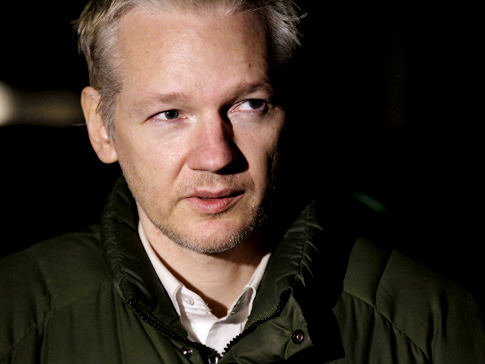
Julian AssangeJulian Assange stated in an interview last Thursday that he feared that if extradited and imprisoned in the United States, that he would die in prison “Jack Ruby style.”
For those not familiar with that reference, Ruby maintained throughout his stay in prison that he was framed – not that he did not kill Lee Harvey Oswald, but rather that he had no choice.
“The world will never know the true facts of what occurred–my motives. . . . Unfortunately, the people that had so much to gain and had such an ulterior motive, and who put me in the position I’m in, will never let the true facts come aboveboard to the world.”
Jack RubyRuby died in prison in 1967, shortly before he was to be given a second trial in Waco, Texas. He was convinced that an injection that he received while in prison contained active cancer cells. I don’t know the science of that – I do know that premature death of people like Ruby should be regarded with high skepticism.
Assange appears to be playing a game here – he is raising his profile, possibly buying assassination insurance. There is no doubt that the Obama people want him jailed, and probably dead. The combination of corporate and government activities to shut down Wikileaks ought to raise eyebrows everywhere, but we are a land of shaved brows.
But if Assange’s profile is kept high, killing him becomes problematic, as any “accidental” death would everywhere (except in the American media) be regarded with suspicion.
Here in the Land of the Free and Home of the Brave public opinion does not favor Assange and Wikileaks. We are a most docile people, not even needing locks on our jail cells.
We are past the portal now and well into our new world, which isn’t new at all. Corporatism goes by many names, the oldest being feudalism. It’s a natural regression to the mean when we cease to be constantly vigilant: a few who have accumulated wealth and power presume to know that they “earned” it, and for that reason believe themselves to have superior wisdom. From there it’s a quick succession from superior wisdom to superior essence, from a big house to a big house on a hill to a gated community.
From that insulated viewpoint, all of us become rabble, outsiders, sometimes glimpsed at through the window of a limousine. Somehow their eggs are on their plate in the morning, somehow their garbage is carted off, but in the meantime they are going on about the important business of amassing more wealth. In their lexicon, which their pet economists are trained to repeat, it is called “creating jobs.”
In fact, didn’t I just hear this from Obama? Didn’t he even say that economists had told him if he kept the Bush tax cuts in place, that our employment picture would improve? (AP restricted story: Yes, he did! He said that “Economists predict higher job growth in 2011-2012 if tax deal passed!” Yes, we can!)*
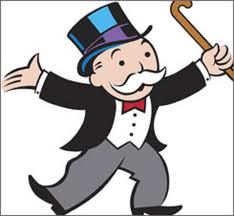
The best expression of how unregulated and untaxed economies function is the board game MONOPOLY. There are strategies at play that can help, but the important life lesson to take from the game is this: once a player reaches a certain critical mass of wealth, it takes on a life of it own, and it builds on itself. And the “economic driver” on the board and in real life and is a set of dice.
In corporate world, post Citizens United, we are all of us going to be second class citizens. As I awoke this Christmas morning, as my mind began to focus, I found myself wondering if us white folks are going to be very good in the roles we used to assign to non-whites.
Will we accept our Wal-Mart jobs with good grace? Will we accept that most medical conditions just can’t be dealt with on Wal-Mart income? Will we easily give up this high-falutin’ notion that education will improve our lot in life?
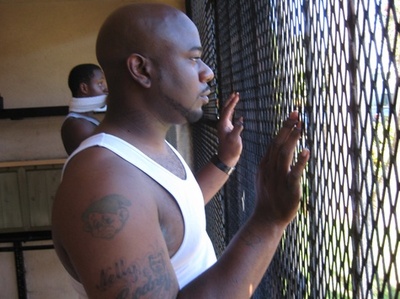
Life in a gated communityWill we too begin to drop out of high school in droves? Will we join the underground economy – the drugs and crystal meth one? That too is mere capitalism, free enterprise of a sort that lands one in a different type of gated community.
My suspicion is that us white folk will not be very good at being black folk, or Hispanics or whatever other color we look down upon. I fear we will turn hateful, and having been taught that there are none to hate above us, will turn our hatred outward and downward.
This is the function of the Tea Parties. They are a product of the public relations industry – no doubt the idea sprung up in a Hill and Knowlton office in DC, or some other such place. They are a political device, but also serve for misdirection. They take our discontent, which is real and reasonable, and direct it away from the real cause of the problems.
Welcome to corporate world. Merry Christmas to all.
_______________
*[Note to self: Economists don’t know much about the past or the present (what’s a cause and what’s an effect and all of that), and so restrict themselves to the future.]
During a recent family tragedy, we were overwhelmed by messages from friends and relatives that they would “pray” for us. I understand the sentiment – they want to be helpful, but are miles away and can’t do anything but offer moral support. The closer to the victims of the tragedy, the more that wonderful people offered real help, support, hugs and tears and consolation. They did so because they could, because they are real, loving and caring people. Those who could not offer real help would do so if they were closer at hand. The “prayer” is really just a way of saying “I feel compassion for you, I hurt for you.” As I told one person who wondered if I, as a nonbeliever, appreciated his prayers, I said that I welcomed all good thoughts and feelings, no matter how he chose to express them.
As I have aged and endured suffering, as we all do, I’ve come to think of Christmas as a pagan holiday masked with our own religious mythologies. It is no coincidence that it happens around the solstice, and the wasting of perfectly healthy trees and references to virgin births go back far into our history, long before 6CE, the year of the Census of Quirinius that might be the one referenced in the Bible. In the modern era, the holiday is also swathed and swaddled in commercial ideology – the need to buy and wrap is deeply embedded in us. “What to buy for someone who does not need anything?” Well, I’ve got to buy him something, anything. I’ll spend an hour at COSTCO and find some Chinese merchandise that he will put on a shelf in his garage and someday donate to Goodwill.
Children are showered with gifts, but are not capable of true appreciation for things that they did not know they wanted, much less needed. A child is capable of expressing only so much appreciation, usually verbally expressed at the parent’s command. That same appreciation is divided by two with two gifts, and with ten gifts is hardly expressed at all, as the child is no longer grateful, but is instead looking for things that offer more than a moment’s satisfaction. Children are children, and I like them just like everyone else, but I deliberately avoid the unwrapping ceremonies. It’s a little unsettling.
The important thing is that I spent some money, so that merchants have a good holiday season. How does a good holiday season translate into our “common good”? It offers people some part-time employment without benefits, and is a great jobs program for the republic … of China.
So here is how we celebrate Christmas: We observe it, in the true sense of “observe.” Mostly, we just watch what is going on around us. We have a tree, because grandchildren expect that of us. We don’t go to church, just as with all other days. We have a nice meal, my wife and I exchange gift that we think really might bring some joy to one another. We devise a letter that tells of all the events in our small family over the past year, avoiding any reference to “straight A’s” and the invention of vaccines and work in Calcutta. Joy to the world!But the truth is that in our family we have one daughter who actually did pull straight A’s for two years (having belatedly discovering her inner student), and another who is working in Haiti for the Canadian Red Cross. She is witnessing true suffering and first world indifference to the third world, and thereby gaining true wisdom. We didn’t do those things, we didn’t cause those nice things to happen. But it was worthy of mention. The rest of our kids are just doing what they do, surviving and making their way.
And that’s about it. I want the holiday to end soon so that David Sirota and the Daily Show and Bill Maher return. It’s also a hump – six weeks after New Year’s day, pitchers and catchers report to spring training.
Two things happened this week that merit some applause – ratification of the “START” treaty, which somewhat lessens our nuclear arsenal, but more importantly allows for Russian inspection to see that we are not violating the limits; and the elimination of “Don’t Ask Don’t Tell.” That the latter was even controversial is an indication of how backward our leadership is in the advance of human rights.
The passage of the treaty surprised me, but I’m easily surprised. Our quest ought to be for total elimination of the weapons, as they, as opposed to conventional weapons, actually threaten our existence. Reduction of our stock from 2,100+ to 1,500 is hardly meaningful, given that one might set off a chain reaction that will end with our annihilation. And hidden in the details is a Bush-era initiative to gussy up our stock, spending $84 billion on making those weapons we are keeping even more threatening. This is a dramatic increase over what Bush initially asked for, $60 billion, as I recall. Again, Obama has out-Bushed Bush.
And then I heard on the radio yesterday that Obama praised the lame-duck session for accomplishing more than any lame-duck session in decades. And I heard radio liberals praise Obama, one saying that he “got his Mojo back.” Why? He gave a good speech. That’s all it takes to make these clowns happy.
What did he accomplish? Removal of DADT is nice, but has little effect on the larger issues of governance – militarism, taxes and rule by wealth – that affect our population. It has the feeling of a wedge issue, though I sympathize with those who suffered under it. I don’t minimize it for them, and congratulate the Congress for finally coming around on that one issue.
Obama’s big accomplishment was a massive betrayal of a campaign promise, for which he has gathered wide praise. While campaigning, he promised to allow the Bush tax cuts for the wealthy expire, while preserving them for anyone making less than $250,000 – virtually all of us. He didn’t “negotiate” or “compromise.” He screwed us with royal vigor. He saved the cuts for the wealthy, probably in perpetuity, while amazingly raising taxes on 45 million of our poorest households. He planted a time bomb in Social Security that will explode in two years.
It is a massive screwing! And done right out in the open. The 2010 elections did not reflect any kind of shift in voter sentiments. Voters with sentiments who voted in 2008 simply didn’t vote in 2010. Obama turned out to be, well, not so much.
Yes, he got his Mojo back. Democrats have to be proud that the old speech-maker is back on his game. For the rest of us, well, elections don’t matter in this country. Back to work now, folks. Nothing has changed.
Division of Wildlife spokesman Randy Hampton tells the Grand Junction Daily Sentinel the hunter didn’t break any rules. Hampton says the incident does raise “ethical issues.”
The hunter, Richard Kendall of Craig, defends his decision. He says he waited outside the northwest Colorado den for five hours, hoping the bear would emerge, before crawling about 6 feet into it and shooting the bear.
The Sentinel reports the bear weighed 703 pounds, about 50 percent more than most black bears.
The newspaper says preliminary measurements indicate the bear could set a state size record.
A visual representation of market failureI am regularly visited here by two ghosts – people unknown to me who present themselves as skillful and successful entrepreneurs. Each assumes suggestive names and persona that mask their real identities. (This leaves open room for speculation that such success would not require anonymous blog identities to advertise their success. But leave that aside – even if they are fictional characters, they present a great opportunity to throw ideas around, and are fun to boot.)
(One of the two is supposedly off in the Southwest now doing reach-arounds for millionaire investors, and so isn’t able to access the Internet, which is not available in that part of the country, and which millionaires know nothing about anyway. But I’ll leave this hanging for his return.)
Here’s what troubles me – each of these literary devices posing as humans preaches the infallibility of market mechanisms in guiding us towards proper outcomes in all areas of life. Government is a negative force, and where governments and markets operate together, the former always screws things up, while the latter picks up the pieces. Our long term survival depends on the elimination, or at least minimization, of government, so that markets can work their magic.
According to one of these Jungian dreamscapers, all of life is about economic transactions. Humans know of no other way of dealing with one another than to exchange value for value. Where we act without economic motivation, we inevitably end up in disastrous consequences. Further, any transaction that enriches one at the expense of another is theft. So the concepts of social insurance, or even private insurance, are forms of theft, as are, of course, taxes and transfer payments. Economic regulation is, even if seeming effective, redundant, as markets self-correct, so that even when regulation appears to have worked, it is just an illusion. Regulation, by definition, interferes with market efficiency.
Econ101 tells us that people acting for their own benefit inadvertently help all of us, so that selfishness is a virtue. We are free from any care or concern for our fellow humans, as by merely creating wealth, we are charitable. Government, which can only exist by expropriating wealth created by private individuals operating in markets, is by definition intrusive, overbearing, and even evil.
That’s my take on my two regular visitors. If I’ve put words in their mouths, I apologize.
I only have two questions:
1) When human transactions are reduced to an economic exchange, not everyone affected by that exchange has a say in the matter. As a thought experiment, place two people in a cold room with a wood-burning stove. One person has control of the wood supply, and so offers to sell the heat from burning the wood to the other. They agree, and one builds a fire, and both benefit from the heat and survive the winter. But the fire also produces smoke, which the owner of the wood conveniently vents into an adjoining room, where people choke and eventually die. They have no say in the exchange, as they are not part of the economic transaction. Is this not market failure?
2) We often don’t know the outcome of our economic transactions for years, sometimes decades. Yet we need to be paid in the present to survive. So, as another thought experiment, imagine bankers from a place called “Wall Street” create elaborate financial instruments, free of government oversight. Because these instruments appear to be immediately profitable, they pay themselves huge rewards for that profitability. Later, when the instruments prove defective (in fact, destructive and harmful), these same bankers refuse to repay their bonuses. Is that not market failure?
Just as a thought experiment, suppose that we changed the measuring period for profitability of economic transactions from one year to, say, twenty. Suppose that our retirements hinged on the long-term consequences of our current affairs. Add one more step – suppose that we measure profitability by including all outflows from transactions, whether the people affected are involved in the financial exchange or not.
Would the world be better, or worse off?
These two questions are fundamental. Obviously I have my opinions, and I’ll put them out there right now so there is no guessing. In my view, market economies and “free” markets are destructive of wealth, societies, positive human values, and in the end, the planet.
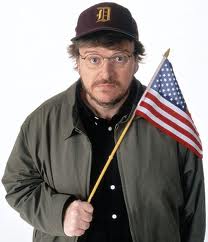
MentchGood news today from film maker Michael Moore. He has put up $20,000 to guarantee bail for Julian Assange, Wikileaks founder. He has also offered use of his servers for Wikileak traffic*. It’s a move that would be unquestioned anywhere in the world, but probably puts him at legal risk here in the U.S., and perhaps if it were done in China.
International criminalIn other news, Halliburton has reportedly agreed to pay $250 million to Nigeria to encourage that country to drop its bribery charges against Dick Cheney. (Sounds suspiciously like another bribe.) As with all well-connected criminals, Cheney walks free.
And isn’t it interesting that $20,000 is a blow for free speech, while $250 million allows a criminal to walk free. What’s wrong with this picture?
_______________
*Moore’s web page
U.S. District Judge Henry Hudson, a Bush appointee, strikes a blow for civil libertiesJC has a nice post about the recent federal court ruling throwing out the individual mandate from the Health Insurance Company Protection Act (HICPA) passed by Obama (usually referred to as “health care reform”). It’s one of those instances where the work of civil libertarians is being carried forward by principled conservatives while liberals sit on their hands. (The bill was pushed through congress by President Obama, a perceived liberal.)
Any fool can see that a mandate that we buy a product from a private company without a public option is immoral. Whether or not it is unconstitutional will end up in the hands of our right wing Supreme Court, and the odds are that this court will come down on Obama’s side, and against civil liberty.
Perceptions screwed up? Try adjusting them, and leaving reality as it is.
“He’s a con man. I have no use for him.” Ralph Nader
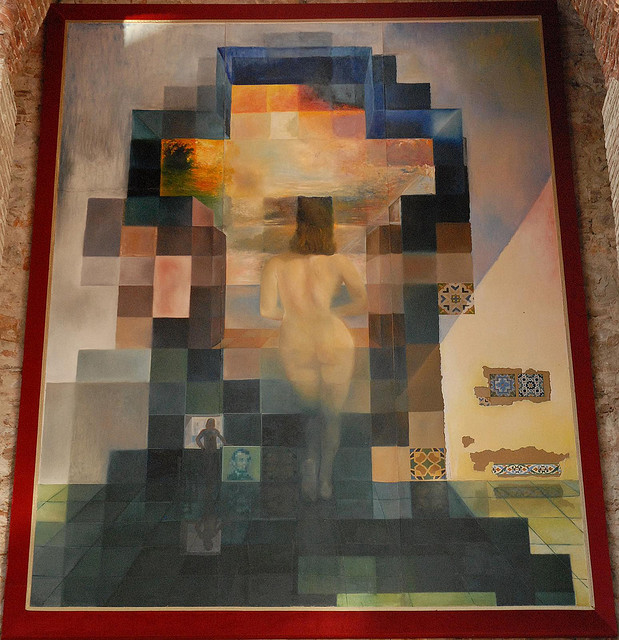
The famous painting above is by Salvador Dali, Gala Contemplating the Mediterranean Sea. I saw the original at the Dali Museum in Figueres, Spain. It’s a beautiful image of a nude looking over the sea, but from twenty meters away you realize that it is actually a portrait of Abraham Lincoln. (I have to stand about twenty feet back from my computer screen for that effect to kick in.)
Clever, I suppose, like those Bev Doolitte paintings so popular in the west – eagles and bears concealed right out in the open among trees and snow banks.
Concealed in plain view … read here how the Obama Administration is now actually negotiating with his opponents, decorating a Christmas tree with goodies to sell tax cuts for the wealthy. They have a myriad of ways to make people vote their way. The open and obvious ones are the bribes – ethanol is the biggest scam going on right now. Underneath that and not discussed are threats – elected officials are told that their funding will dry up, that they will face a primary opponent or well-funded candidate from the other party. Committee positions are auctioned off and earmarks are used as carrots.
And then … one level below that … do you really think that wiretaps are benign, that call girls camped out on Capitol Hill are just for fun, that a little cash bribe here and there can’t be brought back to form a scandal? (When you see an abrupt resignation on Capitol Hill, it is a safe bet that someone has been cornered and threatened with exposure.)
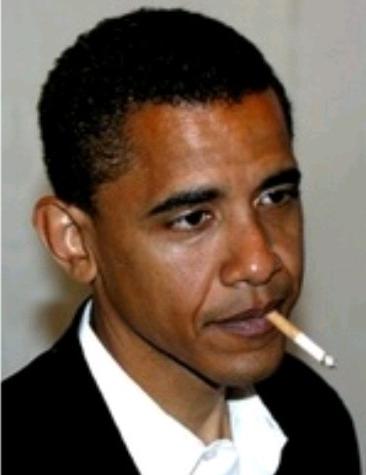
Obama contemplates the nature of powerBut the point is that Obama could use all of these tools to pass bills favorable to the left. He has them all at his disposal. But with the Public Option … not done. With EFCA, not even introduced. But when a bad health care bill was finally on the docket, and now with tax cuts, the power is there, and he is flexing his muscles.
He’s negotiating with his opposition. Who are his opposition? Democrats.
He’s a con man. I bristle when I hear Democrats and others say that Obama is actually a “centrist” or a “moderate.” He is nothing like that – he is a right wing Republican. And it is right there, out in the open. All you have to do is take a view from twenty meters back.
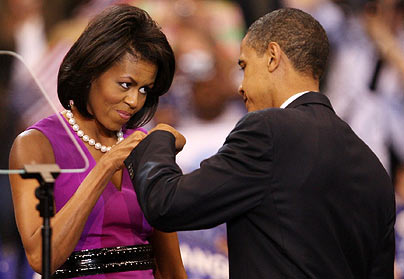
Sanctimonious bastard fist-bumps wifeOne nice thing about being president is that you get to create your own reality. Ordinary meaningless words sound like thunder. Critics are a mere distant echo, as sycophants use up all the existing band width. Here’s Obama after his latest betrayal of his base:
“So I pass a signature piece of legislation where we finally get health-care for all Americans, something that Democrats had been fighting for a hundred years, but because there was a provision in there that they didn’t get that would have affected maybe a couple million people, even though we got health insurance for 30 million people and the potential for lower premiums for a hundred million people, that somehow that was a sign of weakness and compromise. …people will have the satisfaction of having a purist position and no victories for the American people.”
Gave up a lucrative career in health insurance for other pursuitsReality: A health care bill written by the health insurance companies (AHIP) and pharmaceuticals (PhRMA), carefully constructed to preserve their business model, offering only a few tidbits of true reform, and those at taxpayer expense.
The reforms?
Expanded Medicaid, is a true reform, but one affecting AIHIP and PhRMA not in the least. There was no potential for the new Medicaid clients to be profitable to the health insurers, so they allowed them to be dumped on taxpayers.
People can no longer be denied coverage due to preexisting conditions, but it isn’t the health insurance companies that offer that coverage. People formerly turned down for coverage are still turned away, but sent to state exchanges. Those exchanges suffer from adverse selection, and so offer lousy coverage with high premiums. People are staying away in droves – when the premium subsidies finally come through, low-income people will be able to get this coverage, and the health insurance companies will be paid to manage the exchanges, but will not actually face risk exposure.
No soup for you!Children with preexisting conditions can no longer be denied coverage. This was a purely American phenomenon – parents who could not afford or were denied coverage could still buy policies for their kids … if the kids were potentially profitable for the insurance companies. The new law said that insurers had to take all comers, no matter health their status. I don’t know about the rest of the country, but here in Colorado, the insurers simply stopped writing policies for kids.
Preventive care must be covered, indeed a real reform, good public policy. We who have insurance can now go to a doctor for a physical, or a man-ogram, and the insurance company has to pay for it. Here’s how my insurer, Anthem Blue Cross, handled this matter: They now cover preventive care, as required by law, but no longer cover any other office visits of any type.
Frankly, this is the worst possible outcome for our health coverage crisis – fake reform. Democrats told us that we should take what was offered because we could always come back and fix it later. Not on this planet – there will never again be an opportunity like that, and their squandering of that chance is an historic betrayal of their mission and constituency.
There are other parts of the bill that might benefit us, but it is all done under the hovering shadow of AHIP and PhRMA. Before passage of the bill, typical private insurer overhead was 20% – Wall Street watches this number very carefully – if “medical losses” exceed 80% of premiums, stock prices go down. (A Harvard study found that total medical overhead in this country is 31% – that other 11% is hospitals and doctors share of the burden). The Obama bill, in a striking reform, mandates that their overhead not exceed …. 20%. There was a push at one time to get that number down to 15% … it disappeared in the reconciliation process.
Yes, we will have health insurance. We’ll be required to buy it, and if we can’t afford it, the government will pay … the insurers. There’s very little in the bill regarding quality of coverage – deductibles and co-pays, policy premiums – all of that untouched. Lifetime coverage caps are gone now – perhaps that is the one thing that the insurers did not like, as it introduces a wild card feature into their rate structure – they cannot precisely define their risk. But it all gets built into the premium structure anyway, and so will not affect their bottom line, as they are free to charge whatever they feel they need as a buffer.
Screw you, Democrats, screw you, Obama. You are worthless. We cannot afford your good works, don’t need that kind of help anymore. The tragedy of business-run America is that as bad as the Democrats are, and they are truly bad, our only other choice is worse.