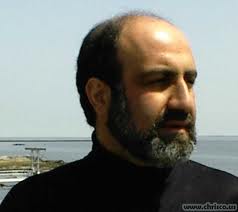
Nassim Nicholas TalebTwo items occupy the vast expanse of my empty head this morning. I am wading through Nassim Nicholas Taleb’s book, The Black Swan, and setting aside his massive ego, he is enjoyable and insightful. I particularly like the following, in which he comments on the ability to have regular income without sucking up to people. His company, First Boston, went belly-up, but he was left with what he called the equivalent of a fellowship.
This is sometimes called “f*** you money,” which, in spite of its coarseness, means that it allows you to act like a Victorian gentleman, free from slavery. It’s a psychological buffer: the capital is not so large as to make you spoiled-rich, but large enough to give you the freedom to choose a new occupation without excessive consideration of the financial rewards. It shields you from prostituting your mind and frees you from outside authority – any outside authority. … While not substantial by some standards, literally cured me of all financial ambition – it made me ashamed whenever I diverted time away from study for the pursuit of material wealth. Note that the designation f*** you corresponds to the exhilarating ability to that compact phrase before hanging up the phone.
I offer a corollary to his words: The number of times anonymous people say f*** you on the blogs corresponds exactly one-to-one with the inability to use those words in real life without serious consequences.
Here’s another tidbit: The Denver Post today reports on the most recent poll in our senatorial race: Ken Buck (R) 48%, Michael Bennet (D), 43%, Other, 8%, and undecided (1%). Bennet is toast, which is OK, as any man who has shat upon his base as much as Bennet has shat upon his deserves defeat. Send him back to investment banking, from whence he came!
The Post, in its entire long article citing “political observers” (?), ordinary street people and other polls – never once tells us who these “Others” are, even though they are determining the outcome of the election!
it’s as if, in 1992, the presidential election ended as follows: Clinton (43%), Bush (38%), Other (19%). Ross Perot gave us minority president Bill Clinton, and unnamed and anonymous “others” in Colorado will give us minority Senator Ken Buck.
My vote? “Other.” It is my vote, and I choose to spend it wisely.
Henry WaxmanThe problem with having Democrats in office is that they say they are for things and then do not fight for them. It is just like having enemies in office, except that we don’t have a chance to organize against Democrats. People think they are our friends.
Henry Waxman announced that a bill to regulate how telecoms control the flow of traffic on the Internet, so-called “net neutrality”, is dead. He failed to garner Republican support, and did nothing deceitful or intimidating or clever to keep the bill alive. He proposed no deals, threatened nobody – he just meekly withdrew the bill.
Isn’t it interesting how flaccid, how timid, how weak these guys are even when they are in power.
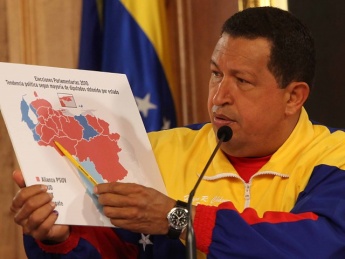
Murderous thugIt is interesting to watch American media reaction to events for which no cheering is allowed. In Venezuela, Hugo Chavez won an impressive victory in the legislative elections, capturing 98 of 167 seats. American media outlets are looking for bad, and of course finding it. Here the Miami Herald, which must have known the news would not be good, warned us in advance that Chavez was “stacking the deck.”
Here’s why they say that the news is bad for Chavez: He did not achieve his two-thirds majority. Further, the vote was closer than the outcome – that is, many of the seats that his party one were by scant margins. Also, some outlying regions are disproportionately represented in the legislature, individuals there having in effect more bang for their vote that those from more populated regions.
Which is eerily similar to American elections with our first-past-the-post winners and senators from small population states who have disproportionate power.
Unlike the U.S. president, Hugo Chavez remains a popular fixture in his country’s politics.
Freedom fighterThis is all very difficult for our state planners, as the desire within the bowels of DC is to attack Venezuela. The usual propaganda is at work – Chavez is a dictator holding office by force, and a clown on the world stage. All false – Chavez is widely respected, and holds office by large mandate.
Nonetheless, there is a buildup of troops now in Colombia, where the U.S. is backing a thuggish government and where those who oppose those thugs are called “terrorists.” The threatened conflict will ostensibly be between Colombia and Venezuela, but much like the Iran-Iraq war of the 1980’s, will be suspiciously convenient for the U.S.
All that is needed is some Tonkin-like event to serve as a pretext to trigger the war.
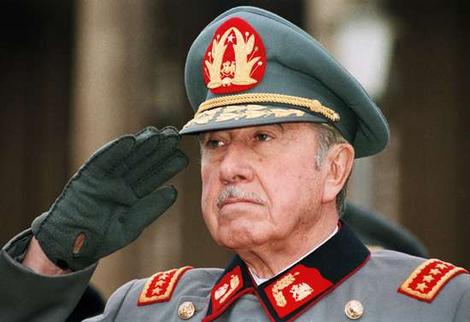
What will follow? Hard to know. Augusto Pinochet is dead and buried, as is the Shah and Suharto. There’s never a shortage of murderous thugs, and all I am missing is the name of the next president of Venezuela. And remember please to speak American English: Venezuela, a free country, will not really be free until we destroy its freedom to elect its own government and install a thug to run it for us.
There’s a debate going on here, and here, and other places no doubt, about the worth of the Obama Administration. He hasn’t accomplished much of anything – mild credit card reform, bad health care and financial reform, and of course, the continuation of
foreign policy, running the wars, state secrets, Guantanamo, DADT, civil liberty abuses, spying, killing, renditions, etc., things that really piss off progressives, no matter who’s in power.
That’s from a comment at LITW.
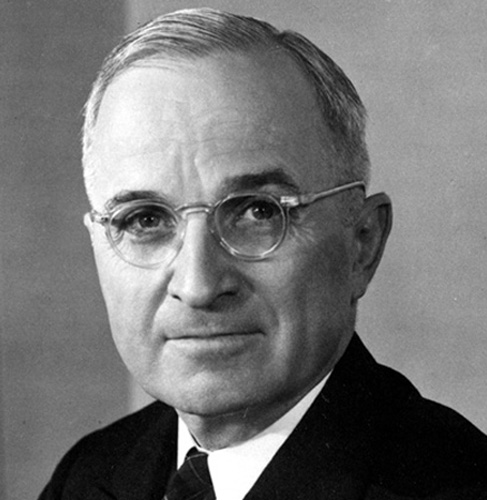
Did not know that Hiroshima was a large city?What instantly comes to mind is a footnote in Howard Zinn’s People’s History of the United States in which he said that Harry Truman’s personal notes seemed to indicate that he thought Hiroshima was a military base. That would indicate that Truman did not decide to drop the bombs. Others did, and he was the conduit for the decision. Somebody buffaloed him.
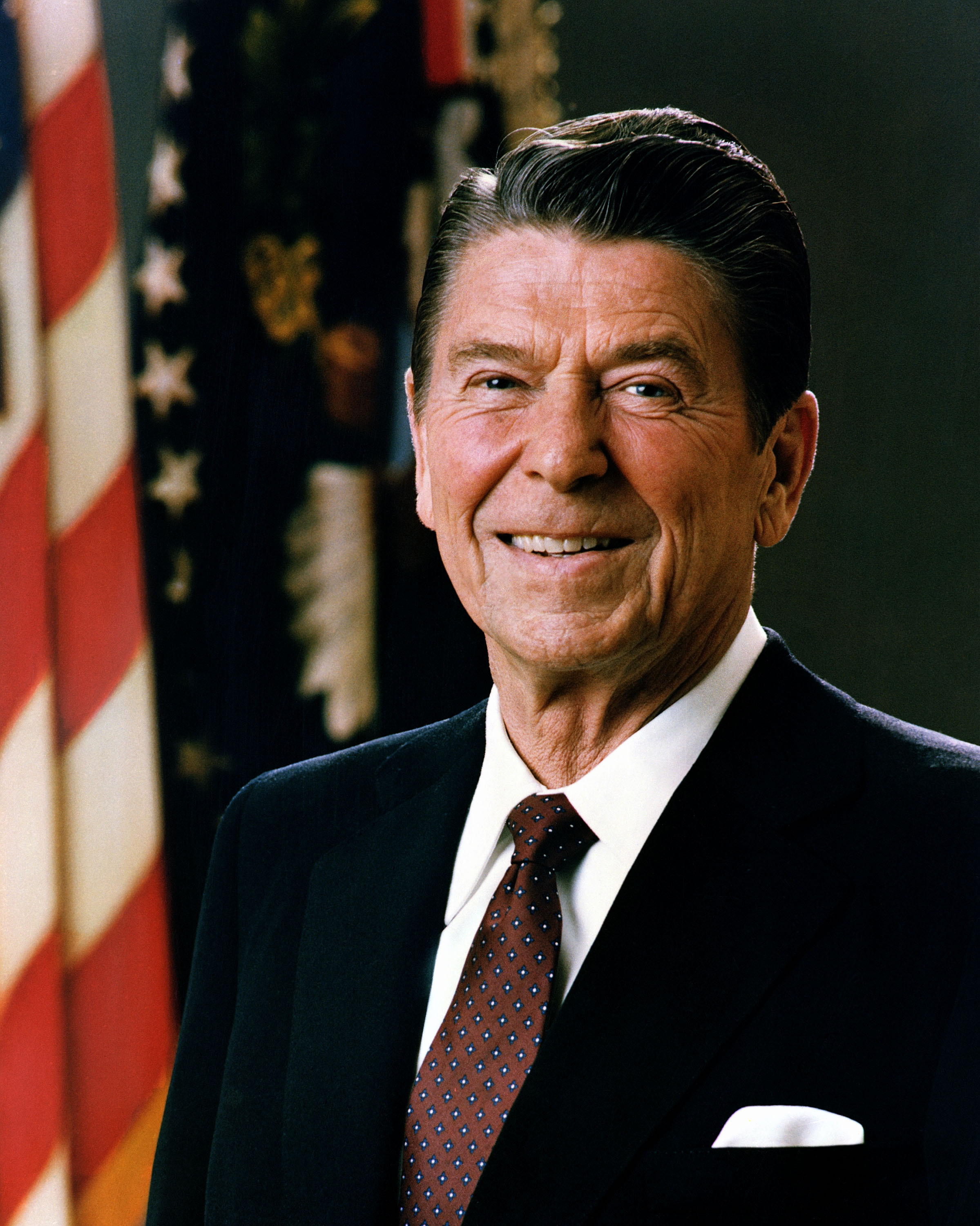
Why is that that ordinary men of limited ability and vision, like the Bush’s and Ronald Reagan, seem to be able to “accomplish” so much, while erudite men of letters, like Clinton and Obama just don’t seem to measure up, in fact, seem to be working for the other camp? The men of lesser ability make massive changes, and the men of great ability just can’t seem to get a grip on things.
A man of limited ability, and huge accomplishments?I have long thought that the presidency is merely a conduit for power, and that the occupant of the office merely imparts a flavor to the culture of DC. Different people are brought into office and the power structure does shift from one wealthy sector to another, but there is very little change in policy. And the wealthy sector still rules.
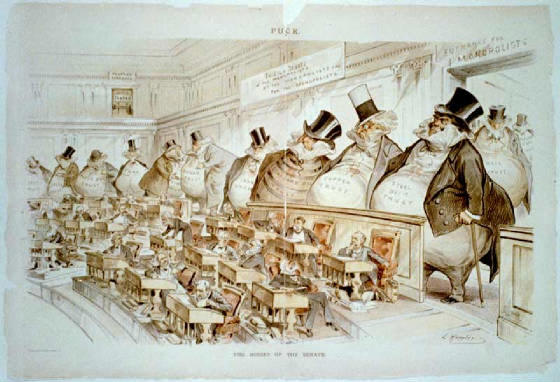
The problem I have is that I cannot describe the mechanism. It is too big. It is “the oligarchy”, the thousands of wealthy people who share common interests and frame of mind. But that sounds like a conspiracy, and it is not, anymore than the fact that Britain is run by an aristocracy that only reluctantly shares some power via parliamentary government is a “conspiracy.” It is just how power plays itself out.
Obama happens to be a weak man, but if he were a strong man of principle who intended to use the power of the office to act on those principles, he would not be president. The oligarchy would not allow it. Candidates for office are vetted over a long period, and those who might not be manageable and predictable are, by various means (usually by media indifference), rejected for high office.
And again, I am left to describe how “the oligarchs” stop candidates from getting votes. They do. Most people don’t think their own thoughts, and follow the leaders. The idea of voting for a Dennis Kucinich, say, is considered laughable. Why? He’s certainly smarter than John McCain, and certainly braver than Obama. But a pall is cast on undesirable candidates, and they rarely rise to the stature of “viable” in the eyes of the electorate.
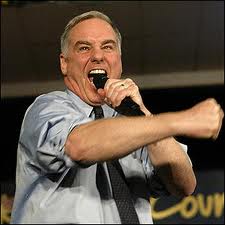
It wasn't the speech that was his undoing ... What is the mechanism? I have seen it at work. John Edwards, even though running even in the polls, was never mentioned as a “front runner.” Later, his sexual peccadilloes were exposed. Howard Dean pulled off an upset in Iowa, and the “I have a scream” hit the airwaves, eliminating Howard Dean from consideration.
I see that it works, I see how it plays out. But I do not know anything about how the upper crust, the corporate CEO’s and wealthy families exert their influence to make these things play out as they do.
Eisenhower warned us about the “military-industrial complex”, a nice turn of phrase, and another word for “oligarchy.” But it was too big, even in 1960, for him to describe in a way that would allow us to grasp its depth and breadth and power.
I only know this: If your vision of the office of president is of a man in charge, then your vision is wrong. If you think that George W. Bush decided to invade Iraq, cut taxes, set up a prison in Cuba and torture people, you’re wrong. If you think that LBJ decided to invade Vietnam and kill three million of them, you’re wrong. If you think that public opinion caused the government to pull out of Vietnam, think again. If you think that Obama decided to push in Afghanistan, you’re wrong. If you think that Clinton decided to bomb Serbia, you’re wrong.
The office has power, to be sure, but the power is not exerted by the man in office. The power is exerted through the man in office. Real power lies elsewhere.
[The company will] stop selling new health insurance to small groups in Colorado and move companies that have existing clients off the plan in the next year, affecting 1,200 companies with 5,200 employees and their dependents.
Aetna says it has to do this because they
…feel they can no longer meet the needs of our customers while remaining competitive.”
State insurance officials said they
… think the 1,200 companies affected by Aetna’s decision to leave the small group market will be able to purchase insurance from other insurers.
Note the careful wording … you’re being “moved off the plan” (dumped). State officials think you’ll be OK … they offer no data, no guesses, no remedy. They just think you’ll be OK.
Tough luck, buddy.
Aetna is leaving because of Obamacare, not that they were doing us any great favors anyway. Good riddance. Bur welcome to health care reform. It’s a game, and the insurance companies won.
People who need health insurance most are the ones that insurance companies don’t want to insure. This is known as “adverse selection.” Insurance companies have devised a myriad of ways to avoid sick people, but sick people are clever too, always looking for loopholes and back doors.
In the U.S., people looking for back doors are considered a problem, or “moral hazard,” while insurance companies avoiding sick people is normal and acceptable behavior. We’re a little perverse in the morality department.
One back door is fake (or part-time) employment with companies for the sole purpose of getting on the health plan. While it may appear that these phantom employees are being insured by the employer, they are reimbursing him under the table. In this manner, they escape the private placement market, where insurers refuse to offer coverage.
The new logoStatistics show that large companies either don’t play this game, or that it is not a large factor in costs. But with small companies, one sick employee can skew the cost structure. The green eye shade people are watching closely, and realize that undesirable clients are breaking through the barriers via small companies. They have two options: Jack up premiums, or jump ship.
In the past, the insurer response has been to make insurance so expensive that small businesses with low wage employees cannot afford it. Those that can afford small market coverage tend to be high skill professionals, but the corner grocery store … no way. So insurance companies avoided undesirables by making themselves unaffordable.
Health care “reform” now offers credits to small businesses of less than 25 employees whose average wage is less than $50,000. Seems like a fix, right?
Wrong. What it really means is that the back door is opened a little wider now, and unprofitable clients are going to have an easier time getting through the barriers to coverage. Insurers still don’t want to cover them, and can either raise premiums to the point where credits are negated, or jump ship.
Run away! That’s all Aetna did. Smart move on their part.
The failure is not the “reforms,” and the health insurance companies are merely rational actors. The failure is the American health care model: “for-profit” companies managing health insurance is bad public policy. Obamacare did not a whit to fix this, and our problems will only get worse now.
And there is no hope of remedy. The health care debate is over.
So easy to set off a bomb here ... I am not big on predictions, but I am going to make a couple anyway, because they illustrate larger points.
1) There will not be another event like 9/11. We were safe before that event, and are just as safe after. The event itself was so off-the-wall that it succeeded.
It is not new security measures that prevents re-occurrence of such an event. The reason I feel comfortable saying this is that mass killing of innocent people is very easy to do. People in other countries are very angry at us, so that it should have happened by now. But no matter how mad people may get at our government and our bombs and bombers and sociopaths, it is very rare for them to vent their anger by killing innocent people. There’s no satisfaction in that. That’s our shtick.
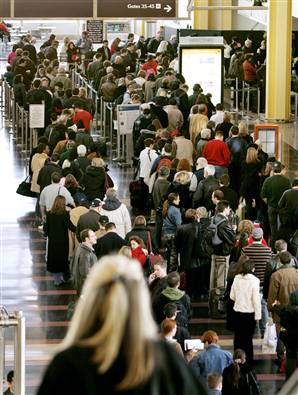
Here’s how easy it would be to do some real mayhem: All our elaborate airport security cannot prevent someone from carrying a bomb into an airport and detonating in the security screening area. Bombers don’t need people gathered on an airplane – they only need for people to be gathered at a single place. All of our elaborate security has merely shifted the gathering point.
As I have long known, and George Carlin reminded us, the whole point of airport security is to keep us in a state of fear. If someone wants to set off a bomb and kill innocent people, it is impossible to prevent.
So no more 9/11’s. Please relax, folks. You’re safe.
The Great Capitulator2): The Bush tax cuts will be preserved. The only reason that they are set to expire is that they were passed via reconciliation, something that Democrats told us was so too obtuse and complicated to be useful. Bills that increase the deficit that are passed via reconciliation are automatically sunsetted after ten years. Otherwise, the tax cuts would have been permanent and hard-wired. It is now up to Obama to perform that task.
Obama is employing the same strategy with tax cuts as he did with the public option in health care. He is candidate Obama again, our progressive friend. It’s triangulation. At an appropriate time after the election we are going to learn that Obama will ‘accede’ to ‘pressure’ from the Republicans to preserve the cuts.
For right now, due to public opinion, the Democratic leadership had to forestall any action on the tax cuts until after the election. That part is done.
The worst part will be that Obama will apply a little Vaseline, offering up a little morsel here and there, as he did with health care, to convince Democrats that they got something meaningful in return for capitulation.
And they will eat it up. The politics I understand, but this constant capitulation I do not. Where is the validation in losing, losing, losing? How can Democrats live like that?
Molly Moody (file photo)“Molly Moody” (middle name “Tooly?”) wrote over at Left in the West on the supposed wonderful reforms of health care “reform.
The primary job of Democrats, as commenter “Ladybug” once reminded me, is to lower our expectations and keep them low. With health care, we are being told that a little bit of change is a really big deal. We are also to assume that this little bit of change would not have happened had not Democrats been elected. But it is public discontent, and not the party in power, that is the driving force behind reform. In the current environment, where money rules all, it is Democrats who are best at suppressing the reform impulse by rubbing a little bit of salve on a gaping wound, and then telling us it is major surgery.
Here are Molly’s six, the wonderful reforms the Democrats have given us. The Wellpoint-written health care reform bill …
1. Bans Insurance Companies from Dropping our Coverage When We Get Sick: The practice of rescission is indeed abominable, but only came about because insurance companies are able to construct artificial barriers around health care to prevent entry by potentially unprofitable clients. When someone lied on an application, the insurance company did not care, as they could simply fix the error by retroactively canceling the policy. Now that they cannot go back, they will simply be more cautious at the outset.
One a scale of 1-10, the amount of positive change here: 1.
2. Prohibits Excluding Coverage for Children With Pre-existing Conditions: There are many families where the parents buy insurance for the kids but not themselves, a third-world kind of fallback for people shut out of the system. Insurance companies here in Colorado, and no doubt elsewhere, have simply stopped writing policies in that area. (0)
3. Empowers Consumers to Appeal Insurance Company Denials: This already existed at the state level. Good grief. (0)
4. Extends Coverage for Young Adults: Young adults can stay on a parent’s plan until they turn 26. Here we might have something of value … if we pay the Piper. These insurance companies are willing to change any procedure if their bottom line is not threatened. Now that they all must insure kids until age 26, they will merely adjust their rates to compensate for the additional exposure. (Kids in their early 20’s are not a high-risk group anyway.) (0)
5. Provides Free Preventive Care: Nothing is “free.” of course, and surely not under these supposed reforms. The requirement that insurers now cover preventive care without deductibles and co-pays will be reflected in premiums. (Remember, there were no cost controls in this legislation.) However, the fact that people who previously avoided preventive care will now more likely seek it out is a good thing. (2)
6. Eliminates Lifetime Limits on Insurance Coverage: As with #5 above, this too will be reflected in premium structure, and insurance company profits are not threatened. Nonetheless, the very idea that our life lines could be cut off was barbaric. (3)
So, six changes heralded as a great accomplishment by these mealy-mouthed quislings we call Democrats … potential positive change: 60. Actual change, in the writer’s view: 6.
6/60 = 10% of mission accomplished. I’ll be damned. As Democrats go, this is overachieving!
Democrats are going to take a drubbing at the polls in November, and will whine that we are better off with them than the alternative. They always whine about that. If that were true, if it were anything more than good-cop-bad-cop, they might have a legitimate case.
As I am so fond of saying, better a real enemy than a false friend.
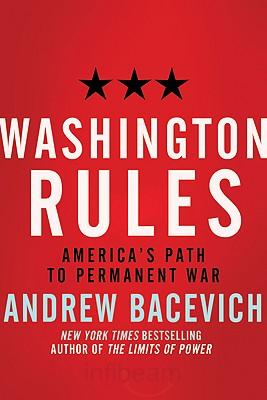
All of my adult life I have been a company man, only dimly aware of the extent to which institutional loyalties induce myopia. Asserting independence required first recognizing the extent to which I had been socialized to accept certain things as unimpeachable. Here then were the preliminary steps essential to making education accessible. Over a period of years, a considerable store of debris had piled up. Now, it all had to go. Belatedly, I learned that more often than not what passes for conventional wisdom is simply wrong. Adopting fashionable attitudes to demonstrate one’s trustworthiness – the world of politics is flush with such people hoping thereby to qualify for inclusion in some inner circle – is akin to engaging in prostitution in exchange for promissory notes. It is not only demeaning but downright foolhardy. (Andrew J. Bacevich, Washington Rules: America’s Path to Permanent War)
Bacevich: A man on the move (to the margins)As I read the above words with a sad realization: Bacevich, widely cited, has appeared in many respectable venues, in addition to less desirable places like The Nation and Democracy Now. Soon only the latter will be available to him. His words are a cry of angst that will move him to the margins of acceptable thought.
The book had a familiar feel and color to it, and so I dug out an old Noam Chomsky book that had the same texture, and sure enough, the same publisher: Metropolitan Books. How far you have fallen, Mr. Bacevich. How many turned you down?
You are toast, Mr. Bacevich. You might as well move to France.
Bacevich is writing above about his Eureka! decade – not a sudden realization, but a painful slow epiphany during which he realized that the Cold War was fought without a viable enemy. The Russians were never a threat to us. This led him to other realizations … that our permanent state of war has as much to do with military Keynesianism as any capitalist ideology; that our current aggressive wars are criminal endeavors, and that there was never a call or need for us to “lead” the rest of the world. But here is the worst: Military Keynesianism doesn’t work anymore, doesn’t give us the needed high. And cold turkey might kill us.
After World War II, and passage of the National Security Act of 1948, the Department of War became the Department of Defense. We’ve been at war ever since. The science/art of propaganda had been abandoned, but was resurrected to scare the population into supporting a permanent war machine. The Soviet Union (with China sideboard), was set up as an evil empire and used to justify every military endeavor we undertook. When they collapsed, we used the Microsoft Word “find/replace” command to insert the word “terrorism” everywhere that “Communism” appeared, and carried on as if nothing had changed.
Americans are scared now, so much so that there isn’t much left of our intellectual culture, which is why Bacevich will never be invited to another party in Georgetown. He doesn’t fit. His realization is counter-cultural. His books will not be reviewed in the Times and NY Review of Books. He will cease to exist.
Hard to fathom, but this kind of nonsense really worksRepublicans recently came up with a new version of their 1994 “Contract with America,” called the “Pledge to America.” In it, they promise to cut spending and taxes and balance the budget … but not to touch military spending. They are sure the formula will work, as the idea that unnecessary military spending is necessary is sacrosanct. There is only one possible outcome: Cutbacks in social spending.
And that is the objective. The guns have won the propaganda battle, and butter is losing. All of our social programs, including Medicare and Social Security, are threatened now (as always), but with right wing Democrats in office, more so than ever before.
Here’s some wisdom from the margins: We are not at war with anyone, except by choice. We are safe. We are threatened by runaway population and environmental degradation. We can make our lives better by investing in health care, alternative energy, infrastructure, science and education.
Our war machine, our Pentagon, our military-industrial complex, threatens all of that.
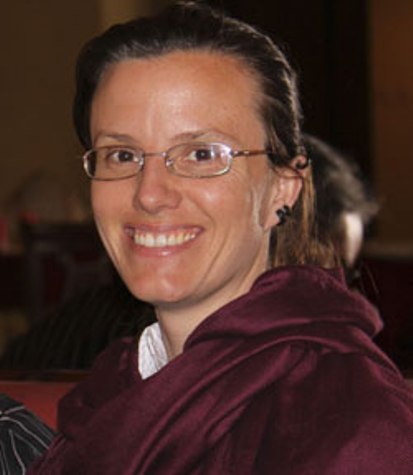
Sarah ShroudThe following are the comments of Sarah Shroud upon release from an Iranian prison after being detained over a year on charges of espionage:
It is so good to be free again, to taste new food and smell ocean air. I wake up with a heavy heart and then realize that I am free to go anywhere, do anything I please. The sense of freedom overwhelms me. It is so good be alive.
If it were only me. But there are others behind bars, people held without charges by an unaccountable regime. These people have been held for years on trumped-up charges, some not having seen their homeland or families for almost ten years.
I am referring, of course, to the prison at Guantanamo, and the secret prisons that the United States runs in Iraq, Afghanistan, and CIA torture prisons in undisclosed locations. I am referring to the hundreds, if not thousands of Palestinians who have disappeared into the Israeli prison system, and for whom Israel refuses to offer details.
Oh yeah, also, my fiance’ Shane Bauer, and our friend, Josh Fattal. Them too. Almost forgot.
OK, yeah, I made it up. Just wanted to point out the American state of mind that can see small injustice and be blind to monstrous ones.
I have read in various places from people who should know that there is no nutritional difference between “organic” and regular food. I do not doubt this, but we eat mostly organic food. It costs more, but we believe it is an ethical choice. I realize that most people cannot justify the extra expense. There is no way we could have afforded Whole Foods when our kids were young.
However, I would not care how food was labeled if we had transparency – if we could know that animals are treated ethically, soil preserved. We would be far better off to let our chickens roam free and put Monsanto in a cage. And if advertising ever told us anything that was true, we might make better choices.
But that’s the way we live. So even though it’s a bit annoying, we pay more for the “organic” label. Part of the high cost of organic food is the “ideology cost” – that is, Whole Foods jacks up its prices knowing that people will pay more if they believe they are participating in an ethical movement.
Whole Foods gouges the eyes out of its patrons. Every single item in that store ends with two digits: $.99. Pricing is merely a matter of picking the numbers that precede .99, and that often seems to be a random process. But they also treat their people well – their employees and suppliers. That matters too.
Here are our justifications for organic food:
An American kid's food cornucopia1. Organic food practices are easier on the land. Most food that we eat is petroleum-dependent, and the soil is merely the medium by which we convert oil to food. Organic food uses natural fertilizers and no pesticides, so that nutrients are constantly recycled to preserve long-term soil viability. I wonder what would happen to the Midwest if we ran out of oil. Would it be a desert?
2. Most organic food tastes better. Organic strawberries are smaller, but sweeter and juicier than their non-organic counterparts. Organic deli meat does not have that oily texture that we find in Subway sandwiches. (God only knows what they inject in that stuff to make it appear edible. Two things about it are certain: They add color, to make it look wholesome, and artificial flavors, to make it taste real.)
Some non-organic food is as wholesome as its organic counterpart. I notice no difference in organic potatoes, peppers, beans, chips, beer. Some is worse – organic bananas are hit-and-miss. Organic peanut butter … well, if I can’t spread it with a knife, I don’t eat it. I’m a Skippy man.
Can it be far behind?3. Animals raised for organic food have better lives. People laugh at the idea of “free range” chickens, but I like the idea that a chicken gets to enjoy chickenhood, eating bugs and pecking at manure, before she dies. Cows like eating grass – it makes them happy. Pigs like rooting. And none of them anticipate death. They are the last to know what is coming. But for their brief stay on the planet, why not treat them ethically?
I realize that this is America, and there is probably a lot of hype behind claims of “free range” and “grass fed.” For instance, if they merely put a door and fifty square feet of lawn on a barn housing several thousand chickens, they can say that the eggs are “cage-free.” And probably much of it is just plain lying, either outright, or using words and phrases, like “lightly sweetened” or “natural” that have no legal meaning. Most likely much of what is labeled organic is just re-branded. This is America, after all, and advertising is nothing more than professional lying.
Free-range potheadsIt’s a compromise. We know that Whole Foods is gouging us, and that some growers are probably lying their asses off. But there’s another movement that makes even more sense – to buy locally. Our local farmers’ market is talking now about five days a week. We can buy local fruit and vegetables, beef, chicken and pork, wine and beer (OK – hops are from far away places), all without that 1,500 miles of transportation regular food takes to get to our table.
As always, it is buyer beware. But the closer to home our food sources, the more accountability there is.

 Here’s another tidbit: The Denver Post today reports on the most recent poll in our senatorial race: Ken Buck (R) 48%, Michael Bennet (D), 43%, Other, 8%, and undecided (1%). Bennet is toast, which is OK, as any man who has shat upon his base as much as Bennet has shat upon his deserves defeat. Send him back to investment banking, from whence he came!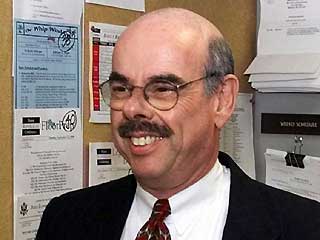








 Piece of Mindful