Brzezinski: U.S. lured Soviets into Afghanistan

Zbigniew Brzezinski
The following interview was published in France but has never seen the light of day in the U.S.

The CIA’s Intervention in Afghanistan
Interview with Zbigniew Brzezinski
President Jimmy Carter’s National Security Adviser

Le Nouvel Observateur, Paris, 15-21 January 1998
Posted at globalresearch.ca 15 October 2001

Question: The former director of the CIA, Robert Gates, stated in his memoirs [“From the Shadows”], that American intelligence services began to aid the Mujahadeen in Afghanistan 6 months before the Soviet intervention. In this period you were the national security adviser to President Carter. You therefore played a role in this affair. Is that correct?

Brzezinski: Yes. According to the official version of history, CIA aid to the Mujahadeen began during 1980, that is to say, after the Soviet army invaded Afghanistan, 24 Dec 1979. But the reality, secretly guarded until now, is completely otherwise. Indeed, it was July 3, 1979 that President Carter signed the first directive for secret aid to the opponents of the pro-Soviet regime in Kabul. And that very day, I wrote a note to the president in which I explained to him that in my opinion this aid was going to induce a Soviet military intervention.

Q: Despite this risk, you were an advocate of this covert action. But perhaps you yourself desired this Soviet entry into war and looked to provoke it?

B: It isn’t quite that. We didn’t push the Russians to intervene, but we knowingly increased the probability that they would.

Q: When the Soviets justified their intervention by asserting that they intended to fight against a secret involvement of the United States in Afghanistan, people didn’t believe them. However, there was a basis of truth. You don’t regret anything today?

B: Regret what? That secret operation was an excellent idea. It had the effect of drawing the Russians into the Afghan trap and you want me to regret it? The day that the Soviets officially crossed the border, I wrote to President Carter. We now have the opportunity of giving to the USSR its Vietnam war. Indeed, for almost 10 years, Moscow had to carry on a war unsupportable by the government, a conflict that brought about the demoralization and finally the breakup of the Soviet empire.

Q: And neither do you regret having supported the Islamic fundamentalism, having given arms and advice to future terrorists?

B: What is most important to the history of the world? The Taliban or the collapse of the Soviet empire? Some stirred-up Moslems or the liberation of Central Europe and the end of the cold war?

Q: Some stirred-up Moslems? But it has been said and repeated Islamic fundamentalism represents a world menace today.

B: Nonsense! It is said that the West had a global policy in regard to Islam. That is stupid. There isn’t a global Islam. Look at
Islam in a rational manner and without demagoguery or emotion. It is the leading religion of the world with 1.5 billion followers. But what is there in common among Saudi Arabian fundamentalism, moderate Morocco, Pakistan militarism, Egyptian pro-Western or Central Asian secularism? Nothing

Note that neither the interviewer nor Brzezinski had any thoughts about the effects of a ten-year war on the Afghan people. Also note that Brzezinski has little respect for the supposed world-wide Islamic threat.

He’s baaaaaack …

I reprint below an article by Paul Haven, Associated Press Chief in Havana. Like anyone else interested in U.S. history in the Caribbean, I read it carefully looking for hints and clues of what is going on with Fidel. I am also interested in his world view.

There isn’t much there – that is, the interview lasted over an hour, but Castro is quoted only once. The article speculates on his health, and the reporter did go out in the street to get reactions to the TV appearance, one negative, one positive.

Overall, the reporter did a credible job, though the “worthy of contempt” phenomenon is at work. This is facet of American journalism that keeps reporters restrained when reporting on powerful Americans, but unleashes them when they report on weak Americans or powerful enemies of the state. Castro, along with Hugo Chavez, is a legitimate target then for confrontational reporting in a way that, say, Ronald Reagan was not.

American journalism critiqued
Imagine that Reagan in his final years in office was scrutinized for hints of his advancing Alzheimer’s disease. Imagine the reporters critiqued him on his stuttering or loss of train of thought or misplacement of various countries.

It wasn’t done. Reagan was surrounded by powerful people, and any reporter who got aggressive with him would have been punished. He was presented to us as lucid to his final day in office, at which point he disappeared from view, never again interviewed or photographed. He ceased to exist.

Political prisoners
I wonder what Castro talked about in that hour and fifteen minute discussion. In the American press, we’ll never know. The reporter did strain to take note of Cuba’s pending release of 52 “political prisoners,” a phrase never used to describe U.S. detentions of anyone anywhere in the world, least of all at a place on the island of Cuba, occupied by force by the U.S., called “Gitmo.”

___________________________________

Fidel Castro warns U.S. against war with Iran

HAVANA — A relaxed and lucid Fidel Castro returned to the limelight Monday after years spent largely out of public view, discussing world events in a raspy voice in his most prominent television interview since falling seriously ill four years ago.

The 83-year-old former president talked about how tension between the United States and both North Korea and Iran could ultimately trigger a global nuclear war, in an interview on “Mesa Redonda” — or “Round Table” — a daily Cuban talk show on current events.

The conversation ranged widely, from Pakistan’s need for energy to America’s out of control defense spending and China’s decision to lend Cuba money to buy energy efficient light bulbs.

One thing Castro did not discuss were events in Cuba, where the government on Monday released and sent into exile the first of some 52 political prisoners they have promised to free in coming months.

The interview lasted about an hour and 15 minutes — but much of that time was spent with either Castro reading essays by someone else or having his own words read back to him by presenter Randy Alonso.

The scene at a sparsely lit office at an undisclosed location was slightly surreal, even in a country that often feels stuck in a 1950s time warp. It was even unclear whether the interview was live or when it might have been taped.

At one point, Castro referred to a July 5 article as having been published six days ago, which would mean the show was taped on Sunday. Later, however, the program’s host read from an essay published Sunday evening, referring to it as having come out “last night.”

The revolutionary leader wore a dark blue track suit top over a plaid shirt as he took questions. Three academics sat silently nearby as Castro spoke, sometimes nodding in agreement.

Castro warned that an attack on Iran would be catastrophic for America.

“The worst (for America) is the resistance they will face there, which they didn’t face in Iraq,” he said.

As the interview progressed, Castro at times showed flashes of his prowess as a powerful speaker. At other points, however, he paused for lengthy periods and shuffled pages of notes he kept in front of him. Later, he listened as the host read back long tracks from essay’s Castro himself wrote recently.

The former Cuban leader has shunned the spotlight since undergoing emergency intestinal surgery in July 2006. The illness forced him to step down — first temporarily, and later permanently — and cede power to his younger brother Raul. His recovery has been a closely held state secret, and his health has been the subject of persistent rumors among exiles in Florida.

Castro remains head of Cuba’s Communist Party and continues to publish his thoughts on world events in opinion pieces.
While Cubans have become accustomed to reading Castro’s writings, he has stayed largely out of the public eye since ceding power, helping Raul Castro solidify his place as the country’s leader after a lifetime spent in his more famous brother’s shadow.

Monday’s highly anticipated interview was announced in a front-page story in the Communist-party daily Granma earlier in the day. Castro has appeared in videotaped interviews with Cuban television in June and September 2007, but Monday’s appearance was the most advertised and extensive.

Cuban media later showed footage of workers watching the elder Castro on large screens set up at their workplaces.
Photos of the elder Castro greeting workers at a science center were published in pro-government blogs and on state media over the weekend, the first time he has been photographed in public since his illness.

Cubans reacted with surprise to word of Castro’s relative media blitz.

“I think it will have a positive effect on people,” 21-year-old student David Suarez told the AP. “It will give hope that once again he will help to solve our problems.”

Magaly Delgado Rojo, a 72-year-old retiree in Havana’s Playa neighborhood, said the appearances must have been carefully thought out by Cuban leadership.

“The photos and now the ‘Round Table’ appearance are meant to send a message: ‘I am here and I am on top of everything. … I am a part of every decision that is being made,'” she said. “This is not casual at all. This is calculated.”

The two Castros have ruled Cuba since overthrowing dictator Fulgencio Batista in 1959. Fidel’s health has for years been the subject of frequent rumors — particularly among exiles in Florida, and his television appearance will undoubtedly be scrutinized for signs of his aging.

The photographs of Fidel published this weekend were taken on Wednesday at a scientific think tank in Havana. He is shown smiling and waving at workers, appearing relaxed and happy, but somewhat stooped. Granma republished the photographs on Monday under the story about his upcoming television appearance.

Cuba has occasionally released pictures showing Castro in private meetings with dignitaries, most recently during a visit in February by Brazilian President Luiz Inacio Lula da Silva. But he had not been photographed in a public setting since 2006.

Castro appeared in a 50-minute taped interview with Alonso of “Mesa Redonda” in June 2007 to discuss Vietnam and other topics. He also appeared on Cuban television for an hour-long interview in September of that year, knocking down a slew of rumors of his death.

A month later, he phoned in to a live broadcast featuring Venezuelan President Hugo Chavez, a close Castro ally who was visiting Cuba. Castro sounded healthy and in good humor, but he was not seen.

Castro has appeared with other visiting presidents and dignitaries in video clips and photographs.

Crips or Bloods (The Athena Paradox)

Why only two parties? There’s a reason, and that reason is systemic, and stems from the workings of financial power. Like Crips and Bloods, there’s only two choices, and each mirrors the other.

One of my favorite books was written in 1965 by Jacques Ellul, and called “Propaganda”. I have never met another person who has read it, or will read it. Perhaps it is the name – “Propaganda” calls up images of Korean indoctrination camps, Soviet commissars and Mao’s Great Leap Forward.

Ellul wrote on a very high level, detached from the power centers, and so described public opinion management not just in the totalitarian centers, but also in the democracies of that time.

Jacques Ellul (1912-1994)
The U.S. was not exempted form his analysis, and “United States propaganda” was just another type alongside French, Soviet, Chinese, Vietnamese, and others. Further, Ellul was not a man given to emotional outbursts about human nature or democratic governance. He even thought that propaganda was inevitable in societies using mass communication methods, and so ought to be constrained to serve our broader interests.

This did not sit well with American elites, who would not even acknowledge propaganda’s existence on this side of the pond. It was only something that happened beyond the Iron Curtain. The idea too that it could serve egalitarian purposes must have chafed.

One of Ellul’s observations was that we suffer from illusions, one of which is “progress.” We buy electric razors because they are “better” than the old blades. They are not, but they are newer, and thus represent progress. In fact, he said, progress doesn’t really exist even as technology improves.

One face of propaganda ...
So I assume, if he is right, that our current cloud computing web-based society is essentailly no different than the one he wrote about in the early 1960’s. Then, as now, we were a two-party state, and most people thought that was the normal state of affairs.

Ergo:

Of course, the political parties already have the role of adjusting public opinion to that of the government. Numerous studies have shown that political parties often do not agree with that opinion, that the voters – and even party members – frequently do not know their parties’ doctrines,

... and another
and that people belong to parties for reasons other than ideological ones. But the parties channel free-floating opinion into existing formulas, polarizing it on opposites that do not necessarily correspond to the original tenets of such opinion. Because parties are so rigid, because they deal with only part of any question, and because they are purely politically motivated, they distort public opinion and prevent it from forming naturally.

Two parties then existed, and people cling to them because they know no other way. They don’t even represent our opinions.

A party or a bloc of parties as powerful as a would-be runaway party starts big propaganda before it is pushed to the wall. This is the case in the United States, and might be in France if the regrouping of the Right should become stabilized. In that situation one would necessarily have, for financial reasons, a democracy reduced to two parties, it being inconceivable that a larger number of parties would have sufficient means to make such propaganda. This would lead to a bipartite structure, not for reasons of doctrine or tradition, but for technical propaganda reasons. This implies the exclusion of new parties in the future. Not only are secondary parties progressively eliminated, but it becomes impossible to organize new political groups with any chance at all of making them heard. … On the other hand, such a small group would need, from the beginning, a great deal of money, many members, and great power. Under such conditions, a new party could only be born as Athena emerging fully grown from Zeus’ forehead.

There were three candidates. Only one was sane.
Ross Perot’s American Independence Party was such a manifestation of Athena, as he had millions to invest and a strong message that resonated well. Perot was crushed, of course, and to this day if asked, most people will offer up some version of “he was on target, but crazy.”

Ross Perot is not crazy. That people think he was is the power of propaganda. Since his time, our two parties have fixed the system so that no future Perot will ever upset them as the one of the 1990’s did.

Ralph Nader’s futile attempts in 2000 through 2008 prove Ellul’s point. It will never happen. There isn’t enough money to overcome the big two. So, no surprise, Nader’s latest book is called “Only the Super Rich Can Save Us.” He too has realized the Athena paradox.

What to do? That’s a question often asked. Over at 4&20 over the weekend, they wrestled with immigration … what to do? The author of the post is a Democrat, and had harsh words for Republicans, who are not ‘offering solutions’ to that problem.

We now have 11.5 million illegals here. Most are here due to Bill Clinton’s NAFTA, also supported by the ‘other’ party. They are not going anywhere. We need to melt them in with us, bring them under our laws, and adapt. But bringing them under our laws would not be enough, as our laws are designed to thwart popular organizations. The illegals have to be blended into the current propaganda structure, and so must be shut out until they adapt. So the two parties are merely fighting for the votes of the Hispanic population while not doing anything concrete about the ‘problem.’

There is no solution to be had, or alternately, the ‘solution’ to the ‘problem’ of immigration is, like so much else, an illusory goal. There is no electric razor that will fix that problem.

And so that’s the way it is in the bipartite state. We must seek solutions that cannot be had until we break from the two parties, and the two parties are too powerful to break.

Super 8 not so super anymore

Email I sent to Super 8 Motels:

I elected not to stay in your Sheridan unit. I almost made the reservation but then learned that you no longer allow cancellations. You merely keep the money.

For that reason, we booked our entire trip in other motels. And we will never stay with you again.

This greed stuff is getting out of hand. Ya think?

Actually, it isn’t just Super 8. Even little Alamo Motel in Sheridan has adopted the no-cancellation policy. It’s a bit like the airlines – where there is no real competition, those few remaining players can act in concert to pick our pockets. We ended up booking with another chain that also, coincidentally, now has a ‘no-cancellation’ policy. We had no real choice.

Airlines decided to charge extra for checked baggage. They all fell in line. Soon they will charge for carry-ons. Once one does it, the rest will too. There is just not enough competition. If one of the players were to see an advantage in underselling the others that exceeds the profit of going along, he would do so. But in a non-competitive environment, that advantage is not there.

Anyway, as you make your motel reservations in the future, check the fine print. And if you find yourself in a no-cancellation corner and must change your travel plans, do not tell them you won’t be showing up! That will only allow them to both keep your money and re-sell the room for that night.

Instead, let it sit empty. That’s the only market power we have.

PS: Here is Super 8’s cancellation policy:

Cancellation Policy: There will be no credit or refund for early departures, cancellations, no shows, or changes in your reservation for any reason. Guests will not receive any refund or credit.

The owner of the Alamo Motel in Sheridan claims that his cancellation policy remains unchanged, and I have stayed there many times over the years and he is a nice and sincere man. What happened is this: He signed on to a centralized reservation system for independent motels. They tell people that their clients do not allow cancellation. He did not know this about them.

Middle East Aggression, Bradley Manning, Hillary Clinton, Georgia, Iran … and other stuff

In the United States we have a massive “news” operation whose primary purpose is to shield us from stuff that is true. Here are a few examples:

Bradley Manning committed (exposed) a crime

Bradley Manning: Pfc. Bradley Manning leaked a film of U.S. soldiers massacring civilians below from a helicopter above. But this story really goes way, way back, to Vietnam. Many on the right blame “the media” for our “loss” in Vietnam. In a sense they are right, but it wasn’t an organized media conspiracy that led to wide public disenchantment with that war. It was pictures. They simply did not understand their impact. Even as Walter Cronkite was reading a submissive narrative on how the U.S. was achieving its objectives, as was his job, the pictures that accompanied his words were telling a different story.

After Vietnam, the U.S. had to gently ease us back into war-making. The war in Afghanistan in the 1980’s had to be done out of sight, and Nicaragua and El Salvador had to be fought by proxy.

LIttle Grenada was a news management experiment
Grenada (October 25, 1983) was the first test case for the new strategy for news management in war. In that attack, all of the reporters were put on a ship and spoon fed bullshit about what was going on. Only later, after the conflict, were they allowed to view the damage.

The strategy was successful, but required a compliant news corps. There were renegades who refused to buckled under the new guidelines, like Peter Arnett of Associated Press, and later CNN.

Journalosaurus in natural surroundings (Museum of Natural History)
He and his breed are long gone now, and news reporting of war is done mostly stateside, and by reporters who seemingly are in the war zone, but are in fact embedded within the shadow of Pentagon brass, and being fed bullshit. On-the-ground reporters are embedded with American soldiers, where they tend to bond and view events in a sympathetic manner. Otherwise, they would never be allowed near battle zones.

Images are tightly controlled. We are not even allowed to view the coffins of dead soldiers. Major U.S. news outlets cooperate with this regime, and do not show the grisly aftermath of bombing or the effects of our violence on ordinary people. It’s all part of thought control – images tell stories, while words are mere sound.

Bradley Manning, under the new regime, has committed a “crime.” He leaked some truth to us in the form of images which tell a story that completely negates years of intense propaganda.

US Military Photo: Iraq Invasion
For this, he might be imprisoned for up to 52 years. In earlier times he might be called a “hero.” Under the current regime, he will waste away, and will serve as an example to any others who are so impudent as to think they can countermand orders to keep the American public in the dark. The full weight of military justice will come to bear on him.

Meanwhile, the helicopter pilots who murdered twelve people that day in the film that Manning leaked … no action. Not guilty!

See how it works? This is both imperialism and counterinsurgency. Both are easier to ingest if we don’t have to see the images.

RNC Chairman Michale Steele: Mr. Steele is in trouble on a much lower scale, and his punishment will be far less severe, and he is surely no hero, as he was merely doing his job: analyzing the political implications of our latest war within earshot of a microphone.

Michael Steele (photo courtesy of Daily Show)
But he too will pay a price. He’ll have to step down now that he has said something true.

Here’s what he said:

“Keep in mind again, federal candidates, this was a war of Obama’s choosing. This was not something that the United States had actively prosecuted or wanted to engage in. But it was the president who was trying to be cute by half by building a script demonizing Iraq, while saying the battle really should be in Afghanistan. Well, if he is such a student of history, has he not understood that you know that’s the one thing you don’t do, is engage in a land war in Afghanistan?”

Steele is being lambasted for his “gaffe”, which indeed it is. One must understand our toxic environment, as a “gaffe” is merely a true statement. Obama did indeed “demonize” Iraq, for political purposes. Even though “he” has prosecuted that war in the same manner as Bush before him, our perceptions have been altered. That war is no longer given much coverage, and emphasis is now on Afghanistan. Obama did say he was going emphasize Afghanistan while campaigning. All that indicates that that the policy shift had already taken place within the Pentagon in early 2008.

Obama is no more in charge of war policy than children are of household budgets. All that can be read here is as follows: The Iraq conflict was widely understood to be “won” – the bases and puppets were in place, and the population subdued by massive violence (as exposed by Pfc. Manning above). Virtually all was concealed from us. It was merely time to move on.

In 2001, while George W. Bush was president, the Pentagon launched on an ambitious plan to take control of the Middle East and Central Asia. Afghanistan was but a doorway, with Osama bin Laden the hated face used to justify the attack.

The face of propaganda
But the real prize was Iraq. Soon after that Iran, Syria and Lebanon were to fall. Afghanistan matters, as a pipeline will run through it, and maybe the resources are important.

One can only guess, but it seems as well that Afghanistan is a parking lot. Plans to topple Iran have stalled, the Russian bear is resurgent, and yet we need to be poised and ready. If an “event”, staged or real, opens up a new front in Iran, I suspect that Afghanistan will once again hit the back burner.

Steele didn’t do anything wrong but offer up for public consumption the inside knowledge that Afghanistan is merely a diversion. Lives and dollars, civilians and poppy plants .. none of it matters. Afghanistan, if Steele is telling us the truth, is merely a place to park troops and tanks as we wait for (or cause) the Middle East to explode again.

Michael Steele is going down, of course. He said something true, and that is not allowed here in the Land of the Free.

Hillary Clinton on Georgia: This has a humor element to it. Secretary of State Clinton criticized Russia for its “occupation” of Georgia, which is considered a “breakaway” state. The Russians are angry that she used the word “occupation,” but mostly just shrugged.

Pictures help here. In the map above, the state of Georgia can be found between the Black Sea and Azerbaijan, and directly north of … Iran. It’s very small and not easy to spot on the map. The location is just a coincidence, I suppose.

But of course what Russia is doing is an “occupation,” just as the U.S. is currently occupying Iraq, Afghanistan, Colombia, Panama, and the sovereign state of “just about everywhere else” with our 700+ military bases.

The U.S. wanted to occupy Georgia, but as Russia grows in strength, it is getting harder to make incursions on former Soviet territories. Military bases in that region are a prized asset. The U.S. invested a lot of money in Georgia, undermining their elections and instigating an uprising. But the Russians were surprisingly aggressive, and fought back. For the time being, it appears that military bases in Georgia will have a decided reddish hue to them.

And for that reason, Hillary Clinton is pissed. The Cold War is still going on. It never stopped, really. The Soviet Union imploded, lost much of its territory, most notably the ‘stans’ of Central Asia and the countries on the Balkan Peninsula. But the Bear is back, and is contesting U.S. aggression on a modest scale.

As Russia and China grow stronger, the world will be safer. If they and India ally and form a power bloc to contest the mighty U.S., we might experience a decade or two of peace on Earth.

Right, righter, rightest

Editorial pages of mainstream newspapers are boring affairs. Is it just me? Most people automatically turn to the letters, as the editorials and op-eds are predictable, pompous, and heavily tilted right.

Most newspapers have glop of local luminaries, usually tilting towards business and academia, that form the “editorial board.” These people write the opinions on the left-hand side of the page.

A typical newspaper editorial board
Group constrictions usually mandate that the glop avoid extremes, and so the opinions are predictably either non-ideological or right-leaning. These opinions are unsigned, either the product of group consensus (yawn), or an outlier opinion. The latter will usually tilt right.

On the op-ed side, there is a stable of right-wing writers who grace every newspaper in the country. These range from George Will to Pat Buchanan to John Fund and Ann Coulter, and here in Denver, the local right-wing radio jock. These folks are usually unrestrained in their writings, as there is no natural force in our business or political culture acting as a damper on right-wing radicalism.

There is hardly any published voice on the “left” to counteract the extreme right wing extreme views that find their way into mainstream print. Editors feel little restraint on their right side, but on their left it’s a little different. There is a need for perceived “balance,” and so opinion page editors look for “reasonable” voices to represent the “other” point of view.

But it cannot be a lefty point of view. Usually, they settle on Ellen Goodman,

Ellen Goodman: A right-wing editor's dream girl
the mild-mannered Boston centrist. In American media, the right wing is allowed any offense or disposition, but the left must be polite. Otherwise, we are offensive.

I call it the “Goodman Line” – “this far, and no further”, as Captain Jean-luc Picard said of the Borg. In the mind of a typical opinion page editor, even Ellen is pushing some kind of “left-wing” agenda. They are that extreme, these editors … and yet, when we are mostly right wing extremists, does anyone notice? They are usually self-avowed “centrists.”

It is not a conspiracy, but rather by the power of money. It is no different than metal particles aligning themselves under a magnet. And it is not just the opinion page. All who work for a media small and large, colleges and universities, feel the force of the right-wing magnet.

Typically, an editor will say that there is an impenetrable wall between news and opinion, but as we all know, only lead can stop Superman’s x-ray vision. All editors feel power, no matter how pompously they parade their independence.

Poor old Gary Trudeau (Doonesbury), who tends to be critical of powerful people now and again, is usually relegated to opinion page where he is “balanced” by some lame-brained talking duck. Even the comic page guy knows about the magnet!

Wherever two people have lunch and talk about a third, there’s a conspiracy afoot. That’s been true since caveman days. Conspiracies are all about us, and are interesting and fun to ferret out. But they are not nearly so important as power itself.

We are not relegated to two right-wing parties and hundreds of right wing newspapers because of conspiracy. Our form is a result of our structure. We are allowed to legally bribe politicians, so that it naturally follows that politicians will serve moneyed interests. Since those moneyed interests are usually bent on wealth preservation and expansion, elimination of regulation, minimal taxes and access to the commons, they generally tend to be “right wing.” They are the magnet that controls the particles.

Newspaper owners and editors, radio and TV station managers are intrinsically aware of the magnets of money and power in the community. It all tilts right.

The only answer, if we really cherish freedom, is to take money out of politics and to foster and fund public broadcasting without corporate interference. Until such time, we will be a land of right wingers, half of whom imagine they are not.

In a land of no left there are only right, righter, and rightest.

All is projection

Man who said true stuff

This is the nature of democracy: You send in the planes and drop the bombs. Then you gather in the journalists and tell them to applaud. We need to study that.
-Russian General Alexander Lebed, commenting on US air strikes in Iraq, 9/96

It is painfully obvious that that the United States and the Soviets were mirror images of one another. Each projected itself on the other. Lebed seemed to grasp that concept. (He died in a helicopter crash in 2002, sadly. I hope it was not murder. Aeronautical crashes killing important people are always suspect.)

Christians and Muslims project themselves on each other. Neither has the answer. Both were likely founded by charlatans.

Here in America we have two political parties comprised of groups who project themselves on one another. Party leadership is unified in objectives while the people below fight their fights.

Russians should study that. When it comes to organizing the masses, two parties work better than one.

A new attack on Social Security is mounting

Most of us have seen the above video, where we diligently count the number of times a basketball is passed unaware that a gorilla has just walked before our eyes.

This is an apt metaphor for our two-party system. The “gorillas” are the wealthy corporations and individuals who govern us. Distraction is the game. We are usually busy counting passes as they go about their business.

Social Security has long been on their hit list. And since I watch the “two” parties closer than most, I know that if the program goes down, it will be Democrats, and not Republicans, who do it. They are gorillas in human suits.

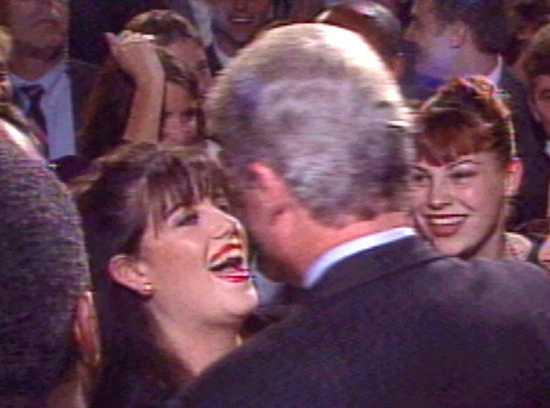
Bill Clinton had a plan to privatize Social Security, and it was in an advanced stage when the Monica crisis set upon him.

Monica saves Social Security - her weapon of choice: a cigar
His personal reputation, his presidency was at stake, and in one of the most fortunate of unintended consequences of his seedy administration, Social Security was spared. His sorry philandering ass was saved, and the fight to privatize Social Security was temporarily shelved.

It appears that Obama has a plan as well, and sadly for us, his personal habits appear clean. So we will have to hit the streets to save Social Security, and there is a big problem: Democrats will be busy watching the basketball as the gorilla mingles among them.

The plan is unfolding via a group called “America Speaks,”behind which lurks the Pew Charitable Trusts. They are running public forums.

Dress well, be civil, ask questions, present facts. (Drives them nuts!)
They most likely will try to make their top-down plan to privatize Social Security seem like our idea. We will be told that we have to scale it back, lower our expectations, and perhaps, maybe, well you never know … might have to privatize it.

When George W. Bush went after Social Security in 2005, he had his hat handed him. This time might be different, as the gorilla has put on his Democrat suit. Because President Obama is a Democrat, and because Democrats do not see gorillas when Democrats are in office, we could well be in deep trouble.

The faces change, but not the agenda
The reasoning behind the “crisis” in Social Security is specious. They merely add up projected expenses in the long haul, and revenue in the short run. Then they say that the program is “unsustainable.”

If one were to apply this financial model to any other government or corporate enterprise, whether it is the Iraq and Afghanistan wars, the space program, subsidies for oil and gas and sugar or the bailouts, none would pass. But Social Security is an egalitarian program that manages billions and billions of dollars. It is well-managed with low overhead. Not one Wall Street banker receives an obscene bonus from it. Therefore, it is targeted.

Politics in America is one scam after another. We get tired of fighting the corporate PR machine, we get lazy. But it takes fighters, and we need fighters most when Democrats are in office. That’s when the worst damage happens. The National Committee to Preserve Social Security and Medicare is one of many groups that are fighting this fight. There are others – join any or many, and remember that the best way to do politics in our country is away from the two corporate political parties.

They have a plan. This time, we need to be the gorilla.

Pew Charitable Trusts, Montana Logging Division

The following is a comment that Matt Koehler left on a post down below.

I had to chuckle a little when I read the comments from Mr. Gabriel Furshong, MWA’s Forest Jobs and Recreation Act Campaign Director, over at George Wuerthner’s excellent perspective piece on Tester’s bill over at NewWest.net titled “Tester’s Response Poor Strategy“:

Mr. Furshong stated:

“Wilderness philosophers from other states can postulate all they want about Montana politics – such chatter will never result in actual legislation to protect 500,000 acres of ground in the largest National Forest in the lower 48 states and create new jobs at Montana mills that have a record of stewardship best practices.”

You know what? Mr. Furshong’s dismissive comment is striking when compared with the fact that just this week the Senate’s Energy and Natural Resources Committee approved 26 bills establishing new Wilderness areas and dealing with other public lands issues. Those 26 bills were approved by the ENR Committee en bloc, by unanimous consent.

Somehow, Mr. Furshong's predecessors pulled this off!

Tester publicly promised in 2006 to protect Montana's roadless lands

Reader’s will recall that Senator Tester’s FJRA [Forest Jobs and Recreation Act] is currently before this same Senate ENR [Energy and Natural Resources] Committee. Sometime in May, the ENR Committee sent Senator Tester a draft revision of this bill, which his office shared with the collaborators. Once the media questioned Senator Tester about the ENR’s draft he proclaimed it “Dead on arrival.”

So now, on June 20, the Senate ENR Committee approved 26 bills dealing with Wilderness and public lands issues

Something I’d encourage Wilderness supporters to consider is the very likely fact that if Senator Tester and the collaborators (Mr. Furshong and MWA included) would have accepted the ENR Committee’s draft revisions when they were shared about a month ago, it too would have been approved by the Committee this week.

So despite Mr. Furshong’s claim that “such chatter will never result in actual legislation” it sure seems to me that MWA and the other collaborator’s insistence on mandated logging and motors in Wilderness might have cost all of us the opportunity to designate over 660,000 acres as Wilderness and get some good restoration and fuel reduction work accomplished as proposed in the ENR Committee’s draft.

Some details of the ENR Committee’s draft:

* It would protect over 660,000 acres in Montana as Wilderness. However, it doesn’t undermine Wilderness by allowing military helicopters to land in Wilderness or ranchers to ride their ATV’s in Wilderness, as Senator Tester’s draft allows.

* It drops the controversial and unprecedented mandated logging levels on the Beaverhead-Deerlodge and Kootenai National Forests. It adds language requiring that any project carried out under the bill must fully maintain old growth forests and retain large trees, while focus any hazardous fuel reduction efforts on small diameter trees.

* It would also establish a “National Forest Jobs and Restoration Initiative” that would “preserve and create local jobs in rural communities…to sustain the local logging and restoration infrastructure and community capacity…to promote cooperation and collaboration…to restore or improve the ecological function of priority watersheds…to carry out collaborative projects to restore watersheds and reduce the risk of wildfires to communities.” Much of this work would be carried out through stewardship contracting.

Senatorial candidate Jon Tester promised, before witnesses, that he would …work to protect all of Montana’s remaining roadless areas.” What we got instead is mandated logging, violations of the spirit of the Wilderness Act itself, and Baucus-style ‘rocks and ice’ wilderness designations. This is not a nuanced interpretation of what the candidate said versus what reality dictates to the Senator. It a broken promise.

Period.

Something should be done here about MWA’s name – perhaps a contest and a new name for this once-proud defender of Montana wild lands. Here are some suggest new names:

Pew Charitable Trusts, Montana Logging Division
Montana Facilitators Association
The Baucus (Jr.) Caucus
Collaborators Roundtable

Paul Richards pulled out of 2006 Senate race based on a Tester promise to protect roadless areas

Other names will surely occur to me later today …

Now we all know how long it takes for an honest farmer from Big Sandy, Montana, to transform into a Machiavellian and dishonest Washington DC politician. (Paul Richards a Boulder, Montana, former candidate for U.S. Senate)

Collaborators versus negotiators

Light green areas are remaining roadless lands
I was very active in Montana wilderness issues up until about ten years ago. At the time I withdrew, I was convinced that there would never be anymore new wilderness in Montana, and that worse than that, in the future we would be fighting to preserve what we had. I had visions of developers banging on the doors of national parks and existing wilderness areas. The motorbacks were just coming into their own, and were making “share the trails” demand much in the same way that smokers might demand to “share the air” in our restaurants. The idea of saving any of our then-roadless lands seemed out of reach.

The players were:

Sen Conrad Burns and his replacement, Jon Tester

Senator Conrad Burns: He was the focus for conservationists, as he was openly antagonistic towards wilderness, and easily adopted the posture of motorbacks that machines should go everywhere. He was a rallying point, and served the cause of preservation well by bringing various groups together in opposition.

Senator Max Baucus, faux bonhomme

Senator Max Baucus: He was the man who undermined any efforts to preserve additional lands. Industry had long lost interest in high and rocky lands and lightly timbered ones. Baucus gathered up all of these areas in his own Wilderness Bill, the “Rocks and Ice” Bill. Predictably, wherever there was serious movement at preservation, Baucus trotted out rocks and ice, and said “this or nothing”.
MWA Founders Ken and Florence Baldwin ... wherefore art thou?

Baucus was the real enemy, yet I will never forget John Gatchell’s words to me after the 1996 election, when Max won another term: “At least we still have Max.” Gatchell is the Conservation Director for the Montana Wilderness Association, a group with a proud conservation history and founded in 1957 by Ken and Florence Baldwin, and others.

Power is dangerous, a narcotic. Proximity to power changes a person, clouds the intellect and alters perceptions. (Wasn’t there some kind of trilogy about a ring or some such thing?) Max, nominally a “Democrat”, managed the conservationists as part of a larger strategy of keeping his left flanks in line and ineffective. (I wrote an op-ed published in the Billings Gazette in which I called him a “faux bonhomme,” literally a “pretended good fellow,” or “false friend.” That is the most dangerous kind of friend to have.

When Conrad Burns left office, we lost our rallying point. Jon Tester was an unknown quantity, but did make serious attempts to reach out to conservationists in his campaign. Many progressives adopted him, placing almost blind faith in his good will as a substitute for on-the-ground organizing. That’s a dangerous situation, as there are few answers inside politics. We were effective against Conrad Burns, literally immobilizing the development forces behind him because we were organized groups with common purpose. That organization stopped the political wheels.

Danger has come to fruition. Tester has set out to achieve what Burns never could – to split environmentalist forces, bring the loggers into roadless lands, and undermine the legal concept of “wilderness” that has guided us thus far. His Forest Jobs and Recreation Act is Baucus “Rocks and Ice” redux, with huge tracts of roadless lands given over to mandated logging. What wilderness it preserves is sullied by helicopter and ATV encroachment.

At the center of this controversy are two people from years past who might now be seen as “collaborators.” They are the aforementioned Gatchell of Montana Wilderness Association (not pictured), and Tom France of National Wildlife Federation’s Missoula branch.

Tom France of NWF: Collaborative participant
There are others, but these two are my focus, as they have seemingly traveled to the other side. (Gatchell’s 1996 statement of fealty to Baucus indicates that for him, at least, it was a short trip.)

George Wuerthner, among many others, is a new prominent voice for conservation in Montana, and has done serious writing on this subject. This piece, from New West, explores the different meanings of “collaboration” and “negotiation.” He gives and example of each:

Quincy Library Group in California Here local environmental activists joined with timber industry to craft a plan that called for logging up to 60,000 acres of the Plumas National Forest annually in exchange for protection of some old growth trees and small roadless areas. Like the Tester legislation, the Quincy proposal was hailed as an example of how collaboration had achieved a resolution to a long-standing stalemate.

However, other environmentalists, including the Wilderness Society, Sierra Nevada Forest Protection Campaign, and Sierra Club among others did not support more logging on the Plumas NF and they railed against the Quincy Library Group proposal. Environmental members of the Quincy group soon joined the timber industry in denouncing the anti-corporate giveaway activists.

The collaborationists adopted the goals of their opposition in an attempt to move the process forward. In so doing, they split from their own ranks and joined the developers, and as the Little Lamb followed Mary, were soon attacking conservationists. This is the Tester Process that Gatchell and France have fostered in Montana.

Steens Mountain National Monument in eastern Oregon: First, ONDA remained very up front that their goal was to end grazing–and they were not afraid to tell the ranchers, the Congressman, or anyone else that if they had an opportunity to eliminate grazing, they would go for it. Indeed, one of the things they negotiated successfully in the Steen Mountain legislation was the first legislated cow-free wilderness. Since they were clear in expressing that their chief goal was to protect wilderness and eliminate grazing, no one, including the local ranchers had any misgivings about their motives.

The ranchers went into the negotiations with their eyes wide open. They knew where [Oregon Natural Desert Association] stood on matters. They did not think ONDA lied or deceived them when they continue to lobby to remove cows from public lands, not only on Steens, but also throughout Eastern Oregon.

However, ONDA’s goal of livestock removal didn’t keep them from working with the ranchers either. By negotiation ranchers got some things they wanted too. They were able to consolidate their private lands by land exchanges with the BLM. Some received permit buyouts, and left the business altogether, but with a golden parachute. With these negotiations, the ranchers had some control over where wilderness designations occurred.

Wuerthner: Carrying on the Baldwin legacy

That is negotiation, with each side sticking to principles, but understanding that they must find middle ground. In the end, ranchers and ONDA walked away from the process, neither side having lost or gained everything, but having achieved primary goals. More important, their principles were not compromised and dignity was intact.

Sen Jon Tester has done what Conrad Burns could not do – he has divided the Montana environmental community, and has set the stage for to degradation of large tracts of Montana’s roadless lands. This is why I have consistently and stridently maintained over the years that we face far more danger form Democrats in office than Republicans.

Join AWR, donate, attend a concert, have some fun

I miss you Conrad. Your replacement is far, far more dangerous than you ever dreamed to be. (In wartime, don’t they shoot collaborators?)

Anyway, as old fighters fall by the road, new ones take their place. The battle goes on. At this time the fighters for wilderness are many, and my favorite group is called “Alliance for the Wild Rockies.” To this date, they have fought for their cause, stand ready to negotiate, and have never collaborated.