Of Natelson and Snowbirds

Rob Natelson put up a surprisingly shallow piece on health care over at Electric City Weblog. Here are his talking points (he’s responding to a Mike Dennison piece in Lee newspapers:

First: Pure single-payer means the government pays all the bills. If you hire a doctor on the side using your own funds because your desperately-ill child is on a waiting list and can’t otherwise get care, you are committing a crime. Few countries have such a vicious system. And countries, like Britain, that used to have purely “regimented national plans” (Mike Dennison’s phrase) are headed toward more mixed systems. (I’ll give an example in a future post.)

Second: As anyone who works in government knows, the costs as reported for government programs are nearly always understated. They often don’t include capital expenses. Or costs are kept down by deferring necessary longer-term investment (that’s why it has been so difficult to get certain kinds of procedures in Canada). And, of course, they never count the costs to the economy from the taxes necessary to pay for the system.

Third: Under “regimented national plans” the waiting lists generated in government programs are themselves a form of uncounted cost – because pain and death saves money.

Fourth: The U.S. has the most innovative health care in the world for a reason – that despite the fact that government and insurance companies dominate the system, they have not yet quite taken it over completely. More government control means, of course, less of that innovation. Another prospective cost.

Fifth: The cost in privacy and autonomy of government medicine can be staggering. (Remember the British Columbia lost health records scandal?) Are you worried about a few hundred prisoners at Guantanamo? That human rights problem pales before the prospect of several hundred million prisoners of government-controlled medicine.

I responded (how could I not?):

Well spoken for the 37th best health care system in the world! We’re 37! We’re 37!

1. All countries that offer universal care must ration and triage based on need. Less important procedures must wait. We’d be doing that here except that we ration based on money and don’t provide services to 47 million except in emergencies, and then only to stabilize, and not treat.

2. If the costs of Medicare, Medicaid, SCHIP and VA are “understated”, you’d better put up something better than “everybody knows”. How about “All the Helen’s in the world agree”?

3. The American notion that ‘ferners ‘ are on waiting lists for vital health care needs is mostly useful domestic propaganda. Yes, there are waiting lists for non-life threatening illnesses. We’d be doing that here if we took care of everyone. All countries ration – our system is based on 1) money, 2) access to employer-sponsored care, 3) access to government-sponsored care, and 4) good luck after that.

4. Most innovation (not all) comes from government sponsorship of outfits like NIH, colleges and universities. It is already government sponsored.

5. Medical privacy is now protected not by private companies, who are dying to share information so they know who to reject for coverage, but rather by government.

In the comment section, Rob reiterates the right wing talking point that excessive consumption (a moral hazard) is driving up costs:

In my view, phrasing the question in terms of getting more people insured misses the crux of the problem, which is too much insurance, not too little. We are not going to make medical care affordable again unless patients pay directly for most day-to-day care, in which case it will almost certainly be far cheaper than it is now.

There is a role of third-party payments in the system, but it should be the exception, not the rule — catastrophic events and care for the poor come to mind.

That’s a right-wing talking point – they have attempted to re-channel the debate from the high cost and unavailability of care into less important areas where they have financial interests waiting to accommodate us: HSA’s.

Finally, here’s a study, Phantoms in the Snow, from the late 1990’s that measure the incidence of Canadian “refugees” coming down to the states to take advantage of our health care system. The number is virtually negligible – far less than 1% in the survey. Of that small number, very few were actually coming here specifically for health care. Most were here incidentally (like “snowbirds”). Canadians routinely buy travel insurance policies when they come here due to our high prices, and those policies are designed to cover traveling emergencies, and not chronic conditions.

Some Canadians were here under contracts between Canada and the US to use procedures we have not available there or to ease their waiting queue.

The report’s conclusion:

Despite the evidence presented in our study, the Canadian border-crossing claims will probably persist. The tension between payers and providers is real, inevitable, and permanent, and claims that serve the interests of either party will continue to be independent of the evidentiary base. Debates over health policy furnish a number of examples of these “zombies”—ideas that, on logic or evidence, are intellectually dead—that can never be laid to rest because they are useful to some powerful interests. The phantom hordes of Canadian medical refugees are likely to remain among them.
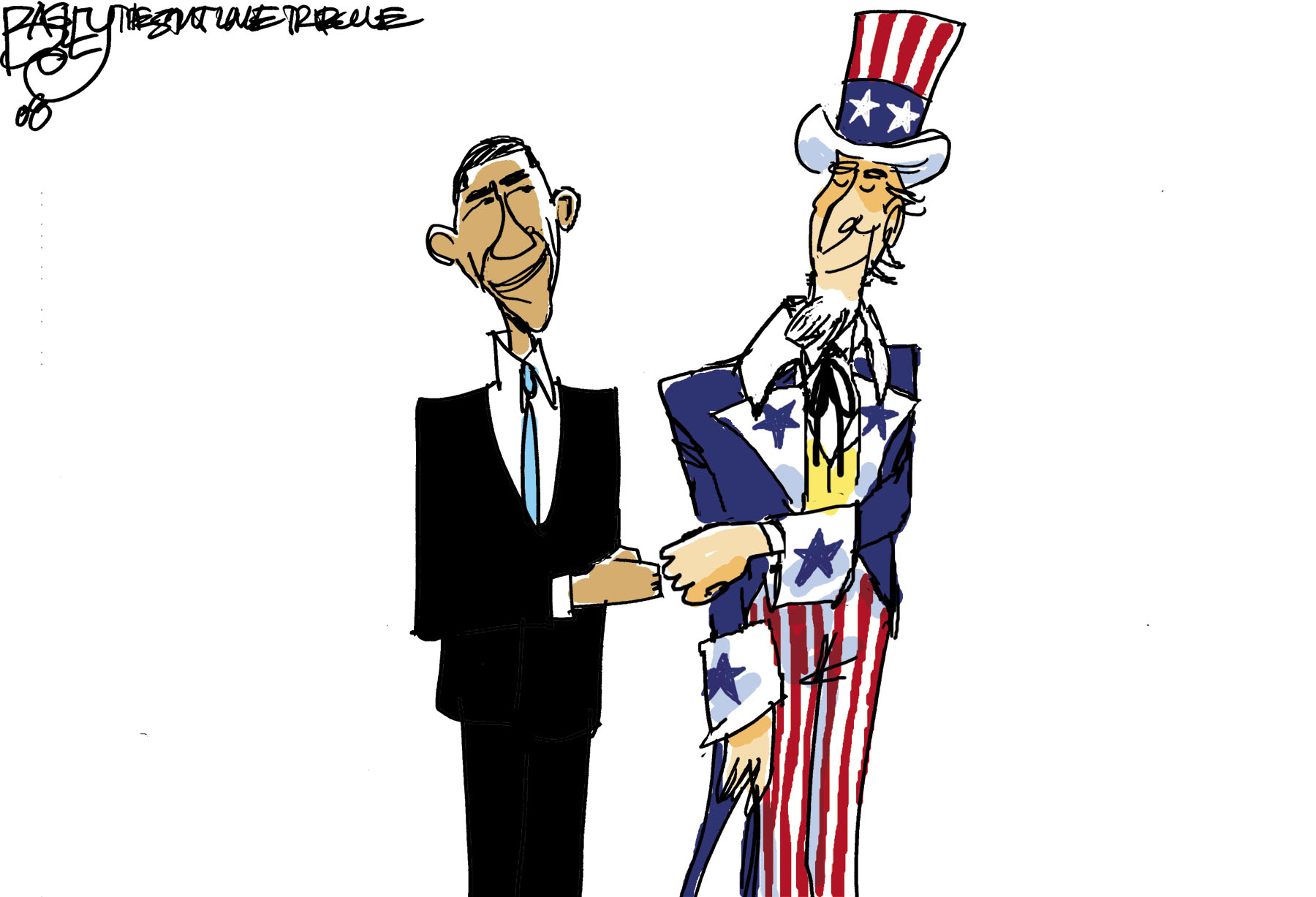
Max Baucus: Faux Bonhomme

Sen Max Baucus is an energy drain – that is – he sucks up all of the good energy of active Democrats, and makes sure that nothing comes of it. He also acts as assurance to uninvolved Democrats that they have someone in office looking out for their interests, so they fall asleep. I was deeply involved in Democratic politics back in the mid-nineties, and carry with me memories of Max’s supporters, clueless, and his staffers – beady-eyed followers. It was weird – staffers were not just loyal to Max, they were fearsome in their loyalty, more about Max than Democrats in general. They would actively try to steal volunteers from other candidates.

Bob directed me to a Mike Dennison Article in the Helena Independent on Max’s new health plan. It’s everything I’ve come to expect from Max over the years. A little bit, but not without a bow and a kiss on the ring of power.

Max’s plan is not totally without merit – it would expand coverage for Medicare, Medicaid, SCHIP and Indian Health Services.

If I understand correctly, my wife and I (age 58) would be allowed to buy into Medicare, and that should be cheaper than the plan we have now, MCHA. But since we are uninsurable by private insurers (preexisting conditions), letting me and others like me into Medicare will put additional strain on that already-strained system. Nonetheless, I’ve seen the care my Mom (and late-Pop) get from Medicare, and it’s excellent. I would not mind buying in.

Here’s where Max goes off the rails in a very predictable manner – he leaves the private health care system intact. If a person is unwillingly married to his job because he needs the insurance, he’s still stuck. He does nothing about the current employer-provided system, which is such a drain on companies like GM. Max mandates that we all have insurance, with varying degrees of support. All of that support would be funneled to private insurers. The big problem we have in this country – the hodgepodge of private insurance companies, each with their own multi-layered bureaucracies, each with their own profit requirements, would not only remain intact – it would be strengthened. If you think it’s bad now, wait until these private little tyrannies realize they are no longer threatened by single payer.

Baucus staffers say it would come close to universal coverage over several years, by expanding public programs and requiring everyone to buy health insurance. Still, that prospect relies on the private, for-profit insurance market to fill some big gaps — something it hasn’t done after decades of being in business.

Max says that that real reform, single payer or a true national health plan is “off the table” and “not politically feasible”. Even though that vast majority of the public wants it, the insurance companies don’t. We’re not a functioning democracy.

Welcome to Maxville. Everything good is usually down the road somewhere. He’s like gas station coffee – he only resembles the real thing.

And this is why Max Baucus is so bad for us. He always offers a little, seldom delivers, and when he does deliver, the biggest package with the biggest bow and shiniest wrapping paper goes to entrenched power. Max knows how to play the game.

Six more years of Max. I was one of the anonymous writers over at “Eyebrows Over Highbrows” – I thought it was a fun gag. I never took it seriously. Baucus had no serious opposition, and that allowed him to carry on being Max. Sigh. Montana needs a new Senator – a Democrat to replace Baucus. He’s been sucking our energy for too long.

Addendum Dennison’s Part II here – damn fine piece. Rob Natelson take him on here – hard to believe that a man as erudite and well-researched as Natelson claims to be merely repeats tired old canards, like “Under “regimented national plans” the waiting lists generated in government programs are themselves a form of uncounted cost – because pain and death saves money.

Is he aware of at least 18,000 Americans who die each year due to lack of health insurance coverage?

The World Will Crash Around Us

We’re so foolish –

Effective today, July 24, 2008, the federal minimum wage for covered nonexempt employees is $6.55. The federal minimum wage provisions are contained in the Fair Labor Standards Act (FLSA).

One of the jobs of the Federal Reserve is to keep worker insecurity high. People who are worried about losing their jobs aren’t likely to demand better pay. In fact, worker insecurity puts downward pressure on wages. In the low-wage sector, that downward pressure is ever-present, as there is usually a pool of unemployed workers to take the place of those who are currently working. Therefore, the woman cleaning your office building and the field worker straining over rows of strawberries are chained to the yoke, and have no hope of a better life.

For them, the only protection afforded comes from government in the form of minimum wage laws. Conservatives, who preach the religion of unfettered markets, despise minimum wage laws. They think the market ought to be left to its own in all areas, and that every market outcome, no matter how unpleasant, is the right outcome. To enforce a minimum wage, they say, is to create distortion, and that distortion will manifest in other ways, like loss of jobs as employers cut back, and in rising prices for basic goods that creates inflation, making goods and services more expensive work workers and thereby offsetting any gains in minimum wage.

The problem is, it doesn’t work that way, never has, never will. In the real world, the market easily absorbs minimum wage increases, as workers were probably underpaid anyway, so employers don’t cut back. Conservatives cannot offer up one laboratory where minimum wages have cause increases in prices or increased joblessness. Quite the opposite. Absent data, they merely pontificate on theory.

At the base of conservatives’ concern is the belief that labor costs need to be controlled, and that market forces, aided by the Fed, ought to be the sole determinant. They show no such inclination to control other costs – rent and food and energy are constantly increasing, yet there is no effort to rein in those costs. We merely have to adapt. But with labor, increasing costs are scary, and Wall Street has heart palpitations with every increase in employment numbers.

Minimum wage laws truly benefit the little guy, and every worker up the line gets a bump when MW goes up. Rising wages is a good thing – more money for the working and middle classes is a positive outcome. If it’s a zero sum game, then we’re spreading the wealth by allowing workers to keep more of the wealth their labor creates. But if low-wage earners turn around and spend their new-found wealth on the basics of life, the money comes back to us in multiples.

If every conservative who preached to us about minimum wage had to live for one week on it, they would very quickly set it at $20 and index it to inflation. They are truly out of touch.

On Strawmen and Living Wages

We had a tiny little debate on minimum wage over at Craig’s mtpolitics.net. It didn’t amount to much, but I ran across the following argument, posted by David, who runs a blog called Better Living Through Blogging :

My answer to the minimum-wage idjits: if increasing the minimum-wage to $6.15 per hour is good, then surely increasing it to $25 per hour is better. And by that logic, increasing it to, say, $100 per hour would be GREAT!

Right?

Oh, but that’s not what you meant? That’s not reasonable?

Well then what makes your figure of $6.15 per hour (or any other mandated wage) reasonable?

It’s an easy argument to answer – living costs exceed wages provided by a $5.15 per hour wage. Low-wage workers are disadvantaged in many ways, one of which is that there are, in many markets, a surplus of them. When that happens, downward pressure is exerted on wages, and people wind up working not for $5.15 per hour, but $4.00 per hour, $3.00, $2.00 – David likes to run his argument out to extremes, so let’s take an extreme case – $1.50 per day, as in places like Vietnam, where they make Nike sneakers.

In other words, there’s no correlation between living costs and wages paid low-skilled workers. The wage they can earn in a surplus labor market is too low to live on. That class of people experiences daily something that most of us are immune to – the free market. It’s not a pretty thing.

So, given the ugliness of market outcomes, we as a society elect to step in and set an arbitrary standard – there shall be no wage less than $6.15 per hour in the state of Montana. We didn’t say $25 or $100 per hour because a minimum wage that high would be absurd. That’s a strawman argument. We said $6.15 because we can easily absorb such a low minimum. In fact, we could do better. The people who worked so hard to get the wage passed surely knew that even $6.15 was not high enough, but politics is the art of the doable.

Question now for David, who put forth the argument above. The standard conservative response to a higher minimum wage – to any minimum at all, is that there’s no such thing as a free lunch – that whatever we gain in wages we lose in the number of people employed. Minimum wage has been raised in many states over the years while the Federal Government has dallied. Please, if you would, David, give an example of a state where minimum wage increased and employment in the low-wage sector decreased.

Clock’s running. Tick tock tick tock …..

There’s talk now of a higher mandated minimum of over $7.00 per hour coming out of Washington in the wake of the election landslide. It’s a good wedge issue, and if Bush were to veto it, his approval ratings would plummet. (Just kidding.) But Democrats have an opportunity here to do something that will truly help their supposed base. Let’s hope they have it in them.

Five and One-Half Utopias

Years ago I read an article so stimulating that I copied it and filed it – “Five and a Half Utopias” by physicist Steven Weinberg. In it, he disputes our tendency to idealize our human pursuits, and specifically disassembles five utopian ideals – bad thought habits, I suppose. They are 1)free markets, 2) rule by the best and brightest, 3) religious, 4) green, and 5) technological utopias. (The “half” utopia is one that he himself idealizes, the Civilized Egalitarian Capitalist Utopia.)

I insert below part one, the free market utopia, as we seem to spend so much time going around about it here. The entire article is equally riveting.

Here’s Weinberg:

Free Market Utopia

Government barriers to free enterprise disappear. Governments lose most of their functions, serving only to punish crimes, enforce contracts, and provide national defense. Freed of artificial restraints, the world becomes industrialized and prosperous.

THIS style of utopia has the advantage of not depending on any assumed improvements in human nature, but that doesn’t mean we have to like it. If only for the sake of argument, let’s say that something (productivity? gross national product? Pareto efficiency?) is maximized by free markets. Whatever it is, we still have to decide for ourselves whether this is what we want to be maximized.

One thing that is clearly not maximized by free markets is equality. I am talking not about that pale substitute for equality known as equality of opportunity but about equality itself. Whatever purposes may be served by rewarding the talented, I have never understood why untalented people deserve less of the world’s good things than other people. It is hard to see how equality can be promoted, and a safety net provided for those who would otherwise fall out of the bottom of the economy, unless there is government interference in free markets.

Not everyone has put a high value on equality. Plato did not have much use for it, especially after the Athenian democracy condemned his hero, Socrates. He explained the rigid stratification of his Republic by comparing society to the human soul: the guardians are the rational part; the soldiers are the spirited part; and the peasants and artisans are the baser parts. I don’t know whether he was more interested in the self as a metaphor for the state or the state as a metaphor for the self, but at any rate such silly analogies continued for two millennia to comfort the comfortable.

In the course of time the dream of equality grew to become an emotional driving force behind utopian thinking. When English peasants and artisans rebelled against feudalism in 1381, their slogan was the couplet preached by John Ball at Blackheath: “When Adam delved, and Eve span, who was then the gentleman?” The French Revolution adopted the goal of equality along with liberty and fraternity; Louis-Philippe-Joseph, duc d’Orl�ans, wishing to gain favor with the Jacobins, changed his name to Philippe-Egalit�. (Neither his new name nor his vote for the execution of Louis XVI saved the duke from the Terror, and he joined the King and thousands of other Frenchmen in the equality of the guillotine.) The central aim of the socialists and anarchists of the nineteenth and twentieth centuries was to end the unequal distribution of wealth. Bellamy followed Looking Backward with a sequel titled simply Equality. It is a cruel joke of history that in the twentieth century the passion for equality has been used to justify communist states in which everyone was reduced to an equality of poverty. Everyone, that is, except for a small number of politicians and celebrities and their families, who alone had access to good housing, good food, and good medicine. Egalitarianism is perhaps the aspect of utopian thinking that has been most discredited by the failure of communism. These days anyone who urges a more equal distribution of wealth is likely to be charged with trying to revive the class struggle.

Of course, some inequality is inevitable. Everyone knows that only a few people can be concert violinists, factory managers, or major-league pitchers. In revolutionary France the ideal of equality soon gave way to the carri�re ouverte aux talents. It was said that each soldier in Napoleon’s army carried a marshal’s baton in his knapsack, but no one expected that many soldiers would get to use it. For my part, I would fight against any proposal to be less selective in choosing graduate students and research associates for the physics department in which I work. But the inequalities of title and fame and authority that follow inexorably from inequalities of talent provide powerful spurs to ambition. Is it really necessary to add gross inequalities of wealth to these other incentives?

This issue cannot be judged on purely economic grounds. Economists tell us that inequality of compensation fulfills important economic functions: just as unequal prices for different foods help in allocating agricultural resources to produce what people want to eat, so unequal rewards for labor and for capital can help in directing people into jobs, and their money into investments, of the greatest economic value. The difference between these various inequalities is that in themselves, the relative prices of wheat and rye are of no importance; they only serve the economic function of helping to adjust production and resources. But whatever its economic effects, gross inequality in wealth is itself a social evil, which poisons life for millions.

Those who grew up in comfortable circumstances often have trouble understanding this. They call any effort to reduce inequality “the politics of envy.” The best place for the well-to-do to get some feeling for the damage done by inequality may be American literature, perhaps because America led the world in making wealth the chief determinant of class. This damage is poignantly described in the novels of Theodore Dreiser, who grew up poor during the Gilded Age, when inequality of wealth in America was at its height. Or think of Willa Cather’s story “Paul’s Case.” The hopeless longing of the boy Paul for the life of the rich drives him to give up his whole dreary life for a few days of luxury.

Another thing that is manifestly not maximized by free markets is civilization. By “civilization” I mean not just art museums and grand opera but the whole range of public and private goods that are there not merely to help keep us alive but to add quality to our lives. Everyone can make his or her own list; for me, civilization includes classical-music radio stations and the look of lovely old cities. It does not include telemarketing or Las Vegas. Civilization is elitist; only occasionally does it match the public taste, and for this reason it cannot prosper if not supported by individual sacrifices or government action, whether in the form of subsidy, regulation, or tax policy.

The aspect of civilization that concerns me professionally is basic scientific research, like the search for the fundamental laws of nature or for the origins of the universe or of life — research that cannot be justified by foreseeable economic benefits. Along with all the good things that have come from the opening of free-market economies in Eastern Europe, we have seen the devastation in those countries of scientific establishments that cannot turn a profit. In the United States the opening of the telephone industry to free-market forces has led to the almost complete dismantling of pure science at the Bell Laboratories, formerly among the world’s leading private scientific-research facilities.

It might be worthwhile to let equality and civilization take their chances in the free market if in return we could expect that the withering of government would serve as a guarantee against oppression. But that is an illusion. For many Americans the danger of tyranny lies not in government but in employers or insurance companies or health-maintenance organizations, from which we need government to protect us. To say that any worker is free to escape an oppressive employer by getting a different job is about as realistic as to say that any citizen is free to escape an oppressive government by emigrating.

From another section of the piece, on a utopian vision he supports, the Civilized Egalitarian Capitalist Utopia:

We are in the process of giving up our best weapon against inequality: the graduated income tax, levied on all forms of income and supplemented by taxes on legacies. A steeply graduated income tax, if accompanied by generous allowances for the deduction of charitable contributions, has another virtue: it amounts to a public subsidy for museums, symphony orchestras, hospitals, universities, research laboratories, and charities of all sorts, without putting them under the control of government. Oddly, the deductibility of charitable contributions has been attacked in whole or in part by conservatives like Steve Forbes and Herbert Stein, even though it has been a peculiarly American way of achieving government support for the values of civilization without increasing government power.

Anyway, I found the piece to be fascinating, in January of 2000 in Atlantic Magazine, and now. And if you have taken the time to read this far, here’s a reward for your troubles – a 74 minute discussion between Weinberg and biologist Richard Dawkins on just about everything. (It’s a Google video – I hope you don’t have to be logged in to Google to view it.)

A Real S.O.B.

From Murial Kane of Raw Story:

A new book about media mogul Rupert Murdoch, whose News Corp. owns Fox News, is to be released next week. Its most sensational revelations involve what the author describes as Murdoch’s loathing for leading Fox commentator Bill O’Reilly.

Politico received a pre-publication copy of Michael Wolff’s The Man Who Owns the News and reported on Friday that Murdoch is not only embarrassed at times by his ownership of Fox News, but that he “absolutely despises” O’Reilly, who is that network’s top-rated personality.

Moral Hazards

The 1990’s saw an attack on Medicare from the right wing – said Newt Gingrich, the program was “Soviet-style health care, too bureaucratic, too centralized, too dominated by government.” Gingrich is a smart man, but is blinded by ideology. Anyone who can compare private health insurance to government-run and say the latter is “too bureaucratic” is missing the big picture.

The primary thrust these days from the right are HSA’s – health savings accounts. The objective is to counter what insurers call a “moral hazard” – the idea that people use too much health care when it is provided by others. HSA’s force people to save for their own care, making them cautious about spending, thereby making only medically necessary expenditures.

HSA’s are appealing to younger, wealthier people. These people have fewer medical problems, and are attracted to the idea that they can accumulate cash in an IRA-like fashion that could later be converted to an IRA account. But medical costs are like the angel of death hovering over all of us, affecting only a few at a given time. A major medical problem quickly wipes out an HSA, and the owner becomes part of the larger scheme again. The overall thrust of HSA’s is to segregate the population into sick and healthy, forcing larger costs on the sick, negating the benefits of large insurance pools of healthy and unhealthy alike. That’s a moral hazard.

HSA’s face another moral hazard – the fact that financial institutions are drawn to the deposit and fund-management aspects of the program. Their main objective is to build up deposits, but HSA’s also offer opportunity for fees for account processing. As with mutual funds, these fees draw down asset accumulation and income stream over time – a subcommittee of the Senate Finance Committee found that mutual funds on average lose 26% of their accumulation to fees. (Social Security drain: 3%.)

People do tend to spend less on medical costs when they are dependent on HSA’s. The problem is that most of us don’t have a crystal ball, and don’t know what’s important, what is not. HSA’s end to decrease the chance for early detection, meaning later and more expensive treatment of diseases and conditions. Furthermore, poor people are most likely to scrimp on expenditures, meaning that they would, as with the current insurance system, get the short end of the stick.

The above are condensed thoughts from Jill Quadagno and J. Brandon McKelvey from an essay entitled “The Transformation of American Health Insurance”, not available on the web. (The 26%/3% figures come from a Sen Max Baucus aide on the Senate Finance Committee whose name eludes me. He was here in Bozeman to address seniors are part of the Wonderlust program.) Here’s an interesting excerpt:

In the past few years, Congress has enacted measures that have given private insurers a larger role in Medicare, most recently with the Medicare Modernization Act of 2003, which created Medicare Advantage, a private insurance option. There is already evidence that inserting private insurance into a social insurance program exposes beneficiaries to the risk of abuse. The private insurers who run Medicare’s new drug benefit program and offer other private insurance options encouraged by the Bush Administration have used deceptive sales tactics and improperly denied claims to thousands of beneficiaries. The problems include improper termination of coverage for people with HIV and AIDS, huge backlogs of claims and complaints, and a failure to answer telephone calls. In 2007, Medicare imposed more than $770,000 in fines on eleven companies for marketing violations and for failing to notify beneficiaries about changes in costs and benefits in a timely fashion. Many of the marketing abuses occurred in sales of the Medicare Advantage product.

Sounds like we need to deregulate.

But seriously, folks, private insurers and patients are at odds with one another, one seeking health care, the other benefiting only when that care is denied. It’s a system in conflict with itself, and doomed to fail. Yet it is the only one that free-market types can fathom for us.

It is probably best to jettison the free-market types. They are a moral hazard.

For the Underemployed

Here’s a way for the unemployed to pass the time – the 100 greatest movie characters of all time. You have to hit them one by one, and I do think that Dr. Emmett Brown (76) should be 43, and #75, Marge Gunderson (Frances McDormand in Fargo) should be more like 28, but it’s a fun list. Here are the top ten:

10: Don Vito Corelone
9: Ellen Ripley
8: Captain Jack Sparrow
7: The Dude
6: Indiana Jones
5: Dr. Hannibal Lecter
4: Han Solo
3: Heath Ledger as “The Joker”
2: Darth Vader
1: Tyler Durden (Brad Pitt in Fight Club)

I sure didn’t see that #1 coming. Here’s some others – 91: Scarlett O’Hara; 74: ET (I did not know ET’s voice was done by Debra Winger); 70: Atticus Finch; 55: Lt. Frank Drebin; 53: Luke (Jackson – not Skywalker); 46: Anton Chugurh – the best villain to come along since Hannibal Lecter, IMO; 34: Rocky; 27: Daniel Plainview (I get depressed just thinking of that movie); and #23: Harry Callahan.

Oddly missing: Jake LaMotta, Rambo, Rhett Butler, Dorothy, Jim Stark, and Ray Kinsella – some very memorable characters.

It’s a clickathon – a good way to sell banner ads. But fun.

Professions and IQ

The chart below represents IQ spans for various professions. My profession, accounting ranges from 92 to 123 or so. My son’s profession, high school teacher, has the same range. My brother’s profession, minister, has the same range. At the high end are college professors and medical personnel. (No wonder most Phd’s are liberals.) Scientists score high, as do lawyers.

To use this chart: Find your profession. Go to the far right end of the bar. That’s where you belong – at the very top of your profession.

h/t: Dr. Peter Rost

iq-range-occupations1