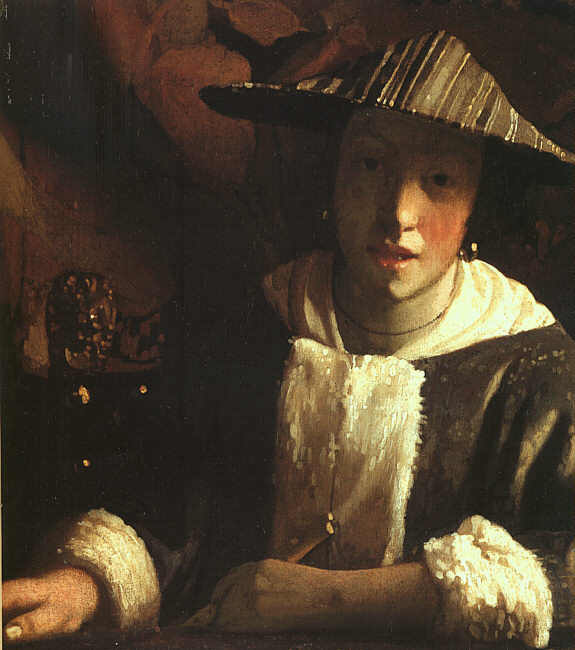
Vermeer the Forger, Part Three

Vermeer’s Visitors
There are two brief diary accounts of contemporaries meeting Vermeer: Pieter Teding van Berkhout (above) and Balthasar de Monconys (below). The former mentions seeing several Vermeer paintings of which their chief virtue was their “most extraordinary and curious perspectives”. Van Berkhout made two trips to see Vermeer originals; the first appears to have been to Pieter Van Ruijven’s digs to survey his collection*. There is no mention of a purchase, which is troubling because van Berkhout was a prominent collector. Odder still is the second diary entry, written a little more than a month after the first visit, which reads almost as if van Berkhout doesn’t recall meeting Vermeer that first time. It’s possible that Vermeer was not in attendance if van Berkhout did meet with van Ruijven the first time around.
*I’m convinced that Van Ruijven owned Vermeer’s entire output, even that which was yet to be painted. Vermeer worked for, was essentially indentured as an artist to, Van Ruijven; and that is why Van Ruijven’s son in law’s estate had over twenty Vermeer originals put up for auction in 1696.

Continue reading “Vermeer the Forger, Part Three”

The Second Restoration

This blog was started in 2006 as a joint project between my son and I – he wrote for a year or so and then moved on, leaving it to me. I found it a nice outlet. Each morning my mind is awash in ideas, some even mildly interesting. So I kept at it, but did not understand how the concept of “blogging” had been captured by the two parties and was being used as a mechanism to keep the herds inside the fences. To my dismay I was removed from the links of party-affiliated blogs and banned from commenting. My manners were less harsh and my insight far better than people who remained loyal to the parties. Still, isolated and ignored in all the right places, I kept at it. It was something to do.

Continue reading “The Second Restoration”

Vermeer the Forger, Part Two

Pieter van Ruijven (1624-1674) loaned Vermeer two hundred guilders on or about 1657. There is no certainty as to why but I will construct an unverifiable narrative that breaks no laws of the physical universe nor confounds human nature within the context of the threadbare facts known of these two men’s lives. Van Ruijven had money; not massive amounts, but investment money. He played angles, something of a gambler, but a reasonably legit business man for the most part. One of his financial concerns was art dealership. The laws of the land forbade van Ruijven from actually dealing in art. The kind of man he sought out to front for him was financially brittle, with many mouths to feed and open to turning what skills and access he had to broader opportunities. This of course was Vermeer, guild member and legal art dealer. So too, he could handle a brush. The pairing allowed for van Ruijven to gain access to paintings and for Vermeer to exercise his photographically accurate rendering skills to copy said paintings.

Continue reading “Vermeer the Forger, Part Two”

Vermeer the Forger (?)

Vermeer the Forger- Part One

(As a change of pace, I want to post a short six part series that I had previously posted several years ago when attempting a second blog. Perhaps a half dozen bots and a couple of stumble-upons were exposed to this, so it is still, relatively speaking, factory fresh. I feel it is germane to the ongoing discussions here at POM as it is an exercise in clear-eyed interpretation of imagery. It concerns the output of the Dutch master, Johannes Vermeer, whose paintings are the most sought after across all of planet Earth, though I am at a loss as to why.)

This has bothered me for a long time and so I am finally going to try and put this somewhere other than my head. Guided by a generally agreed upon chronology, I will use the paintings as a stepping stone to get a handle on how Johannes Vermeer of Delft, Holland (1632-1675) managed to feed ten surviving children, a wife and a mother-in-law on thirty some odd paintings, almost none of which sold while he was alive.
A few basic facts: Vermeer’s mother in law, Maria Thins, an assumed source for most of the household revenue, was not as wealthy as most claim. She owned rented farmland that did yield some steady income. She was Catholic and so restrained to a degree inside Protestant Holland. The fact that several debts were outstanding at Vermeer’s death strongly suggests that the family, at best, had decent credit. The fact remains that Vermeer was in need of work and that he possessed one marketable skill: The ability to render objects and persons, as well as preexisting paintings by others, with remarkable accuracy.
Developing a Technique

Continue reading “Vermeer the Forger (?)”

Commenting Policy

[This Post is written to serve as a reference for people, and will be linked in the right.]

It was never our idea to have a “commenting policy.” It was forced on us by outsiders.

We do not care what you think; we believe in exchange of ideas, even fiery exchanges. People who passionately believe things often express those things in an aggressive manner, and that can offend other people. We don’t care. This is not a nursery school. No one gets sent to the principal’s office. No one will ever be censored for passion, language, assertiveness, intelligence, or even stupidity or ignorance.

That is your business. We leave you in peace to comment as you see fit. Yes, we think it is important to be polite, but have some fun too! We are not hall monitors.

However  there are trolls out there in abundance, and disinfo agents. Their job is to undermine good and honest work in any way possible. One defense we have is to quarantine new commenters – your first comment here will not appear until reviewed. Once you pass that small hurdle you are set free.

In addition, certain theories and ideas are often used as stalking horses to achieve other purposes, what we call “blackwashing.” Mere introduction of these into a comment thread can hijack it and create a debate whose real intent is to associate this site with ideas that are likely to make most people reject anything else we have to say out of hand. Such ideas can be used by agents to discredit us.

Intelligence agents and their employees use these memes to take all of the good and conscientious research done by honest people, and discredit it by association with idiotic or unpalatable ideas. This is not a statement about the validity of these ideas, but simply a statement that we do not wish this blog to be associated with them. Consequently, we ask that you cooperate with us by not broaching the following subjects on this particular forum.  (There are plenty of other forums available besides ours where you are free to discuss them.)

These topics are:

  • Flat earth.
  • Illuminati.
  • Reptilians.
  • Transgender
  • Gematria
  • “Fake news.”
  • Paul is Dead
  • Mandela effect.
  • Dallas Goldbug.

We understand that people will stumble on to those topics without having read this policy, and so we will be patient. Once an above topic is introduced that we feel runs counter to the spirit of this request, we will ask that you come here to read about this policy. A second offense will result in your comment being deleted and a warning. A third offense will result in banning.

Bans are not permanent, maybe a week or so to calm down. Forgiveness is a virtue. Alongside patience, it allows all of us to develop our brains as we try to move forward in understanding this goofy planet.


CGI Videos in Social Media Passed Off as Real

This is a funny topic, and not in a ha-ha sense. It’s downright strange and I hope to get lots of talk in the comments section on why they are doing this (from real posters, preferably).

Let’s start with this video that has been all over social media lately and reported by CNN. Note that it’s 47 seconds long.


For those that didn’t catch it, he’s standing in front of a green screen and punching a CGI kangaroo. Maybe my September Clues days have sharpened me up, but I saw it immediately. I’d also like someone to tell me what video camera they were using to record this when every smartphone in the world takes high quality footage. Below is the screenshot from the Youtube search, how did they get such a high quality shot from such a poor video?

Continue reading “CGI Videos in Social Media Passed Off as Real”

Vintage Psy-opera: Ray Chapman

(This post is conjecture born of extreme prejudice towards all forms of professional media, which forever has attempted to convince the public there is a distinction between their clearly labeled fictions and the non-fiction they take pains to present for our emotional benefit and critical understanding- What they give us is ALL fiction, even when using verifiable facts- But, if in the reader’s estimation that is a delusional position on my part, then consider this post satire, if that makes you feel better- I, like professional media, am not under oath)

I have to admit I laughed out loud when I realized what the punch line to this post was going to be: Ray Chapman, the star shortstop of the Cleveland Indians from 1912 to 1920, and arguably the greatest bunter in major league history, used his bunting skills on August 16, 1920, in collusion with New York Yankee pitcher Carl Mays, to fake his own death in front of thousands of fans at one of the most fabled sports venues in American history, the Polo Grounds in the Bronx, New York City- Officially, Ray Chapman is the only player in Major League Baseball history to be killed playing the game- Continue reading “Vintage Psy-opera: Ray Chapman”