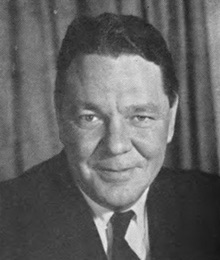
Hale BoggsThe Warren Commission, established to investigate the murder of John F. Kennedy, was comprised of men like Allen Dulles and Gerald Ford, a spook and a dullard. It did not do any investigating, but rather relied on the FBI and CIA for information, and so was (willingly) led down a garden path to a preordained conclusion.
One member, who was a dissident, was Louisiana Congressman Hale Boggs. The name is probably not familiar, but readers, especially liberals, might know his daughter, NPR’s Cokie Roberts.
Boggs was hesitant to sign the Warren Report but was under enormous pressure. His wife Lindy said he’d wished he’d never been on the commission and wished he’d never signed the report. He told an aide that “[J Edgar] Hoover lied his eyes out to the commission – on Oswald, on Ruby, on their friends, the bullets, the guns, you name it.”
Hale Boggs’ small airplane disappeared in Alaska in 1972 and his body was never found. It was probably murder, but with no plane and no body, there’s no case. Small planes are deadly for dissidents of all types in this country. (The Kennedy family has suffered six small plane crashes, five of them fatal.)
That’s all old news. Here’s a “cosmic coincidence,” something that simply defies imagination and explanation, but really is just a coincidence. On his fatal Alaska trip, Boggs was driven to the airport by a young future president, Bill Clinton.
We had some damage to our roof last year due to a hail storm, and are looking for a contractor for repairs. It reminded me how useless the search engines have become for … searching for stuff. The shills, hucksters, carnival barkers have taken over. The same companies turn up again and again in various forms because they paid for that result.
Gone are the days when a search for a business yields an honest search result.
Back a few years when I was still advertising for business, I was offered a deal where my name would appear at or near the top of page one for anyone looking for a CPA in our area. I asked how that could work when there were hundreds of others being offered the same deal. I did not get a straight answer – these are, after all, hucksters. The real answer was the search engine results are tailored to individuals, so that if I used my computer to test search their promise, my computer would yield … me. It was a scam. What’s new?
Thank you, wonderful free market, for taking the best thing to come along in our lifetime, the search engine, and turning it into crap. We finally found a list of reputable roofing contractors, and here is how we did it: We asked our insurance company to provide us with names. That was the only way to break through the clutter – we had to bypass the Internet.
Search engines stopped working once the marketing people got their busy little fingers into them.
Years ago we were all being plagued by pop-up ads, so much so that the television news people even reported on it. A TV story I saw ran down some of the ads to an agency in New York. They asked a gal working there about the annoyance factor. She said, and I quote: “Well duh! It’s our job to get your attention.”
The reporter then turned to the camera, smiled and winked at us, took out a gun and put a bullet in her brain. He was never prosecuted. Everyone realized it was the right thing to do.
(By the way, I am aware of the irony of little pop-up ads appearing in the Bill Hicks piece above. They know we hate them. They are just taunting us.)
Swede reminded me in the comments below yesterday’s post that coincidences just happen, and I should just accept that or something is wrong with my mind. Sigh.
Indeed they do. I’ve had some crazy ones. For instance, when we lived in Bozeman our neighbors up the road, Mark and Cathy, asked if I was related to Tom Tokarski. Indeed I was, as my brother at that time lived just down the road in Livingston. But they were talking about another Tom Tokarski, one who was their neighbor in Indiana and who was a citizen activist fighting to stop the building of a road though a local undeveloped area.
What are the odds, with maybe five Tom Tokarski’s in the country, that Mark and Cathy would be neighbors with one in Indiana, and then move a thousand miles away to be neighbors with the brother of another one in Montana? Very long indeed, but just one of those things. We have all had coincidences like that in our lives.
In the posts linked above, I am not talking about that, but rather the statistical likelihood of related coincidences. When coincidences have an event or person or place in common, we can apply some basic math to determine probability. It’s the logic of the coin toss, that’s all.
Please do go read those posts if you are having trouble understanding why, for instance,
Charles Peirce was able to detect that a will was a forgery, or
Why it is extremely unlikely that FOUR hijackings would be successful on a given day, or
It is so unlikely that a hijacker’s passport would survive and be found in the rubble even as no parts of the plane survived, or
That the surveillance system at the Pentagon, along with the national air defense system, would go haywire on the very day that Vigilant Guardian, the biggest national air defense military drill of the year was running.
(I have not yet mentioned the seventeen military and civil defense drills that were running on 9/11/2001, and how they were intricately connected to the events of that day.)
In other words, if you don’t have a basic understanding of probability, this won’t register with you. If you do have that understanding, it will trouble you.
In the previous post I discussed the extreme unlikelihood that the “Naudet Brothers” would to happen to be in position to catch high quality video of the first “plane” hitting the Pentagon. This happened even as no other citizen of that great city managed to put their cell phone in the air and take even one bad photo of that event that day.
Now we need to take a look at the other side of that coin, the extreme set of circumstances where a building with a highly trained and professional security force and scores of cameras always operating … failed. This is as unlikely as the other event, so that I choose to call it the “Reverse Naudet Effect.” The Pentagon is protected by rings of redundant security, sophisticated anti-missile equipment, and cameras everywhere. The cameras operate 24/365, and are routinely inspected and tested to be sure they are working properly. The images they take are reviewed, catalogued and stored.
On 9/11 everything failed at once, except this:
I don’t mean to be rude, but I want to administer atrial fibrillation to the cranial area of the American public. I have to ask the question: People, what the hell is wrong with you?
The coincidence which has occurred here must have had its origin in an intention to produce it. It is utterly repugnant to sound reason to attribute this coincidence to any cause but design. (Benjamin Peirce)
Please review here for a simple example of probability as demonstrated by coin toss, and here for a more complex demonstration of the use of probability logic to show how certain events cannot possibly be coincidental.
This brief video clip, now called the “Naudet Film,” appeared first on September 11, 2001. It claimed to be evidence of a plane hitting the North Tower of the World Trade Center, even though no plane is seen. Like everyone that day, I was doe-eyed and ate it up. It did not occur to me to question its authenticity.
It does not take much critical examination to show that the Naudet film had to have been staged. It is high quality, focused, and the object of our attention is neatly framed by buildings on either side. Many things had to come together to produce such a film highlighting seventeen seconds of a major crime, to wit:
Jules Naudet had to be outdoors, and not indoors at the moment the event happened. (Almost all New Yorkers at any given time are indoors or in their cars or on public transportation.)
He had to be in a place that had a clear and unobstructed view of the Twin Towers. (Such views in the canyons of Manhattan are unusual.)
He had to be using high quality video equipment at that time.
His view had to be of the north side of the building that was hit, and not any of the other three sides.
Naudet had to be free of moving vehicles and pedestrians to be able to work without interference.
He had to be with people who had the legal power to block off the intersection.
His unobstructed view had to be of the north tower, and not the south, which presented three more viewshed possibilities for an errant aircraft that day.
A gas leak (officially listed now as a false report) had to be phoned into the New York Fire Department at the intersection that provided the view.
There had to be a compelling reason for Naudet to film an uninteresting event such as FDNY response to a gas leak.
His camera had to be positioned at a place in the large intersection where he could easily shift the camera view to pick up the event.
The video of the event is precise and the view centered and the object in focus. He had to be very lucky to make a quick maneuver and get such a result.
After hearing the noise of an aircraft or missile he quickly moved the camera to focus on the north tower, which does not seem the normal reaction to a loud noise. (Three firemen react to noise and look up, but we do not know if is to the noise we hear on the sound track, which can be easily manipulated.)
In sum total, there were too many coincidences. The event was staged, and Naudet was positioned with foreknowledge that there was going to be an explosion in the north tower.
Leslie Raphael has done far more work on this event, and I credit him with the content of the bullet points above. But he is far more thorough, and has in fact come up with a list of 69 happenstance circumstances that had to have been in place for Jules Naudet to enjoy his brief moment of fame. In going over the list, I don’t always comprehend his reasoning, and thought maybe one or two of the 69 coincidences were duplications, but if the list were only the twelve listed above, it is enough to conclude that the Naudet film was a staged event.
Again, if indeed this event was staged and done with foreknowledge, and it is utterly repugnant to sound reason to conclude otherwise, then what are the implications?
The Howland Will Forgery Trial is a very interesting case involving Charles Peirce (pronounced purz). Louis Menand wrote about him and others in a wonderful 2001 book, The Metaphysical Club.
Peirce was involved in the 1868 Howard Will Forgery Trial, and that case is useful here as I try to demonstrate how illogical are the official stories of major crimes of our times. Please refer to this post for a simple exposition of the logic of the coin toss in analyzing observed phenomena.
Anyone interested in Howland (Robinson v. Mandell)can read about it in depth, and I will treat it briefly here. Sylvia Ann Howland died and left a large amount of money to various heirs and legatees. Any residual was to go to her niece, Hetty Robinson, who stepped in with an earlier will. Attached to that will was a letter dated later than the existing will that canceled all the other bequests. It was purportedly signed by Howland, and that was where Peirce entered.
Each of us sign documents regularly, and the quality of our signature varies with our mood, attentiveness, time of day and by pure chance. So it is rare that our signatures will always match in all detail. Peirce noticed with Robinson’s document that part of Howland’s signature, the “downstroke,” when overlaid, matched in all thirty instances with another of her signatures. Using other signatures from other documents, he noted that Howland’s downstroke rarely matched in more than a few instances, and so found this occurrence to be highly unlikely.
He calculated the odds of such a set of identical matches as follows:
That’s one chance in 2,666,000,000,000,000,000,000.
In other words, the Howland signature on the codicil was traced, and the document was a forgery. The conclusion was inescapable. As Charles’ father, Benjamin Peirce, testified on the stand,
The coincidence which has occurred here must have had its origin in an intention to produce it. It is utterly repugnant to sound reason to attribute this coincidence to any cause but design.
The reasoning was relatively new at that time, and the court ruled it inadmissible. Robinson otherwise lost the case.
I will use similar reasoning in the next post as we take a close look at the Naudet film, seen below.
For anyone wanting to understand the true nature of the U.S. economy, a useful concept is “rent seeking.” It’s a term from economics, and honestly, one that might have been invented to make a “leech” into an attractive worm. If you were point your finger at an executive from CIGNA or UnitedHealth or Verizon or AT&T and yell “Rent seeker! Rent seeker!,” they would not care. However, “Leech! Leech!” might get their attention.
Here’s the concept roughed out in economic terms, and please bear with me as I want to keep it simple so I can understand it too. I won’t be too tedious.
Rent-seeking is expending resources on political activity to increase one’s share of existing wealth without creating wealth. The effects of rent-seeking are reduced economic efficiency through poor allocation of resources, reduced wealth creation, lost government revenue, increased income inequality, and, potentially, national decline.
America’s health insurance industry is a pure rent-seeking, or leech industry. They built a fence around the health care system, charge rent for access, and do nothing to make the system better. Quite the opposite, their primary function is to limit access to the system while sucking dollars out of it. They are highly inefficient by design.
This can only happen in a monopoly or oligopoly environment. Competition naturally minimizes rent seeking. New entrants into the market seek to gain advantage by offering better service and products. Consequently, most large American corporations are in the business of buying up and avoiding competition rather than making themselves into better companies.
Internet Service: If you currently get your Internet service from a company that sends it to you via a coaxial cable or phone line, you are a victim of leeches, excuse me, rent seekers. Most likely they are charging $50-70 a month, an outrageous price. Comcast, Time Warner Cable, and Verizon currently control that “last mile,” the place in the transmission network where signals grind to a halt, where everything slows down. They need to fix that, they need to replace copper with fiber optic, which removes upper limits on speed. But they won’t. It’s expensive, they don’t want to, and they don’t have to. They have you where they want you.
Technology will prevail, and we’ll slowly work around the slow-footed giants. But they will fight progress by use of the revolving door to control regulatory agencies and the private campaign finance system.
The recent ruling on “net neutrality” was a small victory, largely due to Netflix, but the ultimate answer is to break up the monopolies. We need an assertive government to interfere in the marketplace (big time) to make it more efficient. We need to have service from many small competing companies while at the same time encouraging cities and towns to build their own infrastructure, as Chattanooga has done.
But the mega-corporations can write their own ticket and make their own rules right now. So for the time being, local governments are the best option for a powerful Internet, as no private sector company is able to budge the giants off their pedestal.
I can tell you from my viewpoint that spinning Montana’s newspapers was as easy as spinning a top. There’s precious little congressional news that is actually broken by a Montana newspaper. That works to the advantage of the politician. Absolutely. When you are free from a burrowing press, you pretty much have clear sailing. (Former Montana Representative Pat Williams, on leaving Congress in 1997)
I was watching episodes of the Daily Show last night, the American version of the court jester. The back-and-forth between the Comedy Central outlet and FOX News leaves one with the impression that we have a rich and full dialogue among factions, and that our democracy is in good shape. In fact, looking over the whole of the landscape, we have vigorous tests of wit between Democrats and Republicans, conservatives and liberals. These exchanges are lively and intense. It appears that ours is a fully functioning system of public debate.
That illusion is very important to those who really run the country. That’s the only reason Daily Show has its perch. Imagine if all we were allowed were FOX, NBC and ABC etc., and the other government mouthpiece outlets. People would begin to suspect that we really aren’t as free as we imagine. The important lesson is that all that noise is ” … a tale, told by an idiot, full of sound and fury, signifying nothing.*
To those paying attention, this week supplied some important evidence regarding the true nature of American “democracy.” It started when Montana Senator Jon Tester appeared on Montana Public Radio and told a bold-faced lie.
“Unfortunately, every logging sale in Montana right now is under litigation. Every one of them.”
We don’t know the inner workings of his office or his mind, but the lie, so obvious and easily exposed, could have been the result of the man’s own ignorance, a signal that he’s being kept in the dark by his handlers. That was certainly the case with his predecessor, former Montana Senator Conrad Burns. Absent any other evidence, I think that a safe resting spot. He had no clue his statement was false. That would make him a mere sock puppet.
He’s just a man occupying a slot. More important here is the reaction of the Montana media when the lie was exposed. In a fully functioning democracy, Tester’s words would have immediately been challenged by a burrowing journalist fully on top of the issue of logging of our commons. Men like Tester would sweat bullets before appearing in public, knowing they would not be coddled. They would stay on top of issues, facts and figures. They would not lie easily and then stroll away.
But no, it was listeners who pointed out the lie, which is all I can call it, given it is so far from the truth. Tester was allowed a full leash with no challenge on the Montana Public Radio program.
Here is the reaction of Montana Public Radio, given to me in a comment by a reader of this blog:
Based on what I know, MTPR did actually attempt to fact-check Senator Tester’s lies, and literally did so within minutes of being informed of the[m], but it was tough because Senator Tester just issued more incorrect statements and then the USFS dragged its feet….then the weekend hit. Then there was more total silence from Sen Tester and the USFS. Finally the WaPost Fact-Checker article appeared on Wednesday AM. I’m not sure if MTPR has done anything on-air with the WaPost fact-checker story, but again, in my opinion MTPR’s newsroom did a good job trying to uncover the truth, especially when up against a US Senator and USFS that clearly just wanted to sweep all this under the rug.
There’s not much content there, but the reader did link me to an official reaction of MTPR, as follows:
Yesterday, in a story about attempts to boost revenue for Montana counties that are mostly federal land, Montana Senator Jon Tester made the following statement:
“Unfortunately, every logging sale in Montana right now is under litigation. Every one of them.”
Several listeners questioned that statement, so we asked Senator Tester to respond.
His communications director Marnee Banks said he is unavailable this week.
Banks says Tester’s staff checked with the Forest Service, and now says, less than half “of the awarded timber volume in Fiscal 2014 is currently under litigation.”
“I apologize for the error,” Banks said via email.
In the story, Senator Tester also referenced Matthew Koehler, with the Missoula-based environmental group Wildwest Institute. Tester said Koehler “is part of the problem” of litigation costs taking money away from timber management.
Koehler responded that the Wildwest Institute has not litigated a logging sale in at least seven years.
Koehler has asked Senator Tester for an apology, and also takes issue with Tester’s clarification.
“He has now gone from claiming that ‘every logging sale in Montana right now is under litigation,’ and has switched to talking about ‘awarded timber VOLUME,’ Koehler wrote to us.
“As expected, Tester’s response is just total subterfuge and he entirely failed to own up to the fact that he lied to the people of Montana on your news program.”
That sounds like MTPR is following up, doing the burrowing duties, but they are not. They are doing “he-said-she-said.” They have devoted exactly zero resources towards holding Tester accountable.
The next part surprised me, as I don’t expect fact-checking and accountability from any mainstream outlet in this country. The Washington Post Fact Checker got hold of the story, dug deep into it, and came up with facts and figures enough to award Tester “Four Pinocchios,” its highest honor for deviation from truth.
Dennison: Earns four Pinnochios of his ownAt this point, the story had legs, and it is hard for the Montana media to continue its other-way-gazing. Enter the Missoulian, and Mike Dennison. Here are the first two paragraphs of Dennison’s story:
The Washington Post “fact checker” column Wednesday chastised U.S. Sen. Jon Tester for misstating facts last week about the impact of lawsuits on timber harvests in Montana.
Tester, D-Mont., corrected his initial statement within 24 hours of making it last week and apologized, his spokeswoman said.
The whole story is longer, but all of these “journalists” know that readers of news generally read headline and first paragraph, possibly second, so that the body of the intended message is going to be in the words above: Tester “misstated” facts and corrected the misstatement. Dennison did not link (!) to the WaPo story. He made no reference to the extensive research done there. His work was either lazy, or protective of Tester. (They also ran a flattering picture of Tester above the story.)
Fortunately, in the comments below the Dennison piece, Matt Koehler did Dennison’s job by citing the story and its important facts and providing a link. However, his comment, 717 words, was probably not read by the same readers who knew only to read the headline and first graph or two of Dennison’s work. So the public mind is not troubled by a Senator who either is wildly uninformed or deliberately dishonest in his public utterances.
Thanks, Montana media. Truth is, however, this is your real job.
That, to my knowledge this Saturday morning, is the extent of Montana’s burrowing press into the lies and misadventures of its Senator, Jon Tester. They are guilty of gross misconduct, in my view, protecting the man. But remember, this is a fake democracy, and Tester’s job, like Burns before him, has nothing to do with campaign utterances. The media’s job has nothing to do with searching for truth or reporting on the activities of powerful people. These media people routinely lay high praise and awards on one another for doing essentially nothing, and doing it badly.
But then again, their job is to protect those with real power from the public scrutiny. With that in mind, they do a good job, and earn those statues, plaques, and citations collecting dust as they peck away on keyboards, oblivious to the role of real journalism in a real democracy.
______________
*Thank you, Mrs. Hudson, for forcing this young inattentive student to memorize MacBeth’s Tomorrow speech. I still recite it when I want to sound well-educated.
Still trying to shake this New Zealand bug, a persistent little bastard.
My wife says that the last line of this email to William Marcus of Montana Public Radio is uncalled for. I responded that genuflection at the door is not in my nature, that Mr. Marcus would not be in his position had he not already made the necessary compromises required to advance in the journalism profession. As Chomsky once told a British editor who was proclaiming his professional courage, “If you sit in that chair, you buy in.”
Maybe it was better said by the late Alexander Cockburn, describing Obama, and I roughly quote, that any time bombs that existed in the man were long defused before he ever got the nod to be president. The “buying in” process precedes advancement in both politics and journalism. People gotta have their mind right, or they become UPS drivers rather than MTPR director.
Maybe that’s why I like these UPS guys that come to our house so much. They are making an honest living.
To: William Marcus
Director, Media Broadcast Center
Montana Public Radio
Dear sir: Senator Tester was caught telling a huge lie on your network. After a thorough working over by the Washington Post fact-checker, even the Missoulian was forced to report Tester’s remark that all timber sales in Montana were blocked by litigation.
This is Timber Lobby talk, of course, and Tester is but a mouthpiece. Because lawsuits are effective in curtailing government agency abuse in our commons, the Lobby would like to see lawsuits, and not abuse, curtailed. Ergo the meme: Lawsuits are the problem, and not agency and industry abuse.
The forum to correct the lie is the one on which it was told. This means that MTPR is now morally obligated to call out Tester on the same platform on which he lied. Otherwise, you are an enabler. No doubt if you do, he will punish you by shutting off access to his office.
Are you going to call him out, sir? Do you have moral courage? Do ya, punk?
I found the following story intriguing. I picked up the book in New Zealand and read it over the interminable flight across the Pacific, twelve hours.
…listening to people describe their drug experiences tends to be tiresome. …But I have one story from my own misadventures that I feel is worth sharing.
Sitting on a beach in Devon in August, 2003, I contemplated grumpily the sprinkling reflection of the swirling ocean that I would return home in three days to Toronto. University, a relentless bar gig, newspaper job, and the usual routine of five hours sleep a night, massive endocrinology textbooks and painfully dry statistics modules. And the upcoming, demoralizing Canadian winter. I wasn’t excited.
“I think I have a solution to the way you feel”, said a friend. I’ve got some DMT: it’s pretty much the world’s strongest hallucinogen.
After pondering, I agreed to try it. Why not? Just this once.
I followed his instructions, smoked three tiny grains from a pipe , and fell to the round in a retching fit, vomiting profusely into the sweet English grass. I emptied the contents of my stomach unceasingly, internally cursing myself for my gullibility. (It felt like hours, but my friends all concurred: the wretching lasted no more than 20 seconds. Such is the nature of psychedelic delusion.)
Once the sickness subsided, I lay back with my eyes closed, gasping for breath, and tried to breathe deeply. Opening my eyes, I looked down at my prostrate body. Every inch of me was covered in grasshoppers. They waved their antennae at me casually, and looked at me with bright compound eyes.
I looked behind me at my friends, and though I had been rendered non-verbal, the look in my eyes clearly communicated what was on my mind … really? Surely this was the spectacular illusion of one of the world’s strongest drugs.
“You are NOT hallucinating,” said one friend. “You are actually covered in grasshoppers.”
“They love you!” another enthused.
Is Dr [Rick] Strassman right? Does DMT wind through all living things – from grass to grasshoppers, hippies, hippos and humans – and is it the key to all spiritual experience?
There’s no hard evidence to back up Dr. Strassman’s beliefs that DMT has some kind of magical property, binding all living things together – and I’m dubious about his claims.
All I can say is that I smoked three grains of his favourite chemical, and found myself covered with grasshoppers. Needless to say, I don’t have a peer-reviewed study to validate the experience with statistical significance. But I do have four friends who saw it with their own sober eyes.
I have been offered DMT many times since – and have never taken it. Once was enough.
Most stories about other people’s drug experiences are boring. I hope this wasn’t.





 Piece of Mindful