The Hitler Project: Hitler’s Sizzle Reel

In my previous post I claimed it was certain the historical figure known as Adolf Hitler was a public persona but that there was no actual Hitler- The character was concocted by high ranking Intelligence agents in Britain and Germany for the family related German Royals that sat on both British and German thrones and their financial backers in London and Wall Street- Rather the character of Hitler was played by more than one actor depending on the circumstances-

While it has long been admitted that body doubles, or political decoys, of Hitler were employed by the Nazi command to misdirect potential assassins, that assertion also implies that there was an actual Hitler to protect- There wasn’t, in my view- The two world wars were engineered by the alleged combatants to sweep and clear primarily the east and install the foundations of a one world government, which we are witnessing the hatching of today- Continue reading “The Hitler Project: Hitler’s Sizzle Reel”

The Hitler Project: Pasewalk Idyll

(Inspired by Mark’s look at the boasts of Captain McCain, I offer another war hero holy wound contrivance)

The author is certain that Adolf Hitler (No middle name) was a fictional construct put   together by a joint force of British and German intelligence agents for use as a lint catcher for the evils being planned under the guise of a second world war by the Anglo/American alliance and their assets in Germany, Russia and Japan (Italy, you were never that into it, were you?)- Multiple actors played Hitler during the course of the character’s life- One was used as a spy, another as the public orator, still another as a liaison between Intelligence and the German High Command- Other actors were employed for various purposes, such as the Hitler on the review stand- Or the meet and greet Hitler for foreign dignitaries- There was a Hitler for any occasion- All that was required was the undercut hairstyle, cow lick and Chaplinesque ‘stache, so taken was the public by the trumpeted integrity and independence of the international press that sold this wanker and his three stooges, Himmler/Goering/Goebbels, as “real” people-

Continue reading “The Hitler Project: Pasewalk Idyll”

Old Show Biz


This is a chapter from my book about my one eared father’s tall tales of old Hollywood. Since it involves a celebrity switch-a-roo, a POM specialty, enjoy…

A Buddy’s Love

jerry

I might return to my parent’s brief marriage but my father had no chance as a husband for we now know he was suffering from a crippling dose of hyperactivity. He was a workaholic because of this, an alcoholic, too, but he was born in 1931 when addiction to bitterness and resentment was a cultural imperative so the bottomless thirst came standard. He never said no to a job and this sickness kept him busy all day and night.

Continue reading “Old Show Biz”

Vermeer the Forger, Part Six

Vermeer’s Forgers

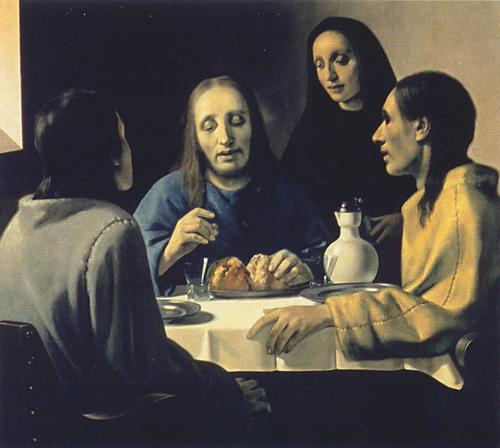
One of the most notorious art forgers in history was the miscreant, Han Van Meegeren (1889-1947). He is sited as much as he is because he had the juevos to engineer a swindle of the degenerate, Hermann Goering, head of the Luftwaffe and Hitler’s number two. This event made Van Meegeren a popular figure in Holland after the war but it was also the reason he was caught. Had he not pulled a fast one on Iron Hermann, his Vermeer forgeries might still be part of the official canon.
His story is told several times, the best English language versions being “Van Meegeren, Master Forger” by an Irish Lord, Kilbracken, with the aid of Van Meegeren’s son; “The Forger’s Spell” by Edward Dolnick, and the superior “The Man Who Made Vermeers” by Jonathan Lopez. If you only have time for one, get the Lopez book.
Also of interest is the filmmaker Errol Morris’ multi-part essay about these events and books at the New York Times website.
(Christ at Emmaus, Han Van Meegeren’s most successful Vermeer forgery)

Continue reading “Vermeer the Forger, Part Six”

Vermeer the Forger- Part Five

Vermeer’s Demise

Two events occurred between 1672 and 1674 that essentially broke Vermeer and hastened a quick and brutal end to his life at the age of forty three. The first disaster was the invasion of Holland by the French who were attempting to wrestle ports in the Netherlands away from Spain, the Catholic super power holding sway over the Protestant region. The immediate fallout was that the Dutch economy collapsed, leaving Delft in particular with holes in its pockets, prompting a mass exodus of tradesmen for Amsterdam, then the richest city in Europe.

Vermeer stayed put, having several children to feed, and he by default became one of the guild leaders as he was one of the few master grade painters left in town. This didn’t do him much good as the market for paintings vanished. It is at this point in time, if the eponymous claim of this series has any validity, that Vermeer may have, with the facilitation and cash flow of Pieter Van Ruijven, executed outright forgeries.

Continue reading “Vermeer the Forger- Part Five”

Vermeer the Forger, Part Four

Vermeer’s Women

Vermeer sired fifteen children, eleven of whom survived infancy. At least seven of these surviving children were female. The adult woman seen in several of his paintings is obviously his wife, Catherine. A few items have their maid, Tanneken Everpoel, at her side (or, as in The Milkmaid, going about her duties alone) Most others, after the first few paintings featuring tavern life, I believe featured one daughter or another.

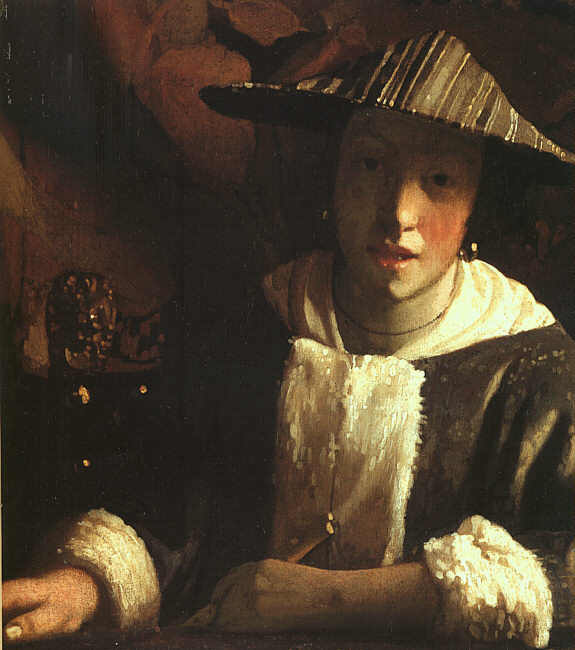
His most famous model, the adolescent girl with the oriental headdress, or, if you prefer, Girl With a Pearl Earring, is either one of his oldest daughters, Maria or Elizabeth. I believe she is the same person in The Girl Writing a Letter.

Continue reading “Vermeer the Forger, Part Four”

Vermeer the Forger, Part Three

Vermeer’s Visitors
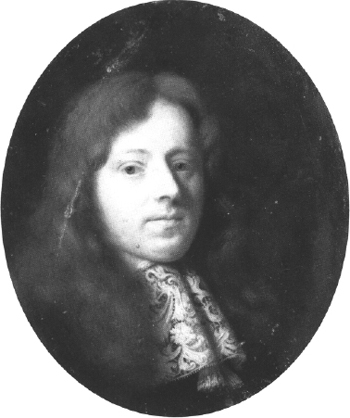
There are two brief diary accounts of contemporaries meeting Vermeer: Pieter Teding van Berkhout (above) and Balthasar de Monconys (below). The former mentions seeing several Vermeer paintings of which their chief virtue was their “most extraordinary and curious perspectives”. Van Berkhout made two trips to see Vermeer originals; the first appears to have been to Pieter Van Ruijven’s digs to survey his collection*. There is no mention of a purchase, which is troubling because van Berkhout was a prominent collector. Odder still is the second diary entry, written a little more than a month after the first visit, which reads almost as if van Berkhout doesn’t recall meeting Vermeer that first time. It’s possible that Vermeer was not in attendance if van Berkhout did meet with van Ruijven the first time around.
*I’m convinced that Van Ruijven owned Vermeer’s entire output, even that which was yet to be painted. Vermeer worked for, was essentially indentured as an artist to, Van Ruijven; and that is why Van Ruijven’s son in law’s estate had over twenty Vermeer originals put up for auction in 1696.

Continue reading “Vermeer the Forger, Part Three”

Vermeer the Forger, Part Two

Pieter van Ruijven (1624-1674) loaned Vermeer two hundred guilders on or about 1657. There is no certainty as to why but I will construct an unverifiable narrative that breaks no laws of the physical universe nor confounds human nature within the context of the threadbare facts known of these two men’s lives. Van Ruijven had money; not massive amounts, but investment money. He played angles, something of a gambler, but a reasonably legit business man for the most part. One of his financial concerns was art dealership. The laws of the land forbade van Ruijven from actually dealing in art. The kind of man he sought out to front for him was financially brittle, with many mouths to feed and open to turning what skills and access he had to broader opportunities. This of course was Vermeer, guild member and legal art dealer. So too, he could handle a brush. The pairing allowed for van Ruijven to gain access to paintings and for Vermeer to exercise his photographically accurate rendering skills to copy said paintings.

Continue reading “Vermeer the Forger, Part Two”

Vermeer the Forger (?)

Vermeer the Forger- Part One

(As a change of pace, I want to post a short six part series that I had previously posted several years ago when attempting a second blog. Perhaps a half dozen bots and a couple of stumble-upons were exposed to this, so it is still, relatively speaking, factory fresh. I feel it is germane to the ongoing discussions here at POM as it is an exercise in clear-eyed interpretation of imagery. It concerns the output of the Dutch master, Johannes Vermeer, whose paintings are the most sought after across all of planet Earth, though I am at a loss as to why.)

This has bothered me for a long time and so I am finally going to try and put this somewhere other than my head. Guided by a generally agreed upon chronology, I will use the paintings as a stepping stone to get a handle on how Johannes Vermeer of Delft, Holland (1632-1675) managed to feed ten surviving children, a wife and a mother-in-law on thirty some odd paintings, almost none of which sold while he was alive.
A few basic facts: Vermeer’s mother in law, Maria Thins, an assumed source for most of the household revenue, was not as wealthy as most claim. She owned rented farmland that did yield some steady income. She was Catholic and so restrained to a degree inside Protestant Holland. The fact that several debts were outstanding at Vermeer’s death strongly suggests that the family, at best, had decent credit. The fact remains that Vermeer was in need of work and that he possessed one marketable skill: The ability to render objects and persons, as well as preexisting paintings by others, with remarkable accuracy.
Developing a Technique

Continue reading “Vermeer the Forger (?)”

Vintage Psy-Opera: Corn Belt bin Ladens

Langley East

The Prussian town of Kassel has functioned in some ways as Germany’s Langley- In the 16th century it became the seat of Calvinism, a Venetian operation designed to reboot the Venetian’s first attempt at a schism, Lutheranism, which had quickly settled into pacifism of a sort with the Quietist movement- Calvinism was militant in implication in that, according to this new heresy, it did not matter what atrocities one committed as the pre-incarnate elect were saved before they were even born, so they could not sin if their life depended on it, even as their behavior, like slaughtering an enemy and their women and children, had the outward form of sin- This elect numbered but 5% of all souls in Christendom, though which Calvinists were the lotto winners was not revealed until after death- In a strong field, this may be the worst iteration of Xtianity, ever-

Later, Rosicrucianism found safe haven within the city’s walls- That was another lunatic op from the mind benders, likely also Venetian derived- Huguenots also found refuge there as the Venetian backed wars of religion raged across the continent-

Continue reading “Vintage Psy-Opera: Corn Belt bin Ladens”