
Continue reading “Tramps shining”
Something ain’t right
 Over the holidays a relative of ours appeared wearing a wrist bracelet. It was high-tech. With it he was keeping track of calories ingested and calories burned. He was amazed at the results. On some days he took in maybe a thousand more calories than he burned. It is so hard for me to stay quiet during such exhibitions of ignorance, but I do. I’ve learned this over the years. I must STFU.
But I’m also aware of another feature of life in America, perhaps everywhere. Our minds are like river backwaters – without effort they easily fill up with brackish refuse. The easiest information to come by is the most commonly believed. Our relative’s notion is that body weight is a simply matter of counting calories. Without effort on his part, that information will stay resident in his mind. And there will be no effort to unseat the information as every dietary expert, every gym, every diet book emphasizes counting calories, burning calories, as the only solution to our obesity epidemic.
Continue reading “Something ain’t right”
The 555 jolt back to reality
Have you ever been watching a movie or TV show and get caught up in it, and they have to give a phone number as part of the plot and it is always a “555” number? They have to do that of course, as there are no 555 numbers in the land so that no one is bombarded with phone calls after a working number is accidentally given mass exposure.
Even so, once that happens, poof! I lose interest. It’s like seeing a wristwatch on a cowboy – it jolts me back into the present and forces me to admit to myself that I am watching fiction. The fun is over.
Perhaps we can all agree on a certain allotment of dead phone numbers that they can use that sound real, or they can pass the number to each other on a slip of paper or have a car horn go off when they are saying the number or something – these are really clever people. They can do better.
Is this just me? Is anyone else bugged by this annoying habit?
Eat your heart out
This post is really a footnote to the one below, but will be much shorter so that busy people might be more inclined to read it.
I questioned below the funding sources for Democracy Now!, noting that a venerable liberal magazine, The New Republic, owed its funding for decades to Wall Street. I am also wondering if DN! is similarly compromised and is operating as a “This far, no further” left-gatekeeping operation. Here’s some evidence to consider:
Jeremy Scahill is a regular contributor on DN!, and has been supportive of the US in attacking Syria. It’s just his opinion. Another opinion was offered by the Syrian nun Mother Agnes, who has been touring various places and claiming that the chemical weapons attack that was supposed to propel the US into that war was much more than just a hoax. She claims that the Western-backed terrorist forces abducted the children, murdered them, and then filmed their corpses for cover for the Obama attack.
That’s gross beyond words, but not at all beyond the pale for people who eat human hearts. (I do not know if that claim regarding what we are watching in that film is true, if it is a hoax or deliberately staged, and offer only this evidence: CNN is almost always supportive of US wars, even the supposed humanitarian ones. In this situation, it would be then a hostile witness carrying more weight than a normal one.)
Both Scahill and Mother Agnes were invited to a conference sponsored by the Stop the War Coalition in London last November, Scahill made it known that he would not participate if Mother Agnes was allowed to speak.
So much for democracy, now, Jeremy. Some voices should be heard others not. (Mother Agnes demurely pulled back, a typically leftist fault, not wanting to disrupt the conference. Scahill had no qualms about doing the same.)
Everything you know is … suspect
Woodward and Bernstein are famous for supposedly uncovering the Watergate story in the 1970’s, a Piltdown-like hoax where evidence planted in advance was waiting to be discovered by the intrepid American news media. Bernstein went on to explore CIA infiltration of American news media, and lives now on the margins. His colleague, Bob Woodward, has enjoyed enormous success. Oddly, a man who undermined an administration and forced the resignation of a president enjoys easy access to power.
Shorthand: Woodward is a CIA mole. Bernstein not. Or maybe not. Who ever knows who to trust?
Continue reading “Everything you know is … suspect”
Scandal to bring down Erdoğan government in Turkey?
Al-Qaeda (also al-Qaida or al-Qa’ida or al-Qa’idah) (Arabic: القاعدة al-qāʕida, translation: The Base)
“Al Qaeda,” for instance, is not a name given to Muslim terrorists by their own hand. “The Base” can be roughly interpreted to be the “database” that the CIA had of Mujaheddin terrorists it had employed in Afghanistan in the Reagan Wars of the 1980’s. The CIA trained them, armed them, built their housing and facilities. When they were show-bombed during the later Clinton years, targets were easy to fix – since the CIA built the bases, it also knew the locations.
In fact, “Al Qaeda” is a western paramilitary force, and has been since its beginning. It wasn’t until the years up to and after 9/11 that the American agitprop system converted them into the dreadful pack of freaks that supposedly hijack airliners and blow up embassies.
Thierry Meyssan has an interesting piece up at Voltaire, Al-Qaeda, NATO’s Timeless Tool. One always has to wonder if these guys like Meyssan, who seem to have inside information are in fact insiders and their writing a “limited hangout*.” I tend to want to trust Meyssan since in the days right after 9/11 when he challenged the world to find the Boeing at Ground Zero, Pentagon. He knew right away what was up and jumped over everyone to point it out. And then again … he knew right away what was up … hmmmmm
As revealed by Turkish police,
We are learning that the Al-Qaeda banker, Yasin al-Qadi, who was designated as such and pursued by the United States since the attacks against embassies in Kenya and Tanzania (1998), was a personal friend of both former U.S. Vice President Dick Cheney and current Turkish Prime Minister Recep Tayyip Erdoğan. We discover that this ” terrorist” led a lavish lifestyle, traveling by private plane and mocking UN sanctions against him. Thus, at least four times, he visited Erdoğan in 2012, arriving by the second Istanbul airport where, after disconnecting the cameras, he was welcomed by the head of the Prime Minister’s guard without going through customs.
This is no surprise – the real terrorists of our world travel freely, surrounded by security and immune from justice. Look up sometime the name “Orlando Bosch**” to see what the US does with real terrorists (harbors them). In Turkey, as with other “scandals” what we are seeing is an ongoing collaboration of intelligence agencies throughout the world. This one has links going back to Reagan years as well, when
…NATO already had accomplices in Tehran during the “Iran-Contra” operation in former President Rafsandaji’s inner circles, such as Sheikh Rohani, who has become the current president.
We are not seeing one more scandal in Turkey, but rather one more chapter in a very thick book, each linked to the other in some fashion, common names throughout. It is complicated, and we never know good guys or bad guys (or wonder sometimes if there are in fact any good guys left standing). It is good to see a rogue terrorist government like Erdoğan’s going down, but then one must wonder who is behind the exposure of his activities, and if in fact another force is behind the scenes making way for a new set of actors on the same stage.
The New York Times, itself loaded with CIA moles, knows just a thing or two about state-controlled news. It reports that In Scandal, Turkey’s Leaders May Be Losing Their Tight Grip on News Media. As bad as things might appear at times, there is always humor.
________________
*A limited hangout, or partial hangout, is a public relations or propaganda technique that involves the release of previously hidden information in order to prevent a greater exposure of more important details.
**Bosch, according to the US Justice Department, participated in at least 30 terrorists acts, including the bombing of a Cuban airliner with 73 civilians aboard. He was freed from justice abroad with the help of Jeb Bush and allowed to live out his live in peace and comfort in the US. He died in 2011.
Marijuana problems
I recently attended a tax preparers’ gathering, and part of the advice we received as Colorado licensees regarding marijuana businesses was this: don’t advise them in any way or prepare tax returns for them. Don’t touch them.
The reason: at the federal level, pot is still illegal. Our licenses could be in jeopardy if there is a crackdown. We could be subject to prosecution for aiding a criminal enterprise.
A commenter down below left this morsel, which was superb, the reason why blogging is more than fun – even worth the effort. If he put it in a letter to the editor of the Missoulian, would be it published? I don’t know, but doubt that it would. It’s the kind of information that scares the gatekeepers of conventional wisdom. Newspaper editors don’t receive phone calls from advertisers or the publisher telling them what they can and cannot print. They intuitively understand what is acceptable and not. It is a shared consensus of silent power within a community, state and nation.
There I go again. Here is the comment:
Former Missoula resident Dan Baum, author of “Smoke and Mirrors: The War on Drugs and the Politics of Failure” got the money quote from Nixon Aide [Bob] Haldeman on why they chose to make a war on cannabis. Haldeman said that although they were fully aware that cannabis didn’t present any significant public health threat that you couldn’t outlaw rock music, black people or long hair so they just outlawed the common denominator. In other words they did it because it aided oppression of the young and the black. It allowed a culture war and a culture war victory for the side of repression.
Marijuana laws have long been enforced or ignored for various reasons. It is currently illegal because its use is widespread, thus allowing the state to use law enforcement selectively to punish groups that threaten its power. In this case, and going back to the successes of the Civil Rights movement, the targeted group is African Americans.
For this reason, the new and sensible laws passed in Colorado and Washington will not stand. The Feds may be tolerating us right now, but it is a mere tactical problem – how to crack down with the least amount of public outrage. So, and pure speculation of course, I venture that there will be late-night raids on dispensaries, and that our tooly local news outlets will remain silent when it happens.
It’s that shared consensus among the powerful I mentioned above.
Law and tyranny
Selective law enforcement and selective prosecution sound similar, and to me seem interchangeable. Both are hallmarks of tyranny. Examples:
Hate Crimes: This is a darling of the liberals because it speaks of moral superiority. Who is to say, for example, that the brutal murder of Mathew Shepard was not a hateful act? But the concept of a “hate crime” takes us beyond crime and punishment and into the realm of attitude. We already allow for mindset – premeditation, passion, inebriation, etc., but “hate” takes us into a subjective area that allows punishment of thought processes.
Continue reading “Law and tyranny”
Blog notes
Two items on today’s agenda before I lapse into a comatose state doing a tax return that I’ve been pushing aside for days:
One, I put up a post yesterday called “Marijuana and tyrants” I think. It is a subject I want to address in-depth soon, but wrote that late in the day, and I am never pleased with my writing late in the day and deleted it. It will be back, as I think that the only reason why a basically harmless substance like marijuana is illegal is that its use is so widespread that it allows law enforcement the luxury of selective enforcement, and that this explains the huge disproportion of African-Americans in our prison system. This also tips into the War on Drugs, which I believe evidence shows to be a cover for counterinsurgency abroad and attacks on civil liberties and use of selective law enforcement at home. I’ll give it another shot later this week.
Second, I seriously considered banning a certain well-known person yesterday and this morning, as I don’t want this place to be anything like Cowgirl. But then I thought of a better way: If you use the expression “dude” or “you see” your comment will be queued for moderation. This, I thought, would allow us the opportunity to talk about him using his name, while he would think that he is banned because his comments don’t appear.
________
PS: In updating the moderation section to include those phrases, I found the word “Kailey.” I was not aware it was still there, as neither of them are banned. Sorry boys.
Dwarf tossing on Wall Street
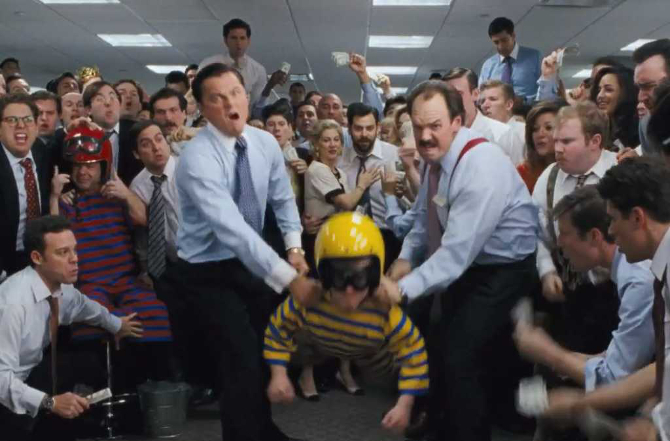 I saw the movie Wolf of Wall Street yesterday. At three hours, it is too long. Scorsese could have made a better, shorter movie. But to the issue at hand, some relatives of ours, very nice and conservative in outlook, were troubled by both the sex scenes and the manner in which Wall Street is portrayed as a drug-infested psychopathic amusement park.
This is not a movie review. There are hundreds of them out there for you, and man do I miss Roger Ebert at times like this. I either sought his opinion out before deciding what to see, or after a movie just to see what I missed.
Scorsese bases the movie on the book of the same name. Leonardo DiCaprio and Jonah Hill are over-the-top throughout. Wall Street brokers are portrayed as boiler-room hucksters, and are all getting high not only on Quaaludes and cocaine, but also conquest. Every now and then someone in the movie has a legitimate moral qualm. But there is really only one rule: they do not rat on each other.
There is full frontal female nudity throughout, and Skinemax-like simulated copulation. That is a nice relief from the intense psychological violence of the boiler room scenes. For that reason alone I would put the movie on our TV screen as I play Angry Birds on the iPad. I have excellent side vision, and instantly know when those scenes are on.
And here is my backdrop, which I did not share with our relatives: The psychopathic personality is not satisfied with the ordinary joys of life – making things, working daily toward long-term goals, love and relationships or even caring about others in general. Consequently, life for them is pursuit of thrills, adrenalin rushes. They do not know fear, and so are found climbing mountains, sky diving, preaching from a high pulpit – anything that gives them a rush. They are drawn to the world of finance for the quick score, laughing when their victims realize they’ve been had. That’s conquest, the ultimate thrill.
I think Scorsese went for the jugular here, as he has probably seen it himself throughout his career. But there is very little physical violence, unlike his mobster films. Instead, he’s going after the real criminals in silk suits and Italian loafers.
No major Wall Street investment firms were harmed in the making of his movie. After the most recent bubble, no one went to jail. They are now busy re-inflating our next nightmare.
More fun below fold, right out of Scorsese’s world.
Continue reading “Dwarf tossing on Wall Street”

