It works (almost) every time

This is completely off-subject, again, the more suitable name for this blog. We are in R&R today, our only walking from here to the restaurant and back. Later we will walk to the pool. And back.

I was watching CNN world news today, talking about the Venezuelan economy and all the trouble it endures. Inflation is rampant, there are food shortages, and trouble is brewing in the streets. Though CNN did not say so, it is a failure of any alternative to the “capitalism,” or more properly corporate global imperialism.

No one will believe me anyway, another suggested name for this blog, but none of that is true. Venezuela is under attack by all of the forces of the US military-industrial complex. The squeeze is on, food is withheld by those who control the food supply, and money does not flow freely. Military forces are on the border, US agents are busily buying off the military to stage another coup. The leaders much watch their backs, and in so doing are branded tyrants. What a beautiful scam! The idea is to make the people give up – then the shelves again have food and currency becomes dependable.

How do I know this? It’s documented – not Venezuela, but rather Chile when Allende took power by means of the ballot. It did not take but a few weeks before the US was fomenting military coup within the ranks, food shortages started, and eventually the ax – Allende murdered, and the crypto-NAZI Pinochet came to power with US blessing. Following that were disappearances, torture, open murder, secret police, and even an assassination on the streets of Washington, DC. All with approval of the overlord.

The leaders and aristocrats and military of the US do not weep for poverty or torture or human rights. These concerns are mere window dressing. The US fears but one thing: That a country will break free of control, go its own way, and succeed. People wonder why little Cuba is under embargo 54 years after Battista was overthrown. I just answered that question. No one will believe it.

Trekking the Annapurnas

image

We are back in Pokhara after a grueling five-day trek in the Annapurna’s in Nepal. Even as the trip was rated “easy to moderate” we found it extremely taxing. We climbed perhaps 12,000 feet throughout, up and down and up and then down again. On the second day, we trekked up 4,600 feet from Hille to Ghorepani, a very long day and the most we have ever climbed in one day. That day included 3,300 stone steps at the beginning. I imagine younger kids might take them two at a time. We were at low altitudes, never going higher than 10,500 and also at Miami-like latitude, so it was not like climbing a North American mountain where oxygen is sparse. But each evening found us exhausted, knees sore and body drained.

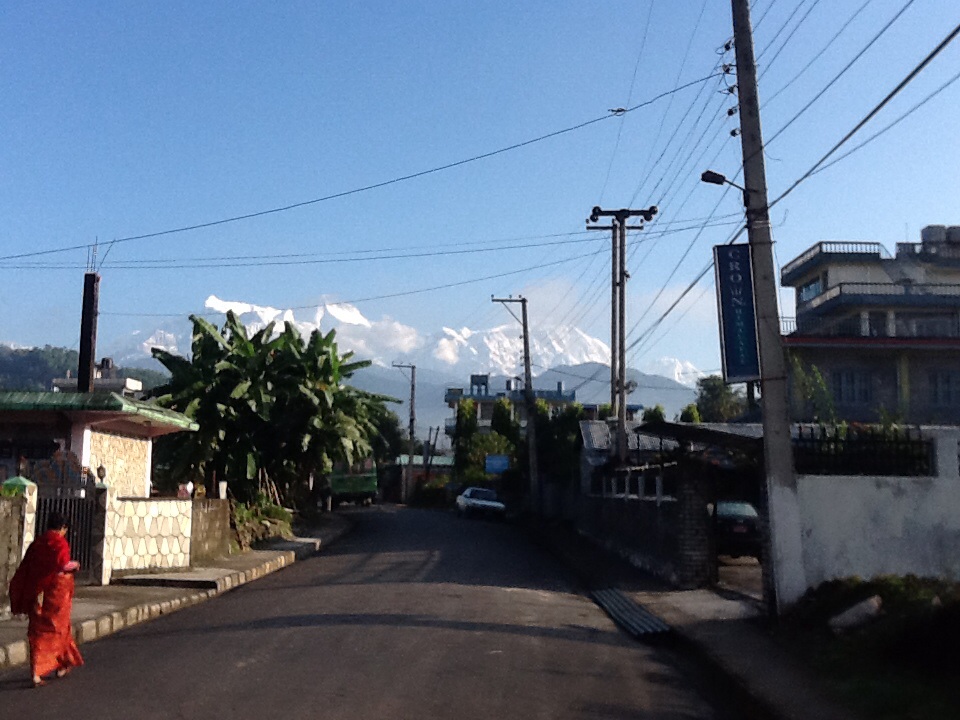
And worth it. The mountains are spectacular, of course. The one pictured above is called Machapuchre, translated to mean “Fish Tail.” It is 22,943 feet and is regarded as a sacred place in the Gurung culture, the place where Lord Shiva resides. It has never been climbed. What I think is that the east face rivals the north face of Eiger (“Ogre”) and is a challenge for those crazy fools who do that sort of thing.

The people are amazing, every bit as smart as people anywhere of course, but it is a third-world country. They walk the trails and steps, porters carry upwards of forty kilos routinely. They wear sneakers, sometimes mere sandals of the type that do not strap behind the heels. Their legs are muscular and sleek, possessing amazing strength. They are friendly and warm – we are tourists, of course, so we will see that face, but there is genuine warmth and spirit among them.

The food is quite a change for us, and I limited myself to those that were hot enough to kill bacteria that the locals are immune to. We also ate very little, not by choice, but because we were not very hungry. My daily diet was porridge and lemon tea for breakfast, noodle soup (think “Ramen”) for lunch, and the same with Gurung bread for dinner. I never felt hungry or low on energy. Water is a problem, and we had to drink either treated or bottled. A young Siberian couple we met refilled their water bottles from a big blue jug like we have in our offices that said “safe water” and were very sick for two days.

We met delightful people throughout, including the Siberian couple, Natalia and Dmitri, who emigrated to Sydney, Australia. I asked them about the difficulties in doing so, and she said there were none. You just fill out papers and get on a plane. They were not escaping repression or anything like that, she said. Siberia is a cold dark place with long, long nights. They had enough, and had enough education to take their skills elsewhere.

There’s poverty, not so bad in the mountains as in Katmandu. Young men aspire to become guides and porters for tourists. They also join the army, for there they receive good pay, medical care and three squares. Americans join the military for the very same reasons.

Education is universal, but they are missing a spark, some civil engineering and a hydroelectric project to get them moving. One or two of our cruise missiles would buy maybe a hundred thousand flush toilets and some sewage treatment? These are tough resilient people in need of development, and like so many others in Asia, once it takes hold they will take off.

But right now the poverty is brutal even as the people are delightful. It is a wonderful place.

Pokhara Nepal

image

image

Pokhara, Nepal. IPad does not zoom, so these do not translate. These mountains are amazing to behold. We are off today on the trek. Rained as we got here yesterday, two inches at least with hail. Eight hour bus trip, two flats, felt every bump. Wife maintained stiff upper lip, I was not as tranquil. Adapting to less luxuriant lifestyle, instant coffee, hard boiled eggs, oatmeal, dahl baht. Beer rare to find, but I am persistent. Namaste.

Katmandu, Nepal

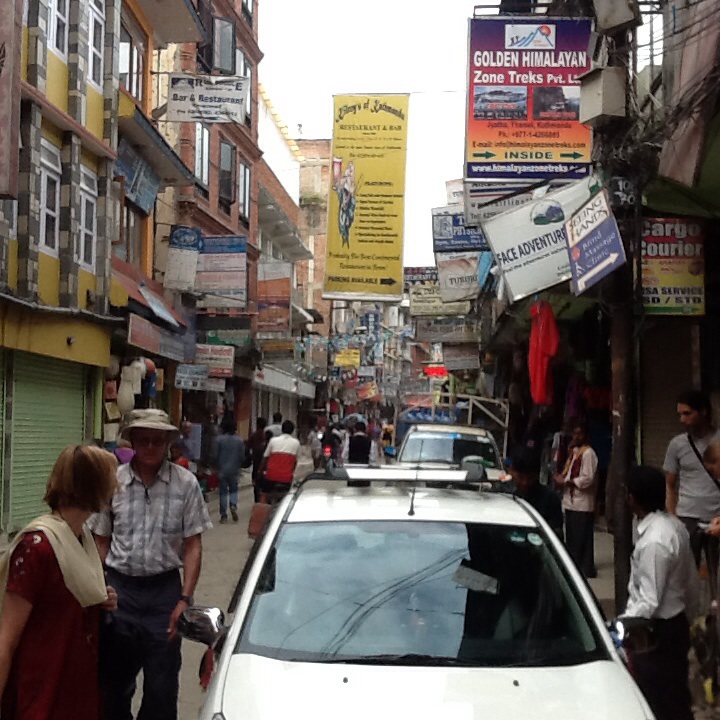
imageOther than being a three-syllable word that Bob Seger needed to make a song, Katmandu is one big mass of dirty streets and dogs sleeping on pavement, just endless poverty. This street scene is one of the better ones. Most side streets are potholed, and there are empty doorways and vacant garage storefronts with graffiti all over them.

I was reading Wiki last night about this place, wondering what would create such a mass of poverty. I don’t understand it at all. Was it colonialism? India was set back a century in its development by the benevolent Brits. South America is developing now only in spite of the overlord to the north. China hovers nearby and is mindful of its borders, as are all countries. Those so unfortunate as to be border states often get caught in crossfire.

Nepal I has gone through monarchies and repression, and now has some form of democratic rule, but most of what I see for commerce is tourism. Our waiter last night has a bachelor’s degree from Great Britain, and wants someone to sponsor him so that he an pursue a masters in the US. That sort of thing, knowing that he’s back in Katmandu waiting tables, is disheartening. Young people need hope, and I’m just an idealist, but I don’t see a lot of hope here. I just don’t understand things well enough. They valley is lush. Once there were tribes and farmers and what had to be a wonderful way of life. How does this happen? It’s just a wickedly poor and dirty Asian city.

But there are people here who want that to change – doctors and teachers and dedicated public servants. The infrastructure is very complex, so much so that one doctor I read suggest that they merely move the city and shut this part down. It would be cheaper to build a new one than to rebuild the old one.

My sleep clock is messed up, and I’m waking up at 2:30 fully rested, trying to hang on at night so that I sleep later in the morning. Feeling very much like an American here, in a hotel with a guard at the entrance. Food is very spicy, much rice and chicken. Beer is surprisingly good, and with the Trekkers and Sherpas on the bottle is obviously made with tourists in mind. We are worried about picking up a bug, and the most likely source would be food, and not water, so we cannot sample street vendors though the food is probably very good. Had a cold shower yesterday and again just now. They ask us to preserve water, and it must take ten minutes for hot water to arrive. I haven’t waited that long. Just bit the bullet. Man, these Nepalese are tough!

People are friendly, and even the motorcycles and drivers constantly honking at one another are not short-tempered. That’s just how they drive over here, using short blasts to warn one another that they are there. If a blast lasts longer than an instant, someone might be mad. Haven’t yet encountered any of that American-style road rage.

On to Katmandu

I am not a world traveler, never even having been to Texas or the south, much less foreign countries, so this is very exciting for me. It’s all so new and different.

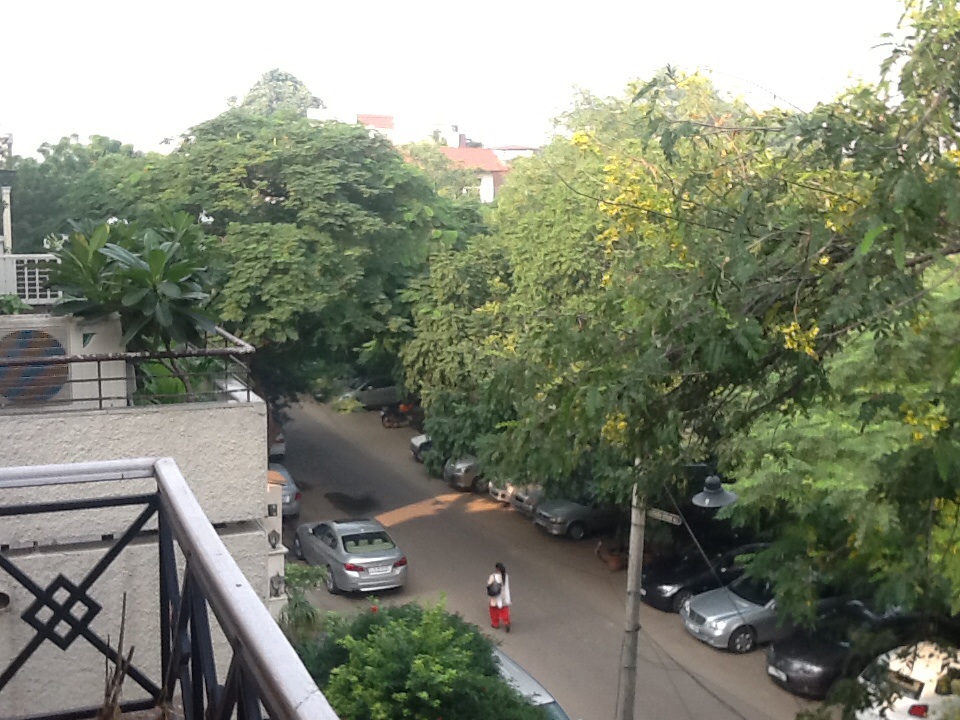
We re headed for Katmandu today, and after that hiking the Annapurna route. Delhi is amazing as I have seen it, but only a tiny slice. It’s chaotic. Traffic is wild, driving lanes only a suggestion, constant honking to warn others of your maneuvers, pedestrians and bicyclists fair game. People are mostly very thin, as if undernourished, or maybe I am over-nourished. There’s heavy military presence. Very friendly, however, English spoken everywhere, signs all bilingual. British influence pervasive. No cathedrals – not their style. Some very old mosque-type buildings. Dominoes Pizza one block away.

Dehli Day One

image

We are in Delhi, India, though I cannot say where. It is not a secret. I just have no clue where we are. It is a city of 22 million, unofficially. We arrived last night at our daughter’s after a wild cab ride and after a 14 hour flight that went very well.

I was able to sleep sitting up for perhaps six or seven hours. The United airlines people were efficient and friendly throughout. We had a crying baby next to us and behind us, so I summoned from deep within me skills I honed as a young father, and slept through it, letting the mothers take care of it.

My Wife is doing well though has not slept as much as me, and so is grabbing some sleep while she can. It is a day to get acclimated. It is very muggy. This is a high desert climate I am told, but right now it is feeling like Long Island in August.

It’s not complicated. It’s just deliberately confusing.

I’ll summarize here for those who do not have time to read this, and please do include JC’s remarks in the comment section regarding payment of costs for people below poverty level to be better informed. What I found is that we are basically being sold catastrophic policies where we are on the hook for the first $6,350 of medical costs. If you have that much in costs, you can ignore all policy features except monthly premium. Go for the cheapest. The more expensive policies are an attempt to buy down the $6,350, but it’s a trap, as you end up spending more in medical expense plus premium than you would otherwise spend with a higher deductible and lower premium. If you have ongoing costs, go cheap.
_________
I was looking over the available policies on the Colorado Health Exchange, and it is very confusing, as it is designed to be. There are differing co-pays, co-insurance and deductibles. So I decided to do a side-by-side comparison, and selected twelve plans with varying monthly premiums, the low $430 (Kaiser) and the high $1,049 (Access Health Colorado). Bear with me here, as it will for a while seem confusing, but in the end be stone-cold simple.

There’s no way of anticipating what kind of health coverage anyone will need in a given year, so I decided to compare policies based on what might be typical for someone my age. I have an annual physical, blood tests, office visits, lab fees, an MRI and out-patient surgery, some physical rehabilitation after surgery, and ambulance and two ER visits, and a two-day hospital stay. I’ve done nothing but visit doctors for minor ailments (one knee surgery, outpatient) for decades, but am assuming that this year, SHTF. The total costs I imagined I would incur: $14,275.
Continue reading “It’s not complicated. It’s just deliberately confusing.”

Soon to be Asia-bound

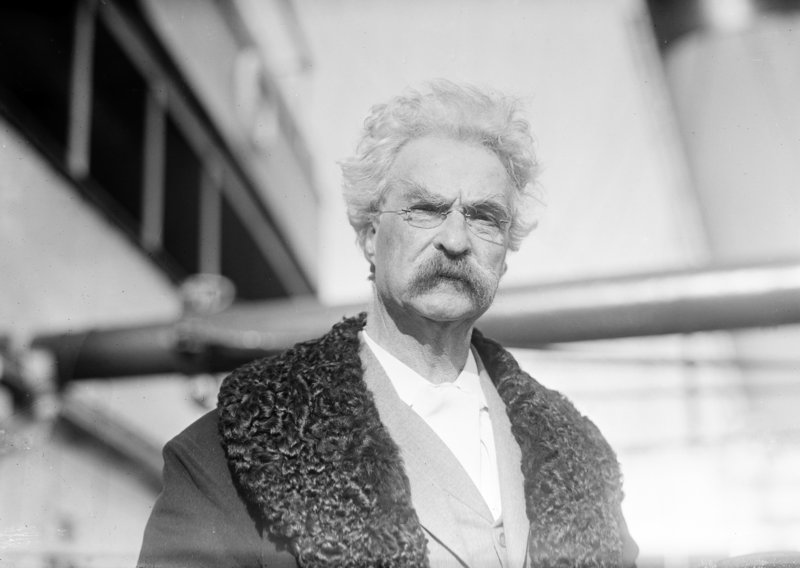
 “Travel is fatal to prejudice, bigotry, and narrow-mindedness, and many of our people need it sorely on these accounts. Broad, wholesome, charitable views of men and things cannot be acquired by vegetating in one little corner of the earth all one's lifetime.”
“Travel is fatal to prejudice, bigotry, and narrow-mindedness, and many of our people need it sorely on these accounts. Broad, wholesome, charitable views of men and things cannot be acquired by vegetating in one little corner of the earth all one’s lifetime.”
We are soon off on our second “trip of a lifetime,” this one to New Delhi, Katmandu, a six-day trek in the Himalayas, and then two weeks in Thailand, one of them unscripted.

Our trip to Europe in 2011 changed my outlook on many things. In Italy we saw Italians doing all of the daily jobs from waiting tables to driving buses. Imagine! Switzerland was just as imagined. Prague was enchanting, and the John Lennon Wall gave me an idea of the power and reach of this man. There are cathedrals everywhere, but deeply embedded in them are hints of the real history of religion – sun worship and astrology. The Vatican had the feel of powerful military fortress, and a long hallway of statues with all of the male genitalia chopped off spoke volumes on Catholicism. Countries on the euro are expensive. Those not are much more affordable, though the standard if living is very high throughout (except perhaps Hungary as we saw it in our brief glimpse*).

Continue reading “Soon to be Asia-bound”

Bachmann in overdrive

1374339_370525706414810_996320657_n I put the photo and caption up on the left here not because I am going to engage in a round of Bachmann bashing, very easy to do. I am also not going to talk about the insanity of selling off valuable public assets, the price-of-everything mindset. It’s enough to know that the only reason Yosemite is so valuable is because it has not been privatized to the degree that other naturally beautiful landscapes have, like for instance Malibu Beach, mostly inaccessible to the public.
Continue reading “Bachmann in overdrive”

Political puzzles are fun …

Controls on the House and Senate are pervasive – they are on leashes, and kept from bolting by threats and bribes. NSA does not keep tabs on people for nothing, and long before there was an NSA, there was Hoover and the FBI with a dossier on everyone in DC. Even if that were not the case, they don’t get campaign money, open or secret, unless they play ball.

So the question we should be asking is why a small band of house members are being allowed to shut down 22% of the government. It’s either misdirection or distraction, or both. To what end? I say Obama is in cloaking mode again, positioning to attack social programs. But that’s speculation based on his past behavior, and I even contradict myself, as I don’t believe he’s anything more than a sock puppet. But merely substitute “the executive” for Obama, and I fall better into line with myself.

Others say something far more reaching is at play, the fact that we’ve been in recession/depression for his entire presidency. But I don’t see how removal of the stimulus of government spending does anything more than exacerbate that situation. It would mean that they want to exacerbate it, and that is puzzling.

Surely there’s more than I see. Please enlighten me!