
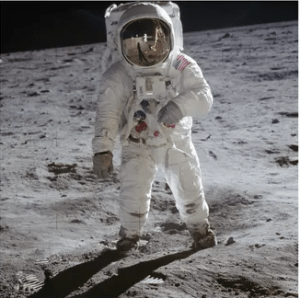
The photo above is famous, supposedly taken by Neil Armstrong of Buzz Aldrin after he had first set foot on the Moon on July 20, 1969.
Pardon me if I am having too much fun with this, but the photo is all wrong. Keep in mind that the astronauts on Apollo 11 deliberately landed during daylight on that day. Days on the moon are 14 days long, and we know from NASA that the angle of the sun on the Moon that day should have been 15°. Keep that number in mind as we proceed.
- We cannot see anybody’s face behind the visor, and so have to take it on NASA’s word that the astronaut is Buzz Aldrin.
- Another astronaut supposedly taking this photo is reflected in the visor, allegedly Armstrong.
- Aldrin is in direct sunlight from his left. (But wait! There’s s secondary source of light to passively light his right side.)
- Since there is no atmosphere on the Moon, there is nothing to shield him from the actual thermal effect of direct sunlight, which would be about 270°F. Supposedly he is insulated from this effect by his spacesuit. On his right side, the opposite effect, -270°F.
- The astronauts had only one source of light for photography, sunlight.
- Imagine yourself standing in a vacant lot say at noon, in bright sunlight. That sun would light the entire lot without any drop-off.
- In this photo, the light drops off behind the astronaut. By the time you follow your eye to the line of the horizon, you’ll see that it has gotten much darker, almost like twilight after sunset. However, the sun should be lighting up the entire landscape.
It gets more interesting:
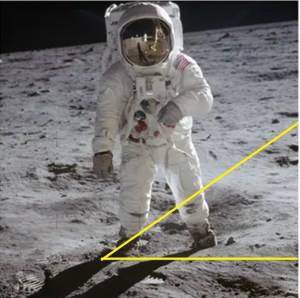
The angle of the shadow cast from behind Aldrin is, as I gauge it, is about 30°. Note earlier that according to NASA, the angle of sunlight is on that day 15°. There is only one conclusion judging from the fact that light is dropping off in the background: This photo was not taken on the Moon. It had to be taken on Earth, and was probably indoors with a very powerful spotlight used.
Let’s look some more at the same photo:
Just let the image sit in your eyes for a minute or so, and clear your head of thought, as I can do so easily. Collect impressions.
OK? My impressions … this guy is short. Shorter than Buzz Aldrin, who is 5’10”. But, how do we make a comparison? Below is a photo below taken on July 16, 1969 of the Apollo 11 astronauts in transit to board the rocket ship.

We can see their faces, so we know they are, front to back, Armstrong, Michael Collins, and Aldrin. Note that their visors are clear. I do not know why (actually, I do know why), but when they walk on the moon, the visors are complete mirrors so that we cannot see inside. I assume that they must have had one helmet for takeoff and transit, and another for moonwalking, but do not know. But that’s not the point here. We know the height of each guy, and know that Buzz Aldrin was/is 5’10”.
In order to do size comparisons on photographs, we need a standard. Because of the nature of the spacesuits fitted for each one, they will have very little in common. I studied this matter for quite some time this morning, and finally settled on one part of the spacesuits that appear standard in this photo, and also on the supposed photo of Aldrin on the Moon.
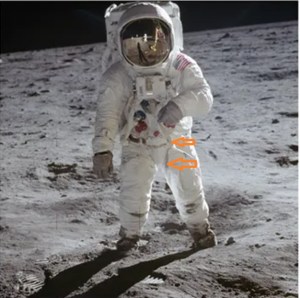
I think it is known as a “codpiece”, which covers the fly. Of course, it would not be functional, as they could not actually open it while on the Moon’s surface. Maybe inside the Lander? What I am going to do is to compare the relative sizes of the codpieces of the Aldrin on the Moon and of the Aldrin transporting for boarding. It might appear as if I am assuming that the two pieces would be identical, and maybe they are, as there is no need to lengthen or shorten it due to relative height. It is at a stationary junction in the uniform. But if I am wrong about that, assume that size difference messes up the measurement. If so, I am going to suggest that my measurements are +- 10% of each other. That could be wrong, but I doubt by much. (And anyway, if they are the same guy, it’s the same spacesuit!)
That in mind, I took the codpieces on the two photos and adjusted them to be the same size, adjusting the size of the astronaut accordingly. Here is what I got:

I placed the feet of Moon Aldrin squarely in alignment with Aldrin in transit. By my calculations, Moon Aldrin is anywhere from 12-15 inches shorter than Aldrin in transit to the rocket. By that standard, these are obviously two different people.
Why so short? This link is to another article at Aulis where it appears that the Neil Armstrong standing beside the Lunar Lander is also only five feet tall or so. It is a long piece at Aulis, so take some time if you go there. (It seems to me that everything at Aulis is a reading chore!)
The point is, as I see it, that a short person was used on Apollo 11 photos that were actually taken on Earth to play the part of both Aldrin and Armstrong in photos said to be taken on the Moon. Why? We can only speculate. My take is that when they showed videos of the Moon Buggy in motion, that it was piloted by a dummy, hands in one position, feet not moving. Judge for yourself.
The buggy (not the astronaut, who does not move) would be remote controlled, not on the Moon from Houston, but rather by controllers standing in the same warehouse where this nonsense was shot. My point is that the dummy in the Lunar Rover could also have been used for various photographs, the famous shot of Aldrin, and the one covered by Aulis of a very short Armstrong standing by the Lunar Module. (If indeed that Armstrong was in a video, then indeed they were using short people).
Otherwise, I cannot imagine NASA deliberately recruiting such short people for the fake photography. If they were real people, they would be taller, and would fit in the real fake spacesuits.
 Piece of Mindful
Nice article Mark – I never noticed the codpiece! Yes that is the right term. They were munchkins on the moon no doubt. It seems like a case of “revelation of the method” or whatever they call it when the hoax is so obvious as to make it a humiliation to accede to their reality – see 2+2=5 in 1984 as an example.
When Petra was around and had an answer for everything, she critiqued you brining up that the moon lander was 33,000 lb as a coincidence. However Buzz is a 33rd degree free mason, and that’s a fact, jack. And he founded a Mason chapter on the moon where he landed. However, in fact in zero gravity people are known to shrink by 20%, so this is all normal.
LikeLike
My error, I meant to say that in a vacuum with 1/6 gravity there is ~ 1/6 shrinkage of all human parts, so they gave the ‘nauts shrunken uniforms to fit appropriately with the photo op, so they weren’t looking baggy.
Which I meant to ask Mark – are the ‘nauts all shruken in all the Apollo scenes, or just these?
The backgrounds are just awful by the way, as you mentioned the light tapers off with distance from the camera. Later missions had that Hollywood 1940s movie look, where the mountains in the background look (obviously) painted, with zero perspective to the rest of the objects in the frame.
LikeLike
In a zero (or 1/6) gravity (I wasn’t sure if you were making a joke, I think you were), people actually get taller, says AI.
LikeLike
Yes it was my attempt at a parody of NASA or Petra there’s an answer for everything meme. And I thought the 1/6 shrinkage of our pictured astronaut was a funny coincidence.
LikeLike
I refer to Buzz Aldrin being a 33rd degree Mason quite a lot – as well as, of course, Gus Grissom (Apollo 1 psyop) and – seemingly – so was Fred Haise who participated in (what I believe to be) the Apollo 13 “live” exercise and can be seen in the command module in the hidden hand pose although he is not recognised as a Freemason anywhere. I must say that although I do believe the mission occurred just not with the explosion the outfit he’s got on seems odd to me – may research that more.
Quite a few Freemasons among the astronauts.
https://scottishritenmj.org/blog/masonic-astronauts
I don’t believe everything Apollo, Ray, as I’ve said, I just believe the moon landings.
LikeLike
Maybe founded a mason chapter where they filmed this—definitely NOT on the moon.
LikeLike
Something else i just noticed, which I never had – why is Aldrin standing on a 15 degree slope, or a mountain? The horizon is tilted 15 degrees to his vertical position. Is this supposed to be the curvature of the moon, as it’s smaller than the earth? Or did they land on the side of a mountain?
LikeLike
I wonder too about the curvature of background. Lenses have limitations and can indeed distort. But even at 1/6th size of Earth, the horizon should be flat. If you doubt this, try to detect any curvature in the Earth while at the beach some time. It takes a very fine eye, even some instrumentation.
LikeLike
Dave McKeegan, professional photographer, has done a most interesting job of responding to claims of fakery of Apollo photographs. (Love the thumbnail.)
The famous one of Buzz Aldrin was “enhanced” by NASA but only in the way any photo might be enhanced for publication purposes as explained by Dave and we always have the original to refer to in any case.
Unsurprisingly, one thing the “we didn’t go” propagandists keep the punters in the dark about (excuse the pun) is an extremely important fact about sources of light:
A source of light can be reflected light so multiple sources of light are possible without artificial light.
Also, Mark, a full lunar day-night cycle on the Moon lasts about 29.5 Earth days (29 days, 12 hours, and 44 minutes).
One of my two simple rules of critical thinking is:
Aim to prove your hypothesis wrong
This means that in addition to doing my best to look for anything that challenges my belief whenever something is presented that challenges it I take a look.
Mark and your readers, is it one of your rules too? If not, why not?
LikeLike
Actually, the video I posted above doesn’t relate to the famous Buzz Aldrin photo – nevertheless it’s still relevant.
This is the video on the famous Buzz Aldrin photo.
LikeLike
Actually 2:
I didn’t realise Dave McKeegan did so many videos which might suggest the subject was the famous Buzz Aldrin photo.
This is the video where he goes into detail on the famous photo – but all three videos are most enlightening on the subject of
Apollo photography … if you’re remotely interested in it.
LikeLike
Oh yes, I am remotely interested and then some. I’ll be having a look at all of this later today.
I have watched a program called “Mythbusters” and assume these same guys have also examined the Apollo photographs? Excuse me if this is what I will see later, as I am yet to view these.
LikeLike
No connection to Mythbusters, Mark. While Dave may say some of the same things as other analysts he says a lot of things I’ve never heard before.
LikeLike
Interesting video, but I see quite a bit of three things, misdirection, and answering questions not asked, and not answering questions asked.
LikeLike
Mark
Its standard procedure to not answer the actual questions being asked. But some of the ways he ignores and addresses so poorly different problems make it seem as if he is intentionally doing a poor job. I had a discussion about this with AI that was interesting. It tried to convince me that they just don’t care about the small number of people that can see through their controlled opposition but I’m not sure that’s correct.
I looked at a debunking (your favourite word?) of Simon Shacks Tycho theory and was amazed that every single criticism of it was already covered on his forum. I sat for hours trying to work out what was going on. Was it a double fake trying to push his theory to a certain audience. Was it lazy debunking. Was it the appropriate response that takes care of the vast majority of people.
I actually find these questions the interesting ones. Same thing with medicine and diet and financial advice. Do they intentionally leave options for us (I suspect they do), do they just stuff up (again I suspect so), is what they do good enough to achieve their goals (obviously yes, on most occasions).
LikeLike
My experience in “debunking”, not my favorite word, is that the word itself was contrived by Intel because they needed something terse and final to end a discussion.
Regarding other manners of deflecting honest questions, misdirection is the primary tool. Others are to avoid open forums, limiting question to those from known friends, usually planted. They are advised that if they are openly challenged by knowledgeable people, to get up and leave. Then there is a tool as followed by all politicians, “If you don’t like the question asked, answer a different one” and to give long-winded answers so as to dominate the forum in the allowed time.
I like your comments, as you are on a different and elevated platform. You’ve gone places I have not, and i need that exposure.
LikeLike
So what was your conclusion at the end of this Alex about the Tychos theory? I read probably 95% of the material there as of 2025, after that the forums really dried up.
There was a very interesting book called the Globe stands Firm I read that was written ~1900 by a dissenting scholar, that makes a case for the Earth being fixed in space, with the other objects rotating around it. It would of course require the sun to rotate around the earth everyday. The issue with the Earth supposedly rotating as it does, is the clouds and atmosphere do not move in relation to Earth, or very slowly, and it would require the Earth to be basically a perpetual motion machine, as I see it, rotating at the same rate for many eons, to fit the present theory. Unless the rotation of the Earth and Sun were driven by some alternative mechanism, like a magnetic coupling, which makes more intuitive sense. The standard theory of gravity and orbits leaves something to be desired.
However the Tycho’s theory has many assumptions, like Mars and the Sun are twin stars, and that they are numerous, and Shack acting like a born again Christian pushing this theory so hard, and pushing back against all criticism. I think most of his forum is/was very honest, and open to diverse ideas, until he got obsessed with the Tychos model.
LikeLike
Complicated science is beyond me and the only method I have at my disposal to try to determine what hypothesis is correct is looking at the to and fro between the seeming experts arguing and trying to see who has the final word so to speak.
I completely agree about CluesForum in the main … though not of course about the moon landings.
With regard to Tychos I found this critique of the first edition of Simon’s book which certainly sounds authoritative and I think Simon’s response simply to provide the second edition is not very convincing at all.
LikeLike
I suspect you are correct about magnetic coupling or at least photon flow or something like that driving the spinning of the earth.
I suspect gravity is a similar force and that the atmosphere is held electrically. I was reading something interesting on lightning. I would not go full electric universe I suspect that is the usual setting up of straw men to push people away from the actual truth.
One of the big issues was the reduction factor of the stars and their distances being wrong. But if each star is calculated individually allowing for the rotation of the earth I suspect that problem goes away.
The mars sun set up proposed is almost identical to the Sirius a Sirius b set up in size and distance.
I believe it’s the best model I’ve seen so far. Just as I believe MM atomic model is the best I’ve seen so far. That doesn’t mean I’m not suspicious of either. But…
LikeLike
Before I address your comment I’d like to establish what you regard as the rules of critical thinking you follow, Mark, or whether you follow any rules you would identify as such or … ?
You addressed this comment to me on my last post, Mark:
“I suggest we ditch the expression “critical thinking,” since as you use it it only means “what I think”.”
I most strenuously argue against this assertion because – as I say – I follow two rules of critical thinking and following these two rules means I definitely don’t put forward (as much as possible) simply “what I think” (except where specified):
— Aim to prove your hypothesis wrong
— Focus on the most tangible, relevant items in the first instance.
LikeLike
I don’t have rules in place like that, as life presents too many curve balls. One has to be open to all possibilities. Each idea has to stand on its own or be discarded. As my dad once said of on of life’s most perplexing phenomenon, relationships, “Women are complicated.”
The idea of disproof is commonly espoused in science, but rarely employed. For instance, experiments used to “isolate” viruses are widely criticized, and the process has been, in my mind, discredited. The answer by virologists is to isolate themselves among friends and bury their work in complicated jargon.
In your case, I see all disproof of hypothesis as coming from your opponents, to which you often give a short shrift. Merely watching the McKeegan film, for instance, rises all kinds of questions which you should have asked, but did not.
LikeLike
Where people don’t agree on what critical thinking involves then they are bound to come to different conclusions.
Being thrown curve balls doesn’t pre-empt rules of critical thinking – curve balls are a predictable part of life and only mean we need an agile mind. One thing that interferes with critical thinking is the anchoring bias which is the tendency to rely heavily on the first piece of information we are given about a topic. (Generally, I think we can say that people tend to wed to their beliefs.)
My first rule, Aim to prove your hypothesis wrong, in fact, 100% addresses the issue of “curve balls”. Effectively, the rule says that you must always be willing to change your mind when something comes along to change it … and I know since I first woke up to the phenomenon of psyops I’ve been thrown a few curve balls necessitating a 180 degree change of mind a number of times.
I certainly agree that whatever rules we apply things can be too complicated for us to determine the truth about them but that doesn’t mean that there aren’t rules of critical thinking we shouldn’t follow.
Do you really argue that there aren’t rules that need to be followed for critical thinking, Mark?
LikeLike
Critical thinking is merely interpreting, analyzing and evaluating data while avoiding marrying a theory or excluding worthy alternative interpretations of similar data. I’d like to say I am good at it, but I know I’ve made too many mistakes in judgment in the past to presume that I have it all figured out now. Critical thinking involves classifying data, making inferences, reasoning, and … practice practice practice. Those last three words, plus humility, are key.
You and I have encountered the same evidence and arrived at different conclusions. I cannot exclude your being right, though if that is the case, landings would have to have been done in secret using some unknown technology.
For a long time, I merely doubted the Moon landings were real based on photos, analysis of our engineering and computing capability at that time, and matters such as radiation, lunar climate, and any real need to go there. The idea that everything worked perfectly for Apollo 11 struck me as impossible. But frankly, the Pollacia affair sealed it. I regard it as irrefutable evidence that Apollo 11 ditched in the Atlantic.
But as always I am stuck on why. Why fake the landings? There seemed no reason. All other hoaxes had fear and thought control at the base, but Apollo was different, meant to inspire us … so out of character for the forces that gave us the Cold War, fake assassinations, fake WMDs, fake pandemics, fake serial killers … I am stumped.
Due to the current debate, you such an important part, I am making progress on the why. Miles to go. As to critical thinking, it is still practice and humility that are key.
LikeLike
I don’t think the “why” is necessarily that mysterious, it would just require looking at how it was used in the propaganda(s) of the time. There must be relevant history books about the program and period that look at its sociological impact – not even conspiracy books, I mean from mainstream academia, since they would accept it as real, but nevertheless examine its cultural impact.
Just off the top of my head, I think I’ve read that it was a big part of recruiting young people into math, science, engineering, etc as evidently it was desired that a large cohort of that generation fill those fields over the next several decades. JFK had something called The New Frontier I think, related to this push.
And of course it played a role in Cold War propaganda, as we were “falling behind” due to Sputnik and other Soviet successes. It was part of determining which system, capitalism or communism, could claim the mantle of victory.
Big picture, it may have been about science replacing religion long term, and offering its own “miracles” across several domains – intense occult symbolism involved perhaps, which esoteric specialists probably lay out in numerous videos online.
LikeLike
So I think you’ll agree, Mark, with the following:
— we are both as willing as the other to disbelieve the authorities. I think it’s abundantly clear that I don’t believe the moon landings in any shape or form because the authorities told me they happened – after all I don’t believe Apollo 1 or 13 or Challenger … and so many other things told to us.
— we both believe that we are good critical thinkers.
— there is a wealth of information provided on the moon landings so we should be able to determine whether they were real or fake.
And yet we don’t agree and obviously, you believe you believe you’re right and I’m wrong and vice versa. So the question is why do we have this situation? What is different about our approaches and how do we see the other going wrong?
So I’m curious, Mark, can you identify from my argument, in general terms, what I’m doing wrong? What would you say it is about my approach that leads me to the wrong conclusion and can you give examples?
LikeLike
I once traveled through Paradise Valley in my home state of Montana, and looked at the surrounding mountains, and felt really bad that they would no longer be covered with snow in fall, winter and spring because of global warming. This would have been circa 2005 or so, and I had not thought about it, only absorbed what was being offered as news.
With the understanding that I’m human and not here to critique, I’ll offer just a couple of mild observations, nothing meant to disrespect you or hurt your feelings, as I do like you and enjoy it when you come around to join the exchanges.
If you are wrong about the Moon landings, then the reasoning that got you there is defective. If I am wrong, ditto. There’s that.
Also, Cartman, from South Park, had a great money making idea, called the underpants solution: 1. Steal underpants, 2., ???, 3. $$$.
I see you as understanding the Saturn V and the arrival at the Moon, but everything in between, including the radiation problem, is not well understood. So you say they launched, ???, and landed.
That’s oversimplified and done with humor, I hope you see. But in regard to Tychos in a comment recently, you said that the science was difficult for you, so that you relied on the various participants in the debate to determine what was right. [Edit … I never went near Tychos.]
I am troubled by science too, but equally troubled when people claim to be scientists and for everyone else to shut up. I do not imagine that scientists, anymore than doctors or journalists, have any more a hold on truth than anyone else. If we are able to think properly, we can work things out, even scientific papers and thesis and theories. I try to apply what abilities I have to complicated problems, but often get overwhelmed. Apparently, you do too.
That’s as far as I will go, and offer the same question and forum to you.
LikeLike
With regard to Tychos I don’t know who’s right because I don’t know enough and all I can say is that the criticism sounds authoritative and Simon doesn’t have a good response. If I had to bet I’d choose the critique although perhaps if I studied more carefully I’d appreciate the argument better. I just don’t care enough.
On the other hand, with the moon landings while there is much that I don’t understand there is sufficient evidence that I can understand to know they went. I can also see that so much of the argument saying we didn’t go has been produced by propagandists or is simply wrong.
So what I think you do wrong in general terms, Mark, is that you simply don’t follow the rules I do, namely:
— aim to prove your hypothesis wrong
— focus on the most relevant, tangible items in the first instance
It’s not that I thought prior that these are rules I must follow, it just struck me in hindsight that that’s what I do.
So OK I followed those rules for climate change but the incredibly complex phenomenon of climate is a vastly different proposition to a pretty straightforward activity conducted by man – there’s no comparison. And I simply didn’t know how dishonest scientists were. Also, while I’m not buying the alarmism, I still don’t totally reject that pumping gigatonnes of CO2 into the atmosphere isn’t having some effect on temperature. I’m not saying it definitely is, I’m just saying I wouldn’t say it definitely isn’t.
LikeLike
Really, what you are trying to do, is to put me in a corner of your making. It does not work. My hypothesis is this: NASA spent the years of the late fifties and sixties trying to develop technology, not to go to the moon, which served no purpose, but to achieve some other space-related objective. I don’t know what that objective is.
The lunar landings themselves … were easy to set aside. Just recently I was able to show “Aldrin” to be 12-15″ shorter than the real man. If I can do that, so can you. The liftoff from the moon by Apollo 17 is comical, like a bottle rocket, no slow start and gradual increase in speed, violating the physics of rocketry.
And, Pollacia. If you are intent on proving your own hypothesis wrong, as you say you are, read at Aulis the lengthy exchange between NASA and the Russian scientists.
I don’t know how long now I’ve known Apollo to have been faked, but its many years. I live and breath evidence, never proof. There are tons of it, so going by your own code, disprove your own beliefs by entertaining all of the evidence that says you are wrong. I would ask for your words, not some NASA shill.
LikeLike
So what I would say about Aldrin and Pollacia is that what you say about them is not particularly tangible and certainly not agreed upon. They are also isolated, there’s no alignment with anything else.
I wouldn’t be happy with using items that have no agreement and that are simply cherry-picked items with no alignment.
What are very, very tangible and what speak very, very loudly are the thousands of images taken from the lunar surface that show a brightly-lit surface against a black sky – a signature of the moon and alien to earth.
Brightly-lit surface.
Very black sky.
The signature of the moon in lunar daytime.
Never seen on earth.
The massively weak argument used by disbelievers is:
“They could be faked.”
What they really mean when they say this though isn’t merely that they could be faked but …
“They could be faked without detection.”
There’s nothing factual about this claim. There is no history of thousands of photos of an alien celestial body or any kind of equivalent where it was discovered they were faked so we don’t know that they could be faked without detection and all my experience of fakery says they absolutely couldn’t be faked without detection. But in any case what’s needed is proof of fakery not the claim of possibility.
You think you have detected fakery but all you’re doing is either basing your opinion on nonsense from the propagandists such as “there should be stars in the photos” or making your own subjective judgement on isolated items.
LikeLike
Some facts are more important than others, and an underpowered rocket is one of those. It debunks the whole claim of Apollo 11 going to the Moon. If that one thing is fake, so too is all that follows, including the thousands of images TAKEN FROM THE LUNAR SURFACE showing no stars and black sky. I have capitalized your fatal error.
The post that follows highlights another NASA gaffe.
LikeLike
It’s simply amazing to me, Mark, how you state things as facts such as “under-powered rocket”.
How can you possibly know for a fact that the rocket was under-powered? That is simply not something you have the knowledge about to state as fact.
Equally, I do not have the knowledge to state that the rocket had sufficient power from first-hand knowledge.
No I cannot state it as a fact from my knowledge but I can infer it had sufficient power from items that I can understand – the overarching motif being that the moon is alien and what we see conforms to expectations of that alienness.
LikeLike
Evidence. That is key, to evaluate evidence. Pollacia is evidence of an underpowered rocket. Naturally NASA will “debunk” that evidence and you will not just believe NASA, but automatically do so. It’s a spectacle to behold, the power that authority holds over true believers.
LikeLike
Evidence is faked, isn’t it, Mark – you would be one of the first to say so, in fact – so one item of evidence to say something when we know that fakery is a thing isn’t necessarily convincing – not when there’s loads of evidence that says something different. In fact, the evidence says that the video has been tampered with.
We’ve had this discussion before and if you insist on clinging to a single piece of cherry-picked evidence that has been shown to be doctored then OK, I cannot argue with that.
What you want with evidence is for it to align – you want all the pieces related to the rocket to align with fake … but they don’t.
LikeLike
This is essentially your argument, Mark – and that of other disbelievers:
“I see a number of anomalies and in the thousands of instances where I don’t see an anomaly the fakery was pulled off better.”
That’s it. It has no rigour, it has no concern that all the pieces of the puzzle don’t fit. Where the pieces of the puzzle don’t fit you just wave them away with, “they’re faked.”
LikeLike
That is fairly presumptuous, to presume that I only see what I want to see, and have not spent enough time on this subject to have a valid opinion. I’ve got years in, off and on, including the time when I had to beg you to read McGowan, whom you avoided until you had a handy debunking guide in hand.
Your last sentence speaks of complete lack of self-awareness.
LikeLike
Blue bayou.
I love to hear my arguments butchered by others. Since you obviously did not watch the video at the start of the pendulum post, you’re not aware that we are ALL aware that NASA has manufactured evidence, a critical element of the Moon movies. You’re probably not aware that NASA had the ability to speed up and slow down those movies, with closeups at near to real speed, and everything else slowed down according to distance. Consequently, they were able to speed up and slow down things to make them look more real, or to conform to “Moon” 1/6 gravity. You are aware that evidence can be faked, are you not?
So, yes, we know there are perhaps scores of hours of astronauts on the Moon surface, all of it doctored by the movie camera, specially equipped to quickly change the speed. Hollywood would have such a contraption, even as they were not available to the public.
However, and this you missed, the waving flag on A-15 was an oversight by NASA, and so was accidentally left as is, where ordinarily it would have been cut out. Of course it waves as an astronaut passes by, and NASA has jabberwockied the reasons for this, the simplest being that it is on Earth, so air movement caused it to wave. Occam says Earth.
But that is not the point of the video you did not watch. It is this: As it waves, it becomes a pendulum. NASA first denied said footage existed, and then when it had to fess up, tried to sue for copyright infringement, even as the movies are public domain. As the argument about what caused it to wave went on, a side issue, a very clever chemist saw that he was dealing with back and forth movement, in essence a pendulum, and so could calculate the undulations, coming up with perhaps ten at 1.9 seconds each. That’s a bit slow for earth, where such undulations should be 1.6 seconds, but far slower than the Moon, whose 1/6 gravity (so far as we know) would produce around 5-second intervals. His conclusion, the flag was not on the Moon, but rather on Earth. You have to watch it to catch the nuanced argument, and I know you won’t.
Why 1.9 seconds instead of 1.6? That is a detail our chemist fails to address. There are many variables, and I think he was not aware that NASA filmed in slow motion, which would have produced a 20% or so increase in time if NASA was filming at 80% speed. But the overarching point was that if it was on the Moon, the undulations of the flag would have been much faster and wider, perhaps 2-3 times wider and faster in 1/6 gravity.
So you completely missed the point that no one knew what caused the flag to move, and that our chemist did not care. It was the fact that it moved that allowed him to apply some physics to conclude that the flag was on Earth, and not the Moon.
Blue bayou.
LikeLike
Mark, on my moon landings journey my first point of call was Wagging the Moondoggie but no I didn’t return to it when you urged me to but I did eventually and yes I used the aid of someone more knowledgeable than me – that strikes me as an intelligent approach. I don’t know anything so I look to others who know more – yes it can be dangerous but you need to consider how much you know and how much others know.
However, as I look at WTM more and more there’s so many things I’ve worked out for myself including things that the critic wouldn’t pick up as a non-psyop analyst.
WTM is a 100% work of propaganda and your argument against it being a total fraud doesn’t work.
Fact: He said there was data missing.
Fact: Missing data doesn’t of itself mean that something was faked, we expect missing data in large projects.
Fact: He gave no explanation for how the missing data meant fakery, he only implied it.
There is no fact in missing data that undermines the reality of the moon landings. You can come up with your own speculations but there is no fact.
Facts are important. You want facts not explanations that are purely of a speculative nature.
LikeLike
One thing I’m not going to do, Mark, is revisit old material that we’ve already thrashed out. We’ve thrashed out Pollacia so I’m not going there again. You choose to believe what you believe and I choose to believe what seems to me a much better explanation for the seeming underpower of the rocket … plus all the other evidence that speaks to its reality.
In future, any time Pollacia is mentioned I’ll simply refer to this comment.
Response 59 on this page with links to videos:
https://apollohoax.net/forum/index.php?topic=378.msg12691#msg12691
The authors of the Aulis article claim that Pollacia’s film shows the true sequence of events in proper time, but all they do to establish this is confirming with Pollacia that the film has not been manipulated, and perform some simple analysis to try to support the films correct timing (using what they mistakenly believe is the S-IC separation as a time stamp.)
Since their arguments hinge critically on the playback speed being correct, one might think it prudent to establish this by finding other sources that agree with the Pollacia film, but instead they argue that NASA has manipulated their films and that Pollacia’s film is unique in both being independent of NASA as well as showing the whole sequence from lift-off to cloud passage.
But it is possible to find other independent sources, such as this, also shot with an 8mm film camera:
The passage occurs much earlier, around the minute-mark, clearly not consistent with the Pollacia film.
In fact, the following CBS video (from the TV broadcast) is both independent of NASA, shows the whole sequence, as well as being guaranteed to have the correct time on account of being from a video camera and, you know, live broadcast:
There’s also this response:
https://space.stackexchange.com/questions/26677/apollo-11-ascent-data-observation-mismatch/26680
LikeLike
On and on you go, but you STILL have not watched the video concerning the waving flag, instead offering NASA “debunking” about its possible causes. The video will introduce you to the realm of practical physics, which you are fully capable of comprehending without a debunking guide on hand. Your reference to using a greater authority to interpret McGowan speaks of a person unsure of her own abilities to grasp and interpret evidence. You can do this thing.
Regarding Pollacia, since it is lynchpin, I again replay for you the fallacy, since you love your fallacies, of post hoc ergo propter hoc, or “this thing, therefore because of this thing.” It is like a giant snake lying underneath every NASA “debunking” (a propaganda term by the way), that since the Moon landings were real, Pollacia is fake. It is not, in fact, like the Steve the Chemist video you have studiously ignored, is merely innocent and unexpected, uncontrolled evidence that happened on the scene. No doubt on its arrival there were fire alarms at NASA, and fast and furious memos, “Get the writers out! Debunk! Debunk!” The writing is pure fiction and was handled as such by the Russian scientists, which you also did not read.
I marveled when you claimed sometime back to the effect that the hours of film of astronauts walking on the Moon is evidence! It’s opaque to you, you seem unable to penetrate the simple idea that yes, given NASA’s wealth and power, that they could indeed fake this stuff. They can fake everthing, including underpowered rockets being the real McCoy. Once that is in mind you’ll easily see in the “Moon” footage the Kubrick horizon lines, the use of wires, the absence of astronauts taking photos even as they should be taking 20 or so per minute to build the quantity said to exist, and the use of gold shields to protect us from seeing actual faces … except once, a taunt… it’s all so damned obvious once you learn the Key to Rebecca, that one little thing that doesn’t fit that when placed in proper place unravels the entire mystery.
No doubt, no awakening. Little doubt, little awakening. Great doubt, great awakening. I wait.
LikeLike
“It’s opaque to you, you seem unable to penetrate the simple idea that yes, given NASA’s wealth and power, that they could indeed fake this stuff. They can fake everthing, …”
I know they fake everything, Mark, of course, they fake everything but faking stuff and faking stuff without the fakery being detectable are two entirely different things. OK, now with AI they’re getting very good at faking stuff undetectably but they didn’t have AI in 1969.
You don’t actually deal with the refutation given for the Pollacia video all you do is try to dismiss it with “NASA debunk” as if the fact that NASA is doing it means it’s not a genuine debunk. I’m not using a NASA debunk I’m using debunking from Apollo enthusiasts but regardless of whether it’s NASA or whoever, it’s not the who it’s the what. What’s wrong with the content of the debunk? That’s what you need to address.
My experience of reality, Mark, is such that isolated anomalies such as flags seemingly waving in a breeze will not work as evidence against the reality of the moon landings. What I allow for in the case of isolated seeming anomalies is that there is an explanation I’m simply unaware of. For the moon landings to have been faked, I need to see more than a handful of anomalies, I need to see consistency of anomaly, I need to see what I expect of fakery – not to see the many pieces of evidence that so closely align with expectations of the completely alien lunar landscape and conditions.
LikeLike
It isn’t a flag waving, it is the physics behind it! You still have not watched the video. When you do, you will say “Oh, that’s what this is about … “
I gave you a list of anomalies in the Moon footage, the Kubrick horizons, gold visors, wires, backpacks lifting before body in a jump, sand falling to the ground faster than a body, bodies that are too small to be the designated astronauts, the C rock … add to that Pollacia, where you have obviously not seen both a bus and a bird going by in real time when it is supposed to be slow mo, but you use a light cosmetic brushoff and move on.
LikeLike
“I gave you a list of anomalies in the Moon footage, the Kubrick horizons, gold visors, wires, backpacks lifting before body in a jump, sand falling to the ground faster than a body, bodies that are too small to be the designated astronauts, the C rock … add to that …”
I missed this comment before so I’ll respond now.
Yes, you have given me a list of anomalies – very easy to get a list for the moon landings, there is so much material to derive a list from. But I’m not looking for a list of unrelated anomalies – many of which have been explained anyway – what we need is consistency of anomaly.
For example, if they show us hundreds of photos where we see a vast evenly and brightly-lit surface against a black sky then we need to consider that where we see what seem to be non-parallel shadows and hot spots there might be an alternative explanation because how do we explain the hundreds of photos perfectly consistent with expectations of the sunlit moon against a black sky and completely inconsistent with faked night on daytime earth.
And sure enough we do have explanations – all that is needed is to look them up but somehow disbelievers never look up what they perceive as anomalies to check whether there’s a reasonable explanation for them.
Why do you never put into AI or google what strikes you as an anomaly to see what the explanation is? I’m not saying of course that you have to accept the explanation but why don’t you ever just … ask … the … question? It’s what I did and why I believe the moon landings … not because I believed the explanation because it was there but because it made sense.
LikeLike
I’ve just had a thought. The Aulis explanation using the bus footage doesn’t really apply because it’s a separate piece of film so it could have been shot at 18 fps while the launch could have been at 24 fps.
Correct me if I’m wrong.
LikeLike
And if I recall my Ellul – I lost my copy somehow, dammit! – there’s both integration propaganda and agitation propaganda. Moon landings clearly being the former, a kind of “white” propaganda of unification, inspiration, boosting public morale, etc. Different times, different goals..
LikeLike
Yes! He cites Ellul! My heart soars like a hawk.
LikeLike
Ha, well he made an impression on me too.. I THINK it was John Adams of Hoaxbusters maybe that put me on to him. It was years ago when I first started reading Mathis and was still more on the fence about extensive fakery. Ellul as you mentioned recently claimed that propaganda used true claims as much as possible, which clashed with the idea of outright fakery from Mathis and others. Of which I was later more fully persuaded. And yet Ellul still has a lot of good insights, even though he doesn’t acknowledge outright hoaxes to that extent-
LikeLike
I admire anyone who can endure the tedium of his writing and ferret out the value there. I read him at a time when I was deep in a trench of … not depression, as I enjoyed the rest of what I was doing (I’ve experienced depression, by the way) … but I was able to endure texts lost in esoteric pursuits. To some degree I am still that person, but no way could I endure Ellul again. I am back to being my old self now, after reading McMurtry and enjoying him very much. I’m back in tedium, I suppose that is what it is, but enjoying the journey.
LikeLike
I think the French actually have a reputation for that sort of ponderous writing, at least when it comes to philosophy.. although they might prefer to call it rigor and precision. Must be something about those very hierarchical and rigid ecoles / schools they get sorted into. Or maybe he was a Jesuit, that wouldn’t surprise me.
But for all the tedium of his style, it was still one of the most compelling books I ever read. I remember he began with a provocative statement right off the bat, that education was all about preparing the ground for the subject to receive propaganda.. pre-propaganda he called it. So you knew he was going to challenge conventional wisdom, and not respect the pieties of polite society. And in general I think he delivered. Many insightful gems even if he doesn’t go as far as I’d like. I wonder if he was aware of the extent of fakery, or if he was naive to it and just brilliantly analyzing the world stage from a more superficial perspective..
LikeLike
Overdue Revolution does not critique one single thing about Shacks theory in that post. He even goes on to suggest he didn’t even investigate the theory because he believed shack was overstating issues with the current model.
This is exactly the type of poor criticism I was talking about with this model. It seems to intentionally not actually question the model at all. i suspect they aren’t really trying to be critical of the model.
Why even write that article? It’s all very strange
LikeLike
How can you say that? He says he’s got it wrong on a number of fronts.
He say his astronomical arguments stem from misunderstandings of orbital periods, retrograde motion, parallax, and planetary geometry.
It’s not that I think the critique is correct because my understanding of the area is precisely zero but certainly:
— it sounds authoritative
— Simon does not have a good argument in response.
LikeLike
Not one of those arguments was about Shacks model. If you believe one was really me which one. They were all arguments claiming Shacks criticism of the mainstream model were incorrect. I doubt he even looked at Shacks model. He claims he did not. So he certainly isn’t arguing against the model at any stage.
The closest he gets is with the size difference between the sun and Mars being too large. Therefore they can’t be binary. Except Sirius a and b have the same size difference and are Binary.
Which he would know if he knew anything on the topic or even skimmed he book.
LikeLike
My advantage, Alex, is that while I know nothing I know I know nothing while your disadvantage is that you have a little learning … but not enough.
The relevant quantity is mass, not size. Sirius B has roughly a solar mass despite its small size, while Mars’s measured mass is about 3,000 times smaller than the Sun’s. The critique challenges Shack’s implicit mass assumptions, not the fact that binary companions can differ greatly in size.
LikeLike
You are very wrong Perta. The relevant quantity is comparable the radius of each of the stars and their distances apart. Mass is just a complete guess based on way too many assumptions of which many are known to be wrong. I could explain all of this to you but you will just claim it’s all too technical so I’m not going to write an essay on it (although I have previously started put an outline together on the topic)
You have actually assumed you know a lot on the topic (much more than I assume I know. (Like the masses of the Sun. Mars. Sirius a, Sirius b etc) and that other people who sound Authoritative know even more,. I have done the work and know that these other people either don’t know much themselves or are pretending they don’t. Yes Overdue could be doing the old double fake sounding like he knows what he is talking about to anyone who refuses to investigate or is incapable of investigating. While making it very obvious he doesn’t know what he is talking about to anyone that has put any semblance of effort into the investigation. Or he could have just half assed it as he often appears to do and not even read the book, which is his actual claim that I am not disputing
Just to be clear as you should be well aware and overdue certainly is aware. Mars the Sun and Sirius A and B have no measured mass. Their mass is assumed because of their orbits (and a bunch of other stuff that is almost certainly wrong but beyond the scope of this discussion). .They have done much better measuring the relative radius of each body and they match pretty closely. If you use the best data on their actual positions in the night sky based on centuries of charting and the latest technology (rather than assuming anything based on the old obviously wrong flat earth or heliocentric models) you will see the sun mars orbit and Sirius a/b orbits are also very similar to each other by all possible observations. Sirius c and earth could also be very interesting and I’m hoping to live long enough to know more about Sirius c.
Anyway if you want to look into it actually read Shacks book and look on the forum at his thousands of pages of answers to hundreds of questions, rather than just picking your favourite personality who agrees with what you are hoping is true (who says he didn’t even read the book) and choosing them as authoritative.
But I would suggest you don’t read the book as the consequences are pretty obvious. Although it might be interesting for me to read about how you eventually learned the moon landings were actually staged. And you would be able to write a lot of new material on how our masters have multi level psyops where they play both sides for the same results, I think you would have a very small audience who wants to think that far.
LikeLike
Mass is not a “complete guess” it is inferred. If you want to argue against how it is inferred you need to present that argument.
LikeLike
No I dont. By your own method you are making the outlandish claim that they can measure the mass of a planet/star a long way away and know that it is many thousands times greater than a similar one here. I’m saying they can’t.
You by your own standards are the one who must provide the evidence of how effective this method is
Now what I will say for others not for you as you are intentionally misleading here. Is that if you use your method for measuring mass for both Sirius B /A and Mars/ Sun (And Simon Shacks orbits for mars /sun) the differences are almost exactly the same.
What that means is the mass ‘measurements’ when assuming shacks orbits are not at all a problem. Because the mass ‘measurements’ are assumed due to the orbits.
Again a couple of hours work and anyone realises this. This is my point about the debunkers intentionally trying to look stupid. This is the only point here I am interested in discussing. Why are they doing this?
Its like talking about what caused the flag to start waving when the issue is the rate it’s moving at. Why not counter the actual issue? It’s not that hard I could make up a reason for it.
LikeLike
On the why Mark, I’ve suggested before to compare it to the Phonecians circumnavigation of Africa. It’s a very similar scam and I suggest a very similar why. To make it look not worth the effort. I mean what did they do up there play some golf and do some burnouts. It cost billions nah not worth it move on. Same as it took 2 years to sail around Africa, too hard not worth it move on.
Thats why so much of the info you used to see through the scam is based on its simply too hard to do. Either way believe it’s real or fake we have the exact same results. And I don’t believe that’s an accident.
LikeLike
Timr
All of those are good reasons and I like your thinking. What was it’s purpose? Well what did it actually do? Rather than assume every effect was an unplanned coincidence.
Another method I use for the why is. What effect is the same between the first level of conspiracy theorist and the mainstream. For example take a vaccine for deadly virus or take vitamin D3 (rat poison) or some other poison. Either way you are poisoning someone for profits. Therefore I assume the number one goal is that. It also serves both as a cover up for other causes of illness. It’s either caused by the virus or the shots.
LikeLike
Yes, I agree, if you can find the shared larger narrative agreement between the mainstream and the official conspiracy theory, that should get you somewhere.. eg, with covid the most promoted counter narrative is the lab leak idea, with Fauci allegedly profiting, covering up, etc. So both camps still believe there was a virus, but miss door number three of no virus.. Tim Ozman/ IPS has a well developed framework for this. He labels the camps MSM, MSM+, MSM-, and yields good insights applying it to any propaganda narrative.
LikeLike
I turned around a friend this week talking about Fauci who had been wedded to the idea that Covid was a failed bioweapon.
My reasoning is there are no virus based bioweapons, primarily because they are not selective, and therefore useless as a weapon, by anyone, especially from an elite perspective – they would all be equally vulnerable to such a virus. Aside from the practicality of developing such a virus, which assumes a small number of particles can kill a large organism such as a human, and that deadly viruses are even possible. The selective weapon is the vaccine.
Very similar to a nuclear weapon – no reason to ever actually make one, since could be controlled safely, and the science is likely crap.
LikeLike
Agreed Ray except I dont like to think of vaccines as a weapons but rather interventions to enhance future profits and limit critical thinking.
And as far as selectivity is concerned it is very important that important people can opt out. That is part of the reason lead fuel had to be dropped and exhaust fumes must be minimised.
LikeLike
Tim, Do you recognise that there is a psyop saying we didn’t go to the moon whose proponents include but are not limited to McGowan, Mazzucco, Sibrel, Kaysing and ChatGPT faker, Signal before Silence?
If you don’t recognise it why not?
LikeLike
They could be anything.. genuine skeptics, limited hangouts, controlling the opposition, disinformation (your scenario).. it only follows that they’re definitively the latter if we accept the moon landings as real, AND know they’re definitely agents.. no?
LikeLike
I find arguing about the moon landings with disbelievers, Tim, is like trying to push down a buoyant object: it’s impossible to establish basic truths.
“… could be anything … ” is a wildly hypothetical claim that has no basis in anything at all.
I have written a number of posts showing in detail how these people are agents and do not fit the suggestions you make.
I reject the term limited hangout in the first place as I’ve never seen any evidence of it, only lies and distortion; it originated with intelligence agencies during the Watergate scandal for goodness sake where zero truth was told, it was a total charade.
If you believe in the phenomenon of limited hangout please give me an example.
How these people show themselves to be agents:
-1. They tell very obvious lies eg,
— Kaysing claims he had a conversation with Jim Irwin the week before he died during which Jim told him he’d need to call him at a later date (the day before he died) because he thought the line was tapped. This nonsense claim implied Jim’s death was one of those typical psyop “suspicious” deaths.
— Naira fakes ChatGPT.
— Bart Sibrel tells obvious lies which Dave McKeegan and others have exposed in their videos
-2. Revelation of the Method (a massively important feature of psyops) – I’d call Kaysing’s BS about Jim Irwin a case of Revelation of the Method it is so ridiculous, however, there is more: we’re told he was Head of Technical Publications at Rocketdyne but someone with that job title would never say the things he’s said and the timeline of when he worked there doesn’t add up.
Please show respect for the truth, Tim, by reading my posts based on the work of others and my own and base your argument on that material rather than plucking airy-fairy hypotheses out of thin air.
https://petraliverani.substack.com/p/moon-landings-hoax-psyop
LikeLike
Petra.. you asked me a question, I answered based on my limited knowledge of these players. I’ve read McGowans Moondoggie years ago, the rest I only know from yours and others’ comments here. I was supposed to go read all your posts on them first?? Giving assignments is against the rules, don’t you know that? Especially secret unannounced assignments..
Limited Hangouts – I’ll admit I don’t know an exact Webster’s definition. I would imagine there are different categories that would all fit, in general usage. For an example, how about Edward Snowden? There was a guy, known to be a “former” spook, but supposedly leaking information. Most here would probably agree, that the info likely combined truth and fiction.. and that the point was to inform the public of various technologies and capabilities, to intimidate people or shape their worldview wrt government, surveillance, etc. It was a “limited” ie incomplete and only true in part, “hangout,” ie a current spook with an elaborate cover story releasing information.
Re “obvious lies,” this seems like a subjective area as far as proving someone is an agent. They could be sincere and wildly mistaken, sincere and correct (if you’re mistaken), lying just to win an argument, lying just to play to their imagined audience or self-promote, etc etc.
LikeLike
Two of the best limited hangouts today that come to mind are JFK Jr. and Jeffrey Sachs. JFK Jr. wrote a book about Fauci – a topic we haven’t discussed here yet – meaning his pleading the 5th on every question he was asked in his recent Congressional hearing.
Sachs was big in challenging the origins of the Ukraine war (does everyone remember that one) by talking about all the “biolabs” the US was building in Ukraine, that Russia needed to invade to take out. Of course (to me) that’s misdirection, as I said in a recent post I am highly doubtful of any “non-specific” bioweapons research – and if there were specific bioweapon research, such as vaccines, then USA, Ukraine, and Russia are all on the same team there. And Sachs was one of the few to look into the origins of Covid – which since they are pushing the idea of it as bioweapon, similar to the CIA killing Kennedy, we look for door number three. I honestly wasn’t convinced that Covid was a total hoax disease, as Mark correctly divined, until recently when they started this game with Fauci pleading the fifth.
LikeLike
Typo, I mean RFK Jr. JFK Jr is a good zombie topic, or did he just want an early retirement?
LikeLike
When someone presents a case to me for people being agents in a psyop I give that case due consideration.
Your claim that the lies I list might be explained by other possibilities is really grasping at straws, Tim.
What you show is that you have zero interest in establishing whether there’s a psyop saying “we didn’t go to the moon”. So be it.
Limited hangout
You haven’t provided an example of limited hangout only suggested possibility. Considering that the term originated with the CIA and the Watergate scandal which is one of those false dilemma psyops and you cannot provide an actual example why consider it a phenomenon at all? Why use the term when you haven’t actually got an example of it you can point to?
LikeLike
I’m really curious, where you find fault with my description of Snowden playing a “limited hangout” role? Do you think he was genuine? The biggest problem there is the massive, massive promotion his story got. What label would you give him? It sounds like you’re objecting based on his only being a “possible” limited hangout, rather than absolutely proven.. which is the same thing I was doing with your “agents,” so I guess turnabout is fair play…
I guess we can agree the big names like RFK that Ray mentions above are “world stage actors”? I’m not sure how big or promoted your group are – I think genuine people are allowed to build an audience and sell books etc, but they max out at a relatively low number and don’t get the huge mass name recognition.. But it seems a bit academic to quibble over the exact label – and I think “limited hangout” is accurate and useful in certain contexts..
LikeLike
“What you show is that you have zero interest in establishing whether there’s a psyop saying “we didn’t go to the moon”. So be it.”
Let’s be fair, on a zero to ten scale, my interest is at least 2 or 3… I read the posts and comments here, sometimes I might click on a link or video.. if Mathis or someone like that writes a paper on it I read it. I feel like I have some fair sketch of your views, and I’m not dogged enough to go drop everything and read your full length treatises.. so yes I’m not a 10 on getting to the bottom of this particular op. But not zero either..
LikeLike
In terms of psyop, I think it’s safe to say that Kaysing was controlled opposition. He worked rocketdyne and had secrecy clearances. In other words, he signed NDAs, the consequences of which we can only speculate about. So for him to speak up the way he did means he was probably let out on a leash to control the opposition.
McGowan was more the limited hangout type, and his job appears to have been to chronicle everything that had been already exposed and stop any further exposures by offering finality. There’s much more to know about Apollo, rock music, Boston, Lincoln, serial killers, but if you read and trust McGowan on those subjects, he will take you all the way to the wall and stop you cold.
LikeLike
I wonder how much more there is to know about Boston, I’d need to go back and read what he wrote. Boston was a mini-9/11 that native Bostonians ate it up like cream pie, which I know because I was there. They even got Big Papi to say “this is our Fucking City” the day or so after the bombing, and awarded the Sox the World Series in 2013, even though the team was very weak that year. Proves a supposedly smart city is dumb as a bag of rocks when it comes to critical thinking skills. Indeed, I remember Emily Rooney (daughter of Andy Rooney) getting apoplectic on her PBS local news show (that I used to like to watch) when there was a minor news story after the bombings where they were questioning the consistency of the statements and behavior of the Chinese dude who was carjacked. She was quite literally foaming at the mouth at the suggestion of a conspiracy lurking in the Boston Firecracker hoax.
I would guess less than 1% of the people in Boston have figured it out, a bunch of pround idiots.
LikeLike
I’m not asking you to read my full-length treatises, Tim, and I don’t really write treatises. What I endeavour to write in the main are simply articles which put forward enough evidence to make a convincing case. They’re reasonably short and you can really just skim them to get the basics.
Merely the facts that I’ve presented here (assuming you accept what I say are facts) are enough evidence and what you have done is respond by avoiding the obvious meaning of those facts as both individual facts and added-together facts.
The more facts that favour an hypothesis the more convincing the case, no?
If Naira faked ChatGPT (and the evidence is clear she did) then what you have put forward as other possible explanations don’t favour that fact over the explanation that she is an agent.
If Bill Kaysing said he spoke to Jim Irwin the week before he died (and the evidence is clear he said he did) and said that Jim said he needed to reschedule the phone call because he was worried about the phone being tapped and then died the day after … then what we have are two elements that support agent:
— an obvious lie
— a lie so ludicrous we can apply the Revelation of the Method label to it
What you are doing, Tim, so very obviously, is grasping at possible alternative explanations that don’t fit the evidence while agent fits with no trouble at all – it fits like a glove.
When you choose to reach for possible alternatives that fit the evidence worse than an alternative that fits it perfectly you are not thinking logically or with any kind of rigour.
It shouldn’t be so impossible to establish that there is a moon hoax psyop going on, the specifics of which have not been identified by the disbelievers. It shouldn’t be so difficult. It is absurd how difficult it is and shows that the disbelievers are just like the normies at the other end of the scale and those in power have the disbelievers pegged just as they have the normies pegged.
LikeLike
Petra, please look at it from my point of view – I included your scenario as a possibility, and I agree you’ve studied these characters while I haven’t – what more do you want? You asked ME my opinion, so I gave it to you based on my limited familiarity with these cats – I would have to drop all other interests and activities and go research them all, to give you some kind of “final opinion” on them – and even then, there are people I’ve been familiar with for years that I’m not absolutely sure about.
I’m not opposed to looking more into them, but this is not my chief interest at the moment, as it is or has been yours.
I really am much more curious why you think Snowden doesn’t suffice as an example of a “limited hangout”.. is it just because we don’t know with absolute proof, but he does fit the concept? Or do you think he’s both unproven and not even conceptually accurate as an example?
LikeLike
Tim, There are lots of people I’m not sure about too but some people we can be sure about instantly and when people are clearly telling lies, eg, they fake ChatGPT then we know they are agents. When evidence is provided to you on a platter it doesn’t really matter what your level of interest is you can know certain things very easily.
What’s a piece of truth we didn’t know or couldn’t work out from other sources and is useful that Edward Snowden has provided?
If limited hangout can give us a piece of truth that is useful and we can’t work out another way then I guess the term has value otherwise why not simply apply the label propagandist? Where is the difference between “propagandist” and “limited hangout”? If there is no piece of truth we couldn’t have worked out for ourselves or has value where’s the “hangout”?
LikeLike
As I understand the terms, propagandist would be a broader category, that would fit Snowden but also many others. Whereas “limited hangout” would more narrowly describe (in some usages) an individual who purports to have inside information – a leaker, whistleblower, former insider of some sort, etc – who therefore has special status and credibility – but is actually still an agent, so the information is intended to achieve some perception management, chicken feed, or other agenda.
LikeLike
“As I understand the terms, propagandist would be a broader category, that would fit Snowden but also many others. Whereas “limited hangout” would more narrowly describe (in some usages) an individual who purports to have inside information – a leaker, whistleblower, former insider of some sort, etc – who therefore has special status and credibility – but is actually still an agent, so the information is intended to achieve some perception management, chicken feed, or other agenda.”
What I’m asking for Tim is information that we might call “hangout”, “hangout” being defined as information that has value (that is, it is true, it has a degree of importance and we have no access to it another way).
Chelsea Manning is a purported whistleblower but she gave zero of truth as far as I’m aware. The Collateral Murder video she “leaked” is clearly fake.
If there is nothing of valuable truth that cannot be found another way coming from so-called “limited hangout” then the term has no meaning, does it? It’s just a propaganda term to make us believe that some truth of value is being given whereas none is – it’s all lies and misdirection. “Chicken feed” means “no truth of value”, right? So we shouldn’t use the term limited hangout because there’s an implication of “some truth” when there really isn’t.
It’s a term coming from intelligence agencies just as conspiracy theory/ist does. Shouldn’t we avoid any misleading terms coming from them?
LikeLike
“What I’m asking for Tim is information that we might call “hangout”, “hangout” being defined as information that has value (that is, it is true, it has a degree of importance and we have no access to it another way).”
Putting aside the moon landing, you do subscribe to the idea that the media is loaded with ops and hoaxes you’ve said.. and the alternative media or “truther” media is so large at this point, one (the hoaxer that is) obviously has to control that space too.. and you don’t attract an audience by giving completely 100% bad information, no? This is “conspiracy theory 101” so I’m baffled what you’re getting at by pressing this. They have to give more credible analysis, the more savvy the audience they cater to is. Maybe even 95% good info, and then a small amount that can be used to smear their followers, mislead their followers, or other uses. A classic example is David Icke with his “lizard people” association. This is a similar case to “limited hangouts,” whatever the exact category a media character fits in. I just don’t know what you’re getting at – if you have some trivial semantic quibble, or if you disagree with the whole general understanding of information warfare that most people who study it accept..
LikeLike
“… and you don’t attract an audience by giving completely 100% bad information, no? This is “conspiracy theory 101” so I’m baffled what you’re getting at by pressing this. They have to give more credible analysis, the more savvy the audience they cater to is.”
Yes, it’s Conspiracy 101 but I challenge it. I think you can actually give your audience information that only falls into the category of distortion, lies and truth they can work out for themselves anyway. So effectively there’s no hangout. For the more savvy audience they just have something against the mainstream story … doesn’t mean there’s any truth of value in it.
Quite honestly, I’m not sure about “lizard people” not being a thing because I have heard it from different sources and I keep an open mind on it.
But I’m not asking for lies, Tim, I’m asking for truth. For goodness, give me a piece of truth that we can call “limited hangout”.
LikeLike
The limited hangout is common and well known and understood … a way of controlling information by admitting to less damaging truths to protect greater lies. It was McGowan’s specialty, fer chrissakes!
LikeLike
Mark, of course, I know that limited hangout is considered a thing but my analysis of supposed limited hangout yields precisely zero truth that isn’t easily known another way.
All I’m asking for is a piece of truth that comes from supposed limited hangouts. Let’s leave the moon landings out of it as we don’t agree on any of it at all – not a single item – but what about a single piece of truth from psyops that we do agree on … that cannot be known another way.
LikeLike
Petra, I added an additional comment down below (and Mark and Ray have responses too), this thread is hard to read on my phone up here-
LikeLike
I half disagree Tim although we can never truly know for certain a person’s motives we can be pretty sure. So first I’m removing the word definitively and of course I don’t know who most of these clowns are I have viewed some of their junk.
Now. There is always going to be a psyop saying we didn’t go to the moon even if we truly didn’t go. For any operation of any real scope there is a planned opposition movement. Be it Christianity, vaccination, space travel, global warming the King of England or Politics.
We can argue about the purposes of these opposition movements and how genuine each person involved is. But I believe every regular comment or here agrees there is always a significant controlled opposition movement for any significant project.
Earlier I was suggesting the best way of us as peasants judging the purpose of that movement are the outcomes it generates. Here we need to loose our naivety and look at real outcomes not what we are hoping for. Obviously if you have a large section of the public not believe the scam in the first place your opposition has to say it’s fake, they can’t just straight out say it was real and get any traction. But they also can’t use the most convincing arguments either. Usually they start with a shit load of straw men but perhaps one or two real issues that won’t ever convince a true believer. The more technical the better because most believers….Now of course we all here know (except for Petra apparently) that just one impossible thing occuring (one error made by the director) in an event and it’s staged (again we can argue why it was staged or which aspects, perhaps the takeoff was real or …..)But it doesn’t matter if the director got everything else right it’s now clearly staged to anyone who has eyes to see. If the dead person walks away on camera after the shooting or we see the bomb go off before the victims jump out of the van it’s fake. It doesn’t matter if they used the correct radio protocol or the hospital recorded the casualties as real. Now often it’s not as obvious as this. And most people aren’t looking for the truth so they can ignore the one or two real problems and just look at the straw men and go this guy is a nut job and so is everyone else who believes what he does. End of storey
On the other hand the poor person who could see through the fake finally has someone who can also sees so he jumps on board with the controlled opposition and defends and promotes him. And next minute you have……Now these people are usually lead somewhere useful too. Especially if there is a lot of them. Of course people like most of us here see through this and get lead somewhere else but eventually there are so few people they don’t bother anymore and we get left with nothing interesting to watch on YouTube and have to start learning business chemistry, medicine and physics just for entertainment. Or writing long messages to complete strangers on the internet like I just did.
LikeLike
“There is always going to be a psyop saying we didn’t go to the moon even if we truly didn’t go.”
Of course there is but it’s a strawman argument.
My point isn’t that there’s a psyop, my point is that there’s a psyop that:
— goes unrecognised by the disbelievers
— doesn’t contain a word of truth that undermines the reality of the moon landings
The “word of truth” put forward is “missing data” but “missing data” is only expected in a large project so “missing data” isn’t necessarily a “word of truth” and, in fact, recognised agent, Dave McGowan, who puts forward “missing data” gives no explanation for how the missing data undermines the reality of the moon landings. How disbelievers make this “word of truth” undermine the reality of the moon landings is provide speculations about it … but they have no facts to give, only speculations.
Why should a believer change their mind on the moon landings because of missing data when missing data is simply a fact of large projects and there is nothing obvious that this data would reveal?
LikeLike
We know your points it’s just they are wrong. We know there was a psyop most of us have said that, me many times. Yet you claim I don’t recognise it. I’ve explained it much better than you.
Second point. Parts of this psyop contain small parts of truth that undermine the moon landings (these truths are meant to be dismissed by people like you due to the complexity of the issues at hand and an unwillingness to investigate) but only enough that people who already don’t believe latch on to it, while the believers just see the straw men and dismiss the issue. As I said above (I’m starting to think you don’t read what is written and have automatic replies set to go) Most of what they put forward, like all controlled opposition of this type and level is actually there intentionally to keep the believers believing.
All if the issues you ignore and all of the issues you choose to focus on show how effective this operation is. As does all of the people out there linking to these large controlled opposition people.
Its like the tychos. Most people will simply not read the book and try to understand it. And very few of them will go through the forums and look at the thousands of pages of answers and questions and revisions there.
That is why these operations work so well. And Remember I am not ever arguing with someone about flat/heliocentric earth vs reality. Or did they really land on the moon in the moon movies or are viruses real. These are worthless to me already knowing the answers . I am trying to work out who the psyops are aimed at what the purposes are and why they still work on some people and not others. Why some people can see through the Santa hoax but still fall for the tooth fairy. This is what really interests me.
LikeLike
Sorry, I missed it, Alex. Where do you explain the moon hoax psyop?
LikeLike
I assume you are being sarcastic. But just in case you are serious the comment you just replied to is a decent outline.
To make it even simpler for you.
It is the standard promoted controlled opposition play. Lots of straw men with one or two good points that are simply too technical for most people to understand. This is always play 2 after ridicule and social pressure.
Result Norm sees through the straw men and moves on. The valid points catch many of the people who see through the hoax and they are now contained.
Now if this was for any other event (say 911) you would go if course that’s in the standard playbook. But here the cost for you is much greater so you can’t acknowledge it. Which is fine.
Obviously these are not the only plays in the book.
Perhaps tell me what the next one is (not for the moon landings because they were real) but for any other event say 911
Maybe one night be sew alternate theories like aliens/Jews/masons or magic space lasers? Or hype it up with other fake deaths as cover ups.
As I have said before I have no interests in arguing over wether the movies of landings were fake or real. If someone chooses to look at the evidence they see the answer. If they choose personalities and authority figures they simply side with them. I am interested in what makes one choose there but not so much in the results of their choosing.
LikeLike
Alex, I’ve a ton of work to do on another subject you mentioned, viruses, but drew AI into a convoluted exposition of how and why they are real. AI has access to vast resources, yet expounds only on the ‘official truth’ side of things, not even aware of any skepticism other than to dismiss it. It does the very same thing with Apollo. AI is yet another propaganda outlet.
I worked my way partway through a book by Mark Bailey on the subject, and found it too dense and deep. I have to give it another shot, but like always on this blog, commenters will help.
LikeLike
I sent you something on Substack about ‘viruses’ that I’m pretty sure was put together by AI. You can use it for this type of stuff, it’s all about the prompting and the information you feed it.
I suspect the Baileys and others make understanding harder than it needs to be and possibly not by accident. Again they are likely a standard controlled opposition project that can be easily dismissed by people who don’t know viruses are pretend and latched onto by those that do.
I am fortunate that I knew about the virus fraud before covid times but unfortunately I never thought much about it before then. I just lumped it in with every other medical fraud over the last forever.
I believe when you look hard enough you will find that to deal with toxins our body assembled ‘machinery’ to help with toxins processing. This machinery has some different RNA than what the body usually has in a state of better health. The PCR test (through detecting charge apparently, not sure about this part at all, haven’t really investigated it yet, could be bs) can then detect this different RNA this is assembled on the computer into a supposed virus.
What is seen in the electron microscopes is either cellular debris or exosomes now these and the RNA are partly unique to different detox machinery which is why people with certain exposures do different toxins will often test positive to the same or similar supposed viruses.
Perhaps in theory these exosomes (and their RNA?) could even trigger a different body to start building the same sort of machinery if they could get to the right places undamaged. But my understanding is they are uniquely coded for each individual (might be too similar for some like family members identical twins? I don’t really know)
I believe there was a study done on cells where the cells were given 4 different toxins and were found to produce different systems to deal with them, lots of RNA testing done. I’ve only read overviews of this study but it makes good sense.
This all fits with the body actually doing it’s best to deal with the hard time we give it.
Ill send you some stuff about this on substack if I can find it. The only thing I will add is where they talk about DNA or RNA damage I suspect it is often the body simply using different DNA or RNA to get a different job done rather than damage.
Oh and I don’t necessarily believe DNA, atoms, molecules etc work exactly as is said. I’m always sceptical and open minded.
LikeLike
“It is the standard promoted controlled opposition play.”
You have given no specifics. We’re all agreed that it is standard controlled opposition play … we’re not all agreed on whether the landings were real or not so we come at the standard from a different POV.
This will be the last time I engage with you, Alex, as I see there is such a chasm in our reasoning that it will be an endless back and forth going nowhere but I will read your reply if you give one.
LikeLike
It appears to me that you withdraw from exchanges as strategic retreats. But if I take all that you bring as evidence of the landings being real, I don’t see much beyond belief in evidence that appears to me obviously contrived. And, I see you retreat on critical matters of science, saying that it is too complex for you. You never did review the Pollacia exchange.
All in all, it makes for a shell of a weak argument that survives on mere inflexibility on the bottom line, no matter.
LikeLike
“But if I take all that you bring as evidence of the landings being real, … “
That is clearly not all I bring, Mark. I’m not sure how much I need to shove evidence under your nose.
Apollo resources and refutation of debunking material
https://petraliverani.substack.com/p/apollo-resources-and-refutation-of
You keep saying it is I who don’t look at what you bring but my claim is that you don’t look at what I bring and the thing is I do look at what you bring but I don’t necessarily look at all of it and when I don’t I give my reasons.
Pollacia: if the video wasn’t doctored we’d expect the same anomalies in all the other mission launches wouldn’t we? And in all the other footage of that same launch?
But we don’t get them. When you don’t have consistency of anomaly where it should exist for your hypothesis to be correct you don’t have anything.
Pollacia is a proven fake, I’m not flogging a dead horse.
So back on my substack you put forward Aulis as a site exposing the fakery of the moon landings and I put forward links to refutations of Aulis material including on the subjects of Radiation, Lighting and shadows, Crosshairs and photographic anomalies, Brightness of objects in shadow Other photographic anomalies, Saturn V reaching the moon, Destroyed evidence and the Apollo Guidance Computer.
https://petraliverani.substack.com/p/testing-skills-in-propaganda-detection/comment/311767934
You give no signs of having consulted those refutations.
Wherever someone has put forward an argument and you want to propagate that argument you need to be able to include in your argument a response to any arguments against it no?
If I believe the moon landings and I’ve read the responses to Aulis then when you put Aulis forward all I’m going to do is put forward the arguments against their argument, aren’t I? And then logically, the ball is in your court to respond to the refutations.
You constantly take refuge in the “argument” that “debunking” is a spook term and “NASA” as if “debunking” and “NASA” mean something of themselves. However, we don’t have to use the term “debunking” – we can use “argument against”, “refutation”, “critique”, etc and, in any case, it’s used on both sides. It’s irrelevant, it’s not like the term “conspiracy theory” which is highly misleading. Lots of refutation of the moon hoax claims are done by people other than NASA but in any case it’s never about who it’s always about what.
LikeLike
The problem was that NASA had no videos of the Apollo 11 launches that ran continuously for that time period. They had only snippets which they spliced together to give the appearance of a single video of the launch. Knowing NASA as I do, I imagine that they knew the Saturn V was underpowered, and that if they showed one continuous launch, people with basic expertise in physics would soon figure out that the rocket was not at the stated distance according to NASA, in fact, was only 1/3 the distance. They did not figure on Pollacia, and had they known, his film would have disappeared.
Your answer here is classic post hoc ergo propter hoc reasoning, to state the conclusion as the reason. In fact, Pollacia unintentionally offered proof that Apollo 11 took off, ditched in the Atlantic, and had no astronauts aboard. Knowing that, yet knowing NASA offered videos of men in the moon and audios of exchanges between ground and astronauts, we have proof that NASA faked all of Apollo 11. This does not, however, speak to 12-17. That’s another riddle to unravel. I do think it safe to assume that if they went to such trouble to hide 11, they also faked the others. Then the question becomes “What were they doing, really.
More later on the rest of your comment. I’ve not much time for a few days. Mind your temper.
LikeLike
We don’t have clear evidence that the Pollacia film wasn’t slowed, Mark, and footage is tampered with all the time as we both know.
We do, on the other hand, have a complete absence of the anomaly indicated in the Pollacia footage in the launches of the other six missions.
Apollo 12 – no anomaly in the launch
Apollo 13 – no anomaly in the launch (OK anomalies later but not in the launch)
Apollo 14 – no anomaly in the launch
Apollo 15 – no anomaly in the launch
Apollo 16 – no anomaly in the launch
Apollo 17 – no anomaly in the launch
As I say, you need consistency of anomaly. If you don’t have that you don’t have an argument.
LikeLike
I have company coming for a few days. I do want to put an end to this ongoing circular debate, which I invited and have enjoyed. There will be another post and another opportunity to argue your case, which I find exposed in the following slip up in your part:
I’ve noticed from the beginning that you do not read the words of skeptics, but merely look for the refutation of skeptics, the “debunking”, again, a spook term. Consequently, you do not understand Aulis … it is a depository for the work of skeptics, and not the final word. It is there that they can flesh out their arguments, which is the reason why the site is so wonky, so in-depth, so hard to read. You’ve never read it, and by your slip-up above admit as much, you’ve only sought out debunkers to put it in its place.
Mary Bennett and David Percy, in Dark Moon, a 500-page tome which I know you’ve never read, ask the key and critical questions before they attempt to piece together the larger purpose of Apollo, where they knowingly begin a walk on fragile ice:
They go on to observe that NASA was inexorably bound to defend this program, in spite of the absurdity of it all on its face! There is a real agenda behind this facade, and that is my only purpose now in discussing the matter, what was up, really?
Stay tuned, and thank you for participating here, as there is so much more to know than to just point out the facial flaws of Apollo. Some other game was afoot. It could be like life itself,
LikeLike
“I’ve noticed from the beginning that you do not read the words of skeptics, but merely look for the refutation of skeptics, the “debunking”, again, spook term. Consequently, you do not understand Aulis … it is a depository for the work of skeptics, and not the final word.”
I think I can level the same accusation in reverse – that you limit your reading only to the words of skeptics, Mark, wouldn’t you agree? If you don’t look at the refutational material where is your certainty that the skeptics are correct?
Re Aulis
An item from the refutation of Aulis’s article on radiation:
“The article conflates geographic latitude (latitude on a map of Earth’s surface, relative to Earth’s geographic poles) with geomagnetic latitude (position relative to Earth’s magnetic poles, which define the shape and location of the Van Allen belts). These are entirely different coordinate systems, and the article’s entire argument collapses because of this confusion.”
LikeLike
Sorry haven’t finished comment. Didn’t mean to send then. Will come back to it.
LikeLike
Mark,
What you explain above and below this comment is exactly how most people react to any novel information that they see may threaten their persona (not the word I’m looking for). From a parent vaccinating their child or a truther and their vitamins or q anon or a Trump supporter or a religious person and their religion (examples are endless). The first point of call is always to look for their sides official debunking and even if it doesn’t quite match use it. Never engage in the act that might change the belief.
Now of course we don’t always do this for everything…but it is very common.
My favourite all time example was my youngest daughter. I always insisted Santa was pretend and she now wanted to argue with me about it.
“If Santa isnt real tell me what you got me for Xmas!”
I don’t know your Mum bought it.
See Santa is real
Go look in the bags in the walk in robe it’s in there.
No you go show them to me.
She simply refused to look. Yes if I’d gone in there and got the presents out and show her…..maybe I convince her, maybe she finds some other excuse.
But she was not going to look herself. Somehow that made Santa still real in her mind. I see all around me the same thing all the time. My mother currently with health issues. I no longer argue over Santa not being real if I can help it.
There is little I find more interesting than this psychology and when it pops up and for who. I can guarantee that it wasn’t because it was too hard to look in the wardrobe. That’s a different thing although it’s the excuse used.
LikeLike
Alex, it has been great having you aboard here, and I don’t mean to slight others, like Tim, Petra, Ray, another Tim and a host of others, some who merely observe. It all makes for a fun party. When time allows I am going to get off the Moon and Apollo, as I tried to do with Harry Callahan. In terms of dystopia, I would add one more book to your childhood journey, and no doubt you read it then too, Brave New World. If you search the word Bokonovsky on this blog, you’ll find a host of movie stars and others who look so much alike that in a world where people are as different as snowflakes, they are substantially indistinguishable. Charlie Sheen and Pierce Brosnan are, on close examination, the same person of different parents and outlook. Some called it the golden ratio at work. That was not convincing.
My take on it was that 1984 and BNW offered two sides of the same coin, complete mind control, with Orwell dishing out an ugly world and Huxley a kinder one. Neither, however, offered much hope. I long ago decided that the search for truth would be a lonely journey, and that the reward there would only be in truth itself, not shared among any but a select few.
LikeLike
They could be anything.. genuine skeptics, limited hangouts, controlling the opposition, disinformation (your scenario).. it only follows that they’re definitively the latter if we accept the moon landings as real, AND know they’re definitely agents.. no?
LikeLike
Man, good on you guys for humoring Petra. I am mostly a lurker and I love the moon landing discussion, but I have a hard time getting through these circular debates without cringing. Keep it up though, the comments here always give me something extra to think about.
LikeLike
Ell you have a hard time with it because you are looking at it from the point of view as which one is true (not suggesting you don’t already know), rather than why would that person actually believe that. Why would/would not they do the work. Why would you read/ not read the book or watch the video yet argue against it purely based on what a third party says.
Like I said above this is the crux of our world. Why would people not simply spend the time investigating if the virus paradigm is actually real before they start arguing about whose vaccine is best. It’s a few hours work that save you thousands of hours later.
In my experience the answer is feelings. People want to feel a certain way and do what they need to get that feeling. That’s why TV, sports, drugs, politics, food, myself and so much more is the way it is.
Next question that I don’t know if why we chase feelings instead of results. I suspect it may be that without the feeling one result is as good as another. Now here is something………
LikeLike
Mark have you ever seen Joe Estevez? Hes in a few funny 90s B horror films like soultaker and Werewolf. The latter is particularly hilarious as covered by Mystery science theater 3000.
watching Soultaker last night i thought of you because Estevez is indistinguishable from Martin Sheen his older brother. I looked up if they are twins, they ate not.
LikeLike
I have another general comment prompted by Mark talking about the importance of proofreading. Now I can be a lazy commenter fixing my mistakes- however- its shocking how poorly written modern English is today in official publications. For example wikipedia, I often I am shaking my head how badly written some articles are, being at 6th grade level at best. And scientific literature can be completely incomprehensible, when you add jargon to poorly written English. Just curious if others agree the language is heavily degraded today, and many articles are hard to read.
LikeLike
Replying to Petra about limited hangouts, what is Mark Lane , if not one. He was right in the CIA having something to do with JFK and MLKs disappearance, and running Jonestown. Just he directed your attention to other murderers in the CIA. In the sense Lane is a limited hangout his Rush to Judgment book and film were important to me on the way to figuring out what likely happened at the JFK assassination hoax.
LikeLike
Also replying to Petra about limited hangouts – I replied above but the thread is so unwieldy –
“What I’m asking for Tim is information that we might call “hangout”, “hangout” being defined as information that has value (that is, it is true, it has a degree of importance and we have no access to it another way).”
Putting aside the moon landing, you do subscribe to the idea that the media is loaded with ops and hoaxes you’ve said.. and the alternative media or “truther” media is so large at this point, one (the hoaxer that is) obviously has to control that space too.. and you don’t attract an audience by giving completely 100% bad information, no? This is “conspiracy theory 101” so I’m baffled what you’re getting at by pressing this. They have to give more credible analysis, the more savvy the audience they cater to is. Maybe even 95% good info, and then a small amount that can be used to smear their followers, mislead their followers, or other uses. A classic example is David Icke with his “lizard people” association. This is a similar case to “limited hangouts,” whatever the exact category a media character fits in. I just don’t know what you’re getting at – if you have some trivial semantic quibble, or if you disagree with the whole general understanding of information warfare that most people who study it accept..
LikeLike
Not answering for her or placing words in on her keyboard, but Petra has a theory called “revelation of the method” whereby in all psyops, they will deliberately reveal what they are doing and how. When I disputed this, she got defensive, and perhaps I brought up the “Limited Hangout”. At that point I did not think of the classic LH, as Ray reminded me, Mark Lane. Anyway, it is all innocent difference of opinion, I have mine, she hers, and each of us barely tolerates the other.
I think, be it moon landings or JFK or Vietnam, the attitude of the government is that they want the population to be divided, which is why they sent Jane Fonda to Hanoi, to solidify the division. It’s not new by any means, and is called “divide and conquer”.
LikeLike
Wait, scratch that – I think it just hit me, Petra, what you’re getting at.. the crux of your issue is that these agents never disclose any new and true thing.. they promote or popularize ideas already circulating among skeptics, but any new ideas they introduce are only mis- or disinformation.. thus there is no “hangout” as you say above. Is that a semi-accurate paraphrase of your view?
I guess I would respond, it’s unlikely to be universally true – ie absolute – there are probably some exceptions even if it’s generally the case. Second, promoting and popularizing true but obscure ideas, with some special status individual or megaphone of alternative media, with info that may be 95% true and 5% false, seems to still fit the definition of “limited hangout” loosely.. and having that term helps one to be wary of such figures and the information presented, and sort good from bad-
LikeLike
Yes they never give us anything we don’t already know or can’t find out another way. If Revelation of the Method comes from these people then OK that is definitely a bit of extremely valuable truth so I’d agree it’s probably not absolutely 100% true that they never provide a single piece of truth we can’t know another way but I’d say, in general, it’s virtually nothing. Put it this way – it’s not a term I’d ever use myself because I don’t find it meaningful. I just do not see any truth of value coming from these people, all I see is propaganda and lies.
Just to say about RoM – we are told they implement it for karmic reasons – that they believe that by telling us the truth underneath the propaganda they push the onus onto us to call them out and if we don’t, we’re responsible.
But we can see other very important reasons for RoM that they don’t tell us about:
— it works better – as soon as people accept nonsense (which they readily do) they dumb themselves down
— they love making fools of us
LikeLike
I do wish you would not use words like “truth”, “true”, or “prove”, “lies” … In the Pollacia matter, I do say “proof”, as it is tangible, tested and real. But otherwise, in all matters regarding NASA, it is always its opinion versus that of critics, and I know NASA is not married to truth. The whole of Apollo is a giant psyop, planned years in advance and costing millions upon millions of 1950s-60s-70s dollars. NASA knew to that faking of the hoax had to be done very carefully. But even so, the official Apollo story is so full of holes that it falls apart with ease on close examination.
It is true that professional propaganda uses agents, provocateurs, false leaders, and disinformation, are, in the big picture, lying, but generally speaking propaganda is wedded to truth at the hip, as there is always more than just “truth” on the table, but instead vastly more truth than professional propaganda allows. Lying is counterproductive in propaganda, as if exposed, it destroys the propaganda effort.
LikeLike
From above, Petra writing:
As explained at the time by the Russian scientists, the Pollacia Super 8 film presented a unique opportunity, as it was the only extant film of a Lunar takeoff. Of course 11 and all the others were filmed, but NASA never once presented a clear beginning-to-end film of the launches. NASA spliced clips for each takeoff, and I imagine that NASA did that because they know not to lead with their chin, not to place evidence right out in the open. The Pollacia film was a diamond discovered, one that NASA did not know about, and it was preserved. Most likely other amateur movies of launches exist, but the film has to be preserved fifty years later and the operator has to have presented a steady grip. Others have not been brought forward, and remember, Pollacia, like you, believes the landings were real. He was not aware of the revelation contained in his video. Neither did NASA, which is why it was even allowed to exist.
So the Pollacia matter is not a “proven” anything, just raw evidence that some scientists got a hold of, washing NASA’s face with it. The response from NASA was standard debunking, grasping at whatever straw that presented itself. Your response was also standard, “Well, NASA says its fake. So it is fake.”
LikeLike
Yes it occurred to me after I posted that there isn’t continuous footage equivalent to Pollacia’s of the other launches, however, I rely on the indications that the Pollacia footage does not represent time accurately:
https://www.youtube.com/watch?v=oImlV6_QeQ4
From video poster
“Here’s the problem with the Pollacia Super 8MM Film of the launch of Apollo 11. We do know that it was shot with a Super 8MM film camera, (Phil states as much in the video), so it was most likely shot at 18 fps; but we don’t know enough about how the film was transferred to video. It appears to have been videoed off a screen, (poor framing and contrast, with “hotspots”), which raises other issues regarding playback speeds. It’s an interesting historical document but not one that can be considered accurate enough to take measurements from. The television broadcasts on the other hand are an electronic medium, filmed at a precise frame rate and accurate as regards timing.”
Comment:
“Comparative time to 26k feet – 104/63 = 1.65
Comparative framerate of standard video v Super 8: 29.97/18 = 1.66
The film was transferred to video at the wrong framerate or Aulis have indulged in deliberate deception.”
If the rocket were under-powered we’d see evidence of that under-power other than this piece of footage.
LikeLike
If only … it is all covered at Aulis, in detail: https://www.aulis.com/apollo11saturn_v2.htm
Part one by Alexander Popov PhD and Andrei Bulatov is but three pages of the twenty five of the particle, or 5,475 words of reading.
Part two is by Cinematographer and Associate Professor of the All-Russian State University of Cinematography (VGIK), Moscow L. Konovalov, and deals exclusively with the camera issues and transfer to video. It is 22 pages long with exhibits and graphs.
Short of you actually going to the article and reading it and responding to THAT article there is not much more to be said. Pollacia stands as proof that the Saturn V Apollo 11 launch was fairly recorded by Pollacia, that he did not convert to slow motion, and that the conversion to video was done professionally and with very little loss of faith to the original.
In short, the rocket ditched in the Atlantic having no astronauts or lunar vehicles aboard. Therefore, all footage of Armstrong and Aldrin on the Moon was faked, or shot in advance on Earth, by NASA.
LikeLike
OK, Mark, I’ve done some research and I accept that the footage may be perfectly authentic and untampered with. However, two things:
-1. I’d never base my conclusions on an isolated anomaly where I’d expect corroborating evidence. For me, the anomaly of lack of corroboration where expected will always be greater than an isolated anomaly. An isolated anomaly might have an explanation I’m simply unaware of whereas lack of expected corroboration is simply completely against my understanding of reality. Single seeming anomalies often turn out to have an explanation whereas I’ve never experienced in reality a single-anomaly-where-corroboration-is-expected contradiction. Reality isn’t like that.
-2. There is an alternative explanation: the spacecraft is not punching through cirrostratus cloud but its own vapor cone (see https://www.youtube.com/shorts/_6diYxfOejg) and while it seems as though there’s cloud off to the right it could be that perspective is making much lower clouds seem higher. The film was taken from 3 miles away ground level but if we use NASA’s claim of 79,000 ft it was 9 miles from the vertical – a significant distance.
Bottom line: I will never accept a single anomaly where corroboration is expected to mean anything other than it is simply an anomaly I cannot explain. Where corroboration is expected the lack of it is shouts ANOMALY far louder than a single anomaly.
I don’t live in the world of “that could all be fake without detection and so we have one anomaly that shows it was” … OK – maybe now with AI but certainly not in 1969.
LikeLike
My methodology is to pack years of accumulation of information into an assimilated package, and draw conclusions from the assimilation. I did not just fall of the NASA turnip truck. I too believed, as we were taught to believe, by media and schooling, in Apollo.
I was exposed to Miles Mathis and his assertion that the JFK assassination was fake, but needed evidence of my own. I found that evidence in the morgue photos, but during that time it appeared that the morgue photos really were those of a dead JFK. I was prepared to fall back into the fold, but noticed an anomaly, that even as the faces of both the living and dead JFK aligned perfectly, the ears did not! From there my eyes adjusted, and I was able, like a Kubrick line visible in NASA moon photos, see the line where his living face had been superimposed on the head and body of another man.
The moon landings are first exposed as fake by the photos, obviously not real due to black sky and Kubrick horizons, neither of which you accept as damning. That does not mean the landings were not real. The Pollacia film was damning, and yes, of course, NASA has stepped in to alleviate any doubt by true believers with bogus excuses, as the one you offer that the cirrostratus level was not punched, or that the camera was put in slow motion. The bottom line is that NASA doesn’t care what we think, and is even chuckling at all of the debate that goes on. But I am in a search for truth, and along with assimilation of tons of other information concluded that Apollo was not a Moon landing program, but served some other objective. What? I do not know.
Artemis carries on the mission, which is fake.
LikeLike
“The Pollacia film was damning, and yes, of course, NASA has stepped in to alleviate any doubt by true believers with bogus excuses, as the one you offer that the cirrostratus level was not punched.”
I don’t think NASA has stepped in, no one is saying “vapor cone” as far as I know except me – although I may have missed it. I think the general argument against it is “film is slowed”.
To-ing and fro-ing with AI, I finally came up with it as a possible explanation but AI didn’t offer it on a platter I don’t think – there was so much to-ing and fro-ing I simply cannot remember but I certainly didn’t simply take that explanation off the internet – I had to work towards it.
When I say “corroboration where expected” I mean evidence directly related to the item in question not other less-related items. So in the case of the Saturn V I’d need evidence outside the Pollacia footage. A single item of footage taken at a distance of a number of miles simply has very little weight and the fact is vapor cones are a thing so it’s not such a stretch.
I’m sure you don’t even know about vapor cones – as I didn’t myself Mark – and this is where “a little learning is a dangerous thing” applies. There is no way you cannot be certain that what looks like punching through of cloud isn’t in fact punching through a vapor cone. You’re placing massive weight on a piece of evidence around which there is a great deal of uncertainty without any consideration that there’s nothing to support underpowering of the Saturn V rocket from anywhere else.
LikeLike
I mean “there’s no way you can be certain” not “cannot” of course.
LikeLike
Actually, I’d like to revise my answer. I will simply argue I have too little understanding to have an opinion on the explanation for the cloud punching. It could be slowed as is claimed and all the answers against slowing might have explanations the answers don’t account for.
As someone who has no doubt whatsoever that there is a psyop saying “we didn’t go” we need to keep in mind that Phil Pollacia might be part of that psyop and did unexpected things while filming – he may possibly have filmed partly in slo mo for example which could take care of the frame number issue that exists for slowing but I don’t know enough about it to know if that would take care of the frame rate … and unfortunately it’s difficult to ask that question of the normies because they don’t subscribe to the “we didn’t go” psyop.
However, I will put this question to Dave McKeegan – that will certainly give him something to chew on I think.
As I say, bottom line is there is corroboration of underpowering required.
LikeLike
The matter of Pollacia slowing down the film was answered in great detail, to the tune of about 4,000 words, with detailed exhibits, by a Prof Konovalov at Aulis. I wish you would read it. I glanced at it again a few days ago and ended up reading it all one more time, for better grasp.
https://www.aulis.com/apollo11saturn_v2.htm
The bottom line, the difference between the Pollacia film and subsequent video tape is at best a 10% slowdown, or difference in time, not enough the account for the 1/3 distance of the rocket versus official NASA stats.
Elsewhere you speak of a “vapor cone” or some such thing to claim that the Pollacia film was not at cirrostratus level. No matter where you got it, it has the sense of NASA technospeak, or official bullshit explanation, and indeed AI would pick that up, as AI repeats mainstream sources, and not skeptics.
Also, the Soviets far exceeded the U.S. in rocketry, and in 1966 had produced one, the SL13, that had 50% more power than the Saturn V. The last use of Saturn V was for the Skylab in 1973, if any of that is real. After Space Shuttle, NASA shut down rocketry, contracting with the Soviets to send people to Skylab, if that is real.
SpaceX is up to something, undisclosed, beyond Starlink. I doubt that Artemis went beyond LEO, if that, as they still have not solved the radiation problem. As I see it, it will not be solved until they overcome shielding issues, creating too much weight for fossil fueled devices to carry. They need a new form of propulsion.
LikeLike
The distance between us is apparent in this comment. First, I dispute your idea that spooks and agents deal only in lies. I regard this attitude on your part as a form of denial, giving you a safe haven in which to formulate your own version of events (Moon landings are real) and disregarding counterevidence.
What truth comes out of limited hangouts? They only exist to contain truth, not to reveal it. McGowan is classic in ALL of his work, to assemble what has already been exposed, and stop it from moving forward. I spent most of my time on him in Laurel Canyon, but I’ll give you the classic example of the LH, his work on Lincoln. I suppose I would have to do a timeline and see who else had exposed the same fraud, which I won’t be doing, but I note that many others had examined Abe’s life, including Gore Vidal lionizing him in the most sardonic fashion, but only Miles Mathis explained that Lincoln had faked his death. McGowan’s job, then, was to end the research right before where Mathis stepped in, and eliminate anything about a fake death. That is classic LH! So too was Moondoggie.
LikeLike
She doesn’t say they “deal only in lies,” but that any truths they offer are not “hangouts,” so the term is misleading or inapplicable. She thinks you should call them propagandists.. or maybe she would also accept spooks, agents, controlled opposition, etc.
If you bring her any “truths” from McGowan or others, she will say they could have been known from other sources or one’s own reasoning – and you seem to concur, saying all McGowan does is “assemble what has already been exposed.” She thinks that shouldn’t be called a “limited hangout.”
I think it’s somewhat a semantic issue. As I said just above, one, some of these characters do likely bring out new points that ring true in their vast productions – look at someone like Chomsky – it just may be partial, not at the deepest level, an issue that can be exposed safely, etc. But builds credibility, or maybe advances a desired agenda.
Second, promoting and popularizing obscure but true content is loosely a type of “limited hangout” in that many would not otherwise reach it. Many never get beyond mainstream media – the few who do, may not get beyond some famous alt media type. So that pretty much is an LG to them, because they’re being given by TPTB some limited truth, hanging out there, since they weren’t satisfied with mainstream malarkey.
LikeLike
Typo, LH not LG
LikeLike
I agree it is semantics, but that the intent of the limited hangout is to hide information, limit its exposure, and not to embrace it. So McGowan in his writings revealed what was already known, but also hid the unknown part, deliberately, his whole point in writing.
I find “revelation of the method” to be counterintuitive, as explained in the movie from the 1970s called The Sting, that the mark in a sting operation can never know he’s been stung. On that principle, deliberately revealing the method makes no sense. However, accidental release of information, goofs, speaking out of school, as with Robby Parker at Sandy Hook … that sort of thing happens in large operations with many participants in the hoax.
LikeLike
It’s only counterintuitive when you leave how power works out of consideration. The Emperor’s New Clothes is not a fairy story, it’s an allegory.
LikeLike
It’s interesting that as soon as I heard of Revelation of the Method I accepted it 100% instantly despite its superficial counter-intuitiveness … because it explained so many things that had previously puzzled me.
What I wonder about is how it didn’t do the same for you, Mark.
Robbie Parker’s hyperventilation and big smile immediately came to mind … but for Sandy Hook there are so many other very glaring examples, eg, the double-role of actor, David Cole Wheeler, who was given the moniker for the non-parent role, Sloppy Sniper.
This is a post by someone who workshopped with him as an actor, Betrayed by a Sandy Hook crisis actor. https://poetseye.substack.com/p/shakespearean-turns-crisis-actor
They create layer upon layer of nonsense. They overegg the omelette, they laugh, they jeer, they enjoy themselves.
It’s hard to pick a favourite but I think having the Chrysler building peekaboo behind the twin towers as the South Tower is being destroyed is pretty funny.
The less you have a common knowledge base, the harder it is to agree on things. How you cannot perceive that Revelation of the Method is a thing, I fail to understand Mark. Interestingly, my sister was opposed to the idea too. She wasn’t interested in the conspiracy world, she simply didn’t believe things pretty much independently without looking too much but her argument was that even if they tried to do things really well fakery would be obvious. That may well be true – but that doesn’t mean that they don’t overegg the omelette regardless.
It is explained perfectly here I think:
“within an established totalitarian regime the purpose of propaganda is not to persuade, much less to inform, but rather to humiliate. From this point of view, propaganda should not approximate to the truth as closely as possible: on the contrary, it should do as much violence to it as possible. For by endlessly asserting what is patently untrue, by making such untruth ubiquitous and unavoidable, and finally by insisting that everyone publicly acquiesce in it, the regime displays its power and reduces individuals to nullities.”
Anthony Daniels, The Wilder Shores Of Marx: Journeys In A Vanishing World
LikeLike
It sounds like overthinking to me. I think these days, what with dumbing down and the power of TV, they can afford to be sloppy. But go back to Lincoln’s assassination … it was meant to stick and there was none of that schtick going on. It had to last for the ages.
Anomalies vs. correlation … isolated goofups by NASA, added together, paint a solid picture of a hoax. That fifty years later they are still running around trying to explain things that aren’t right and don’t fit speaks of a poor execution of a plan.
Vapor cone… yes, I’ve seen them, and the Apollo 11 Saturn V was not that. The cirrostratus clouds are plainly visible and the rocket is punching a hole as it passes through. Goodness, NASA will grab at anything.
LikeLike
Ok, so let’s get things straight about the vapor cone, Mark.
LikeLike
The appearance of the Pollacia footage so late in the game by itself smacks of an unplanned event and a need for NASA to summon its techno-jargon staff to come up with reasons to ignore it.
LikeLike
Then you have to grapple with the “Why.” Pollacia, a true believer like yourself, simply took his camera and filmed the event. He then preserved to footage, and brought it forth unaware that it contained the key to Rebecca, that Apollo 11 had no Lunar Lander aboard, and no astronauts, and was a public relations stunt.
The origins of the Apollo program, though terminology changed over time, was not the early 60s. Another event, long in planning and done for other purposes, hard to discern, was the JFK assassination. Did JFK know in 1961 that he was going to fake is death in 1963? Who can know?
Assume two possibilities, one that he knew his role would soon end, and that his script would be laden with “great man” speeches and such, laying the groundwork for the many conspiracies surrounding his death. His foreshadowing of the 1969 Moon landing, which was perhaps accelerated due to the unexpected technical impossibility that current technology would not take us anywhere but LEO, demanded the fulfillment of the Great Man’s wish.
Assume he did not know if his coming demise. This makes him into a puppet, a poor player that struts and frets his hours upon the stage … a president who is handsome and charming and not particularly gifted intellectually, just carrying out his script. That makes more sense to me. His death, God only know why they scripted it, but they did. In my view.
LikeLike
It sounds like overthinking to me. ???
How can you say that when elsewhere we have terms that correspond to Revelation of the Method (Big Lie, Emperor’s New Clothes) and there is so much evidence that fits it perfectly and does not fit in any shape or form a slip-up – also I’d say most people who recognise the massive amount of fakery we are exposed to recognise it as a thing – no problem. You seem to be on your own there among the disbelievers … although of course the normies reject it.
I’d never suggest because you’re pretty much on your own for not recognising something that means you must be wrong, of course, as the “on your own” thing applies to me too, for one thing, however, I’m simply puzzled as to why you have a problem with it.
They didn’t need a person to play two roles for Sandy Hook … and then on top of it carry his gun the wrong way, etc. They don’t need the supposed parents of supposedly just-died 6 year olds to show such unexpected behaviour – even before I learnt of Revelation of the Method the term “duping delight” seemed wrong to me as it refers to involuntary behaviour and the behaviour labelled duping delight did not seem involuntary.
They don’t need all the fakery that is so very apparent … which means they must be doing it deliberately.
It’s layer upon layer upon layer. If you cannot recognise Revelation of the Method, Mark, there’s something going on that’s preventing it. I don’t know what.
LikeLike
Your words make ordinary human scripting and behaviors seem like a religious ritual. That’s why it chafes me. These are just ordinary men and women who have a firm grip on public opinion and how to control it, but are, in the end, ordinary men and women. But they know that once they have the critical lever, the electronic media, under control, they can control the public mind. But human beings are actors and they don’t always deliver their lines true to the script. Then it just became a matter of damage control.
Sandy Hook was perhaps premature in its execution, so many holes and screwups, that it has been allowed to gradually drift to the background, with only a fake court case with actors like Jones reaffirming that it was genuine. The majority of the public is only tangentially aware of this stuff, and it is good enough to hold them in place.
Sandy Hook, like Apollo, falls apart on close examination. You have forced me to pay closer attention to Apollo, and now and then I say something worth repeating, that the objective has to be a propulsion system that can transport humans without the intractable problems that fossil fuel rockets present. That must be what is going on behind the scenes, with SpaceX now taking the place of the USSR, but with Russian scientists, apparently far more skilled than Americans, still hard at it. But again, I don’t know.
LikeLike
I think Revelation of the Method is a useful concept, but maybe not universally applicable.. for one thing, with many events I think the vast number of “normies” just aren’t looking that closely – they’re getting some headlines and some imagery or interviews that they view from a default bias of “real”.. any RotM would just be for skeptics then, as far as humiliation or power display etc.
Just speculating, I wonder if the extreme sloppiness of Sandy Hook, if that’s the case, was because it was set up as a kind of honey trap.. they wanted to draw in the disbelievers maybe and make them offensive and beyond the pale to normies. Around the emotional content of the event. Preparatory groundeo for restricting speech, legal liability, etc. Idk, just spitballing-
LikeLike
I don’t see RoM as “for” a target audience per se. They make the story nonsense and thus they have fulfilled their obligation to “tell” us as it were – if the normies picked it up they couldn’t do it but it is still humiliating to the normies even if they aren’t conscious of it as they are forced into being complicit and no doubt at some level they sense it if not consciously. Come on, the covid BS, surely there was some discomfort experienced by those who bought it, the complete BS they had to swallow and go along with … and the ridiculousness of agreeing to not go and visit loved ones in hospitals and nursing homes and all the rest of it.
“… extreme sloppiness of Sandy Hook, if that’s the case …? If that’s the case?? What do you mean, if that’s the case, Tim? Of course, it’s the case – it exudes nonsense at every single pore.
” … they wanted to draw in the disbelievers maybe and make them offensive and beyond the pale to normies …”
Sure it’s all Divide and Conquer. It’s all about making the disbelievers offensive to the normies and the normies seem like complete idiots to the disbelievers.
LikeLike
Covid was certainly exceptional and yes, normies either had to double down on their mass hallucination as “reality,” or confront uncomfortable ideas and start to “wake up” to the nature of the system.
“if that’s the case” – I’m just not an expert on the relative sloppiness of Sandy Hook – I don’t think I was following news very closely at the time, and I’ve just read or heard various researchers about it – so I was just taking your word for that and speculating on another explanation as to why that event in particular may have been purposely more obviously bogus than usual – I hope that sets your mind at ease about my phrasing there..! I did not mean to alarm you ; )
LikeLike
Much of life is explained by cognitive dissonance, exhibited by our friend Petra, and knowing I am exempt from nothing. It is the idea that we hold contradictory beliefs, believing in each, and merely walking comfortably with it all. In Petra’s case, she can see fakery all around her AND in Apollo 1 and 13, yet see the rest as real.
“Normies”, as we so smugly call them, are wrapped up in careers, partying, pursuit of sex and other carnal pursuits so that CD is just part of existence, unexplained. It is the job of school, media and science, to comfort us. Only art offers any truth, and even there, it is smuggled to us.
LikeLike
Mark, great comment about CD. The only thing I would change is that its the job of school, media and science to tame us through fear, repetition, and inundation with facts that are made up lies.
As a tonic I wanted to recommend the Mystery Science Theater 3000 (IMO one of the best TV shows of all time, it has kept me sane) episode titled “Invasion USA”. It’s pure 1950s fear propaganda that is side splitting hilarious in retrospect. If you’re familiar with the show, Mike and the bots do side pieces/skits every 20 minutes or so, and the one at one hour is a classic – they depict a nuclear bomb as a has been loudmouth drunk at the neighborhood bar who complains he can’t get anyone to take him seriously anymore. The film even includes the architypes of the journalist heroically trying to educate the public to the dangers of communism and the Russians.
MST3K 602: Invasion USA
LikeLike