
 We are scheduled for a meeting tomorrow with our homeowners insurance agent, who works for State Farm. I’ve been busy gathering data, and it has taken me places I did not know I would go. I won’t give our personal numbers here, but the keys to our insurance are two: our location, and the “replacement cost” that is used to calculate the face of our policy and our annual premium.
I was first triggered by seeking a quote from Allstate, the only other insurer now operating in the front range, the so-called “foothills” on the eastern face of the Colorado Rockies. State Farm used the number $350 psf (per square foot) in determining our premium, Allstate used $240, and said we needed far less coverage than we were getting from State Farm. As insurance goes, that doesn’t matter much, as Allstate charges a much higher rate per 100K, but set that knowledge aside. The information we got from Allstate was useful. The difference, it appears, is that State Farm applies its $350 number to our entire square footage, where Allstate uses a lower number for basement footage, one-third of our square footage, which is far cheaper to replace.
That in mind, I got on the Internet yesterday to seek out some quotes, knowing we are redlined so that most insurers cannot write policies here. But they do not know that right away when we encounter their sales mechanism on the tubes, so they will, at the outset, give us honest numbers.
I came across Farmers Insurance, which does not write policies up here, and its agent blindly went through the data gathering process, and after coming up with a replacement cost of $285 psf interrupted the process and said, my words, “Hey, wait a minute. We can’t write a policy for you. You’re in the fire zone!” I said yeah, I knew that, I told your person that. He advised have a nice day.
Why are so many people concerned with the kind of day I should have?
Later yesterday, I got the follow email from “Maya” at “Lemonade”. Read it or skip it, but grab a highlight if you’re interested.
Hey Mark,
Great seeing you today!
Since you just completed a quote with us, we are required to share some information with you regarding your property’s wildfire risk. The information included will help you understand your wildfire risk so you can proactively manage your risk and ensure that your wildfire premiums reflect your exposure. Please note that insurers may use different scoring models, which can lead to varying risk scores and underwriting decisions from one company to another.
Verisk FireLine® score has been used to measure the wildfire hazard at your location. FireLine® scores range from 0 (negligible risk) to 30 (extreme risk) and provide an objective assessment of a property’s propensity to burn in the event of a wildfire based on the most current assessment of three key wildfire risk factors, which are also recognized by the National Fire Protection Association (NFPA):
- Fuel: Grass, trees, or dense brush can feed a wildfire.
- Slope: Steeper slopes can increase the speed and intensity of wildfire.
- Access: Limited access and dead-end roads can impede firefighting equipment.
- Your FireLine® Score is: 12
Right to Appeal
You have the right to appeal this wildfire risk score whenever such score or classification is provided to you. If you disagree with the wildfire risk score or other wildfire risk classifications, you may appeal the decision through your agent or directly through Lemonade by emailing help@lemonade.com. We will acknowledge receipt of the appeal in writing within 10 calendar days and reconsideration and decision within 30 calendar days. You may contact the Division of Insurance for assistance if you disagree with the written reconsideration or final determination through the Department of Insurance toll-free consumer hotline at (800) 930-3745 or at https://doi.colorado.gov/for-consumers/consumer-resources. In the event your appeal is denied, upon request by the Department, we shall provide a copy of the appeal, and our written response, to the Department.
If you have any questions, please feel free to reach out via email at help@lemonade.com.
Hope to see you again!Stay safe,
Maya
Key words there, “since you just completed a quote with us” … “Verisk Fireline” has been used to measure wildfire hazard at your location”, “you have a right to appeal this wildfire risk score…”
I answered “Vera” this morning, as follows, pre-coffee. In fact, she messed up my day!
Dear Maya,
I don’t recall seeing you today. I dislike the expression “stay safe”, as it implies there is some kind of danger about that we should be looking out for. I guess it works if people live in fear, but I don’t. Our wildfire danger has not changed in 50 years, but the Climate Scare crowd says it is suddenly upon us. It’s all smoke and mirrors, pardon the use of the word “smoke”. The whole of Climate Change is 1) power of suggestion, no 2) perception management. But now it’s getting scary! Maya, from Lemonade, is telling me a decision has been made about our property but I have a right to appeal it! This can only mean you’ve worked behind the scenes to grab power over homeowners. and now you are going to use it to make our lives tough …
My question is who in the hell are you and why are you contacting me? Lemonade? Are you a sister corp of Sizzplepop? Who in the hell has inspected our property? Is there some force of law behind it, or are you just part of the climate nutters doing a power grab?Fire danger is real, like always, but does not scare me. People like you do. Do NOT threaten me again.
MT
Maya wrote back:
Hi Mark,
I understand that your objection is not limited to the phrase “stay safe.” You’re objecting to the wildfire evaluation process, the assumptions behind the notice, and language you experienced as threatening. We take that complaint seriously, and we won’t debate your views or ask you to repeat them. Your messages already provide the key details: what happened, when the email was sent, and the specific wording and evaluation you object to. Our complaint process is to send those details to the appropriate channel for review. I can’t promise a particular outcome from that review, but your concerns have been stated clearly and in substantial detail. I also acknowledge your direct request that Lemonade not use threatening or fear-based language toward you. If you choose to add anything specifically for the complaint review, you can reply here, but there is no need to restate what you have already written.
Best,
Maya, Customer Experience Specialist. Lemonade & Metromile Insurance Companies
In case you have not figured it out yet, there is no “Maya”. “She” is AI, which is why I can use “her” photo above without permission. AI is slowly integrating itself into all corporate-human interfaces, taking the place of real people. I wrote back, but since I am debating a computer, I’ll stop here. You don’t want to know about psyberdisnihibition, or the loss of respect and manners when one is dealing with an impersonal blob.
____________________
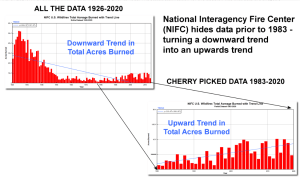
The above graph, and excuse me for showing it as I am aware graphic information is Greek to most people, is an illustration of the art of lying, but convincingly, aka “public relations . The National Interagency Fire Center, Boise, Idaho, is a government agency charged with keeping statistics on wildfire in the US. Over time they’ve done a good job, with integrity and honesty. However, the information they compiled, shown in the upper left quadrant, was for the Climate Alarmist crowd … inconvenient. Because this movement is powerful, it had the ability to force NIFC to rewrite history. In 2021, NIFC purged all data prior to 1983, which you can see from the upper left graph is the lowest fire point in the last 100 years or so. Back in the 1930s, when it was so incredibly hot, fires were off the charts, with 52 million acres burning in 1932 alone. But we cooled down, fires retreated, and we entered a period of low occurrence.
But the graph is ugly from a State of Fear standpoint, so NIFC did what all propagandists know to do when faced with inconvenient data … PURGE! All information on the public record prior to 1983 was removed from the public record. In effect, NIFC cut the dog off and only left us its tail.
It is only because of Anthony Watts and his WattsUpWithThat website that the data was recovered from the Wayback machine. That is why we have the original graph, and the lower right graph, the cherry-picked result. Cherry picking, by the way, is a user-friendly expression for “lies.” The graph on the lower right is based on lies, professionally told, as is the job of the public relations industry.
We residents are told by insurers and news and political agencies that
“Five of the worst fires in Colorado history have happened in the last 23 years.”
Now you know why. It is because information prior to 57 years ago was removed from the public database by NIFC, allowing our insurer to lie us, as he will be doing tomorrow at our meeting. It is at this point that I express gratitude for the freedom of having a small blog. While I have no power or influence, I can write as I please, knowing that our agent tomorrow will know nothing of it.
So yes, Maya, there is a Santa Claus. It is called “AI”, and its job is to tell lies, but with authority. You are good at your job, Maya! Keep it up.

