
 The theory that all trees are fake, an optical illusion put there by bears to hide their dens, is gaining wide traction these days on the Internet. Bears are actually very clever manipulators who run the planet from underground, with elaborate lighting and shadowing devices that create the illusion of trees within a thirty yard radius around us as we walk outdoors.
My morning on Facebook
My kingdom for a good book to read in the morning. Any suggestions? Instead, I skimmed Facebook … it appears now to be the primary vehicle for spreading propaganda, once the role of TV news and tabloids, but I repeat myself. It is coming down fast and furious these days.
This morning’s lessons:
Meryl Streep is a blueblood descendant of British royalty, and was chosen to be famous for that reason. She’s not smart, not even a good actress. Her opinions don’t matter.
The 2002 Venezuelan manufactured coup d’état
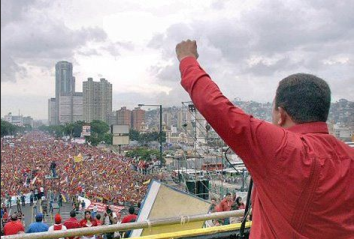 The 2002 failed coup d’état in Venezuela spawned a 35-page Wikipedia entry, and Hugo Chavez another 52 pages. As I came to understand that Fidel Castro was an American Intelligence agent, I began to realize there is a pattern here. Hugo Chavez, like Castro, is/was an Intelligence agent.
Chavez led a plot against the government of President Carlos Andrés Perez in 1992. It was an illegal coup, and could have easily led to his permanent imprisonment, execution or banishment. Instead he went on to become the President of Venezuela by popular election. That tells us all we need to know.
Continue reading “The 2002 Venezuelan manufactured coup d’état”
The Manufactured 2002 Venezuelan coup d’état
The 2002 failed coup d’état in Venezuela spawned a 35-page Wikipedia entry, and Hugo Chavez another 52 pages. As I came to understand that Fidel Castro was an American Intelligence agent, I began to realize there is a pattern here. Hugo Chavez, like Castro, is/was an Intelligence agent.
Chavez led a plot against the government of President Carlos Andrés Perez in 1992. It was an illegal coup, and could have easily led to his permanent imprisonment, execution or banishment. Instead he went on to become the President of Venezuela by popular election. That tells us all we need to know.
Continue reading “The Manufactured 2002 Venezuelan coup d’état”
Welcome to the calm zone
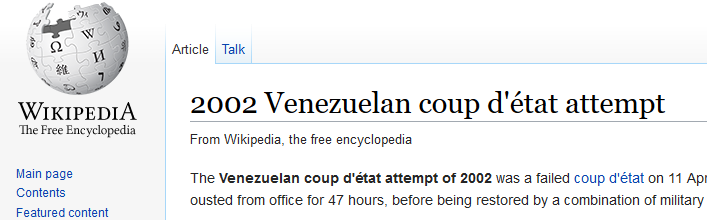
I have been busy researching an event from 2002, the failed coup d’état in Venezuela. Then-president Hugo Chavez was taken hostage for a couple of days and then restored to power. The upshot is that Chavez was controlled opposition and that the event was manufactured for the benefit of the Venezuelan people. It instilled confidence in Chavez, its whole purpose. (Wikipedia clues us in in the first sentence with the number “47.” That is a spook marker telling us the event was fake. We are not supposed to know that.) [A better word than “fake” is “manufactured,” as thousands of honest people were sucked into it by agents provocateur.]
Vermeer the Forger, Part Six
Vermeer’s Forgers
One of the most notorious art forgers in history was the miscreant, Han Van Meegeren (1889-1947). He is sited as much as he is because he had the juevos to engineer a swindle of the degenerate, Hermann Goering, head of the Luftwaffe and Hitler’s number two. This event made Van Meegeren a popular figure in Holland after the war but it was also the reason he was caught. Had he not pulled a fast one on Iron Hermann, his Vermeer forgeries might still be part of the official canon.
His story is told several times, the best English language versions being “Van Meegeren, Master Forger” by an Irish Lord, Kilbracken, with the aid of Van Meegeren’s son; “The Forger’s Spell” by Edward Dolnick, and the superior “The Man Who Made Vermeers” by Jonathan Lopez. If you only have time for one, get the Lopez book.
Also of interest is the filmmaker Errol Morris’ multi-part essay about these events and books at the New York Times website.
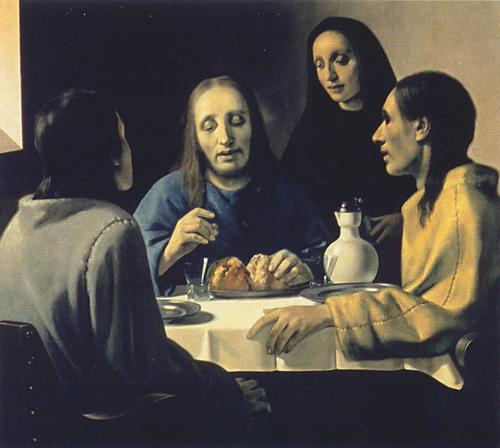
(Christ at Emmaus, Han Van Meegeren’s most successful Vermeer forgery)
Vermeer the Forger- Part Five
Vermeer’s Demise
Two events occurred between 1672 and 1674 that essentially broke Vermeer and hastened a quick and brutal end to his life at the age of forty three. The first disaster was the invasion of Holland by the French who were attempting to wrestle ports in the Netherlands away from Spain, the Catholic super power holding sway over the Protestant region. The immediate fallout was that the Dutch economy collapsed, leaving Delft in particular with holes in its pockets, prompting a mass exodus of tradesmen for Amsterdam, then the richest city in Europe.
Vermeer stayed put, having several children to feed, and he by default became one of the guild leaders as he was one of the few master grade painters left in town. This didn’t do him much good as the market for paintings vanished. It is at this point in time, if the eponymous claim of this series has any validity, that Vermeer may have, with the facilitation and cash flow of Pieter Van Ruijven, executed outright forgeries.
What became of the recounts?
“Democracy was invented as a device for reconciling government with liberty. It is clear that government is necessary if anything worthy to be called civilization is to exist, but all history shows that any set of men entrusted with power over another set will abuse their power if they can do so with impunity. Democracy is intended to make men’s tenure of power temporary and dependent upon popular approval. Insofar as it achieves this it prevents the worst abuses of power. (Bertrand Russell, Unpopular Essays, 1959)
“No serious sociologist any longer believes that the voice of the people expresses any divine or specially wise and lofty idea. The voice of the people expresses the mind of the people, and that mind is made up for it by group leaders in who it believes and by those persons who understand the manipulation of public opinion. It is composed of inherited prejudices and symbols and clichés and verbal formulas supplied to them by the leaders.” (Edward Bernays (“Father of Modern Advertising”), Propaganda, 1928)
“The chief problem of American political life for a long time has been how to make the two Congressional parties more national and international. The argument that the two parties should represent opposed ideals and policies, one, perhaps of the Right and the other of the Left, is a foolish idea acceptable only to doctrinaire and academic thinkers. Instead, the two parties should be almost identical, so that the American people can “throw the rascals out” at any election without leading to any profound or extensive shifts in policy.” Prof. Carroll Quigley, Tragedy and Hope, 1966)
Bernays words, that no serious sociologist believes in the voice of the people, neatly sums up the general attitude of our leadership class regarding elections: they are a necessary evil, but in no way should be allowed to influence public policy (as Professor Quigley makes clear). Consequently over the centuries American elections have always been the object of fraud and foul play. The only time the voice of the people is allowed to make a real choice is when the same people in power control both candidates. Then the votes can be counted and a winner legitimately declared. Thus I have no doubt that Nixon beat Humphrey in 1968.
Did Those Uruguayan Rugby Players Really Start Eating Each Other?
It is known as “The Miracle of the Andes.” A plane of people, including Uruguayan Rugby players crashed in a remote area of the Andes mountain range. In waiting for help, they were forced to turn to eating the flesh of the passengers who died during the crash. Their story was made into a Hollywood movie in 1993, “Alive,” starring Ethan Hawke. True story or another public hoax? Continue reading “Did Those Uruguayan Rugby Players Really Start Eating Each Other?”
Vermeer the Forger, Part Four
Vermeer’s Women
Vermeer sired fifteen children, eleven of whom survived infancy. At least seven of these surviving children were female. The adult woman seen in several of his paintings is obviously his wife, Catherine. A few items have their maid, Tanneken Everpoel, at her side (or, as in The Milkmaid, going about her duties alone) Most others, after the first few paintings featuring tavern life, I believe featured one daughter or another.

His most famous model, the adolescent girl with the oriental headdress, or, if you prefer, Girl With a Pearl Earring, is either one of his oldest daughters, Maria or Elizabeth. I believe she is the same person in The Girl Writing a Letter.
 Piece of Mindful