
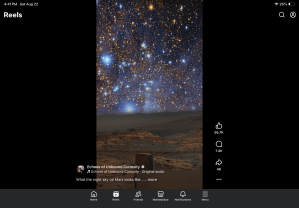
Sometimes in arguing about this and that, we are reduced to absurdity by official truth: The view of the sky from the Moon was total blackness. Yes, I know, we are told that the cameras used by the astronauts had to be shielded from intense light and so were f-stopped down so that the surface was visible while the stars invisible. But honestly, folks, you would think that one or two of the guys who walked there would have said “Holy shit, Batman! It’s beautiful beyond belief! We gotta get a photo before we leave!”
The above image is said to be taken from the surface of Mars, and a commenter or two has noticed that Moon pictures are oddly lacking a night sky. OK, it’s NASA. They claim to have landed a rover on Mars, Curiosity, and this is the view. The panoramic view has all the colors of the rainbow, and I only grabbed what looked real, and I don’t buy all those colors, obviously doctored. This by itself is reward enough, if if is real. A big IF, as always with NASA. But we have all seen doctored images from Hubble, so we know it is amazing once we get out of Earth’s atmosphere, even after the Hubble doctors do their graphics.
By the way, I got back on Facebook after a few years absence, and have now four friends! I go by the name Iksrakot, and got past the censors. Facebook now has a feature called reels, and it runs a constant algorithm based on what I watch all the way through, feeding me more of the same. Today I listened to music, classical and contemporary, beautiful pieces like Elgar’s Enigma Variations, Dvorak’s 9th Symphony, Second Movement, and the theme from Dances With Wolves and Forrest Gump. These were all performed by major city symphony orchestras. There was some Andrew Lloyd Weber mixed in too. I am not one who looks back on the past with nostalgia. I think we live in the best possible times now. I would not go back to my fifties childhood for anything. I could never have spent an afternoon like today’s, not in the 50s, 60s, 70s or 90s … it was not better anytime in the past than it is right now.


Can’t buy this kind of entertainment.
https://www.facebook.com/reel/9957878897629948?fs=e&s=TIeQ9V&fs=e&fs=e
LikeLiked by 1 person
Mark, I can hear NASA now explaining that the Mars sky photo was taken at night, while the Moon ones were taken in full daylight. They have an answer for everything, produced by experts and vetted by SNOPES. At least, in this best of all times, we are allowed to disagree and publish our disagreement.
LikeLiked by 1 person
Are you being sarcastic, Tim? I don’t follow.
NASA doesn’t have to provide the answer – anyone with any clue would respond the same and it was the thought that came to my mind immediately.
LikeLike
the most spectacular night sky i remember was Yosemite Valley in around 2000 in February when it was very cold, very dry air, with no light pollution in my cousins remote cabin. Im sure people who live at altitude in south America get to experience this all the time. Which was an incredibly spectacular sky full of light like i had never seen. I am sure the less atmosphere you have in the way and drier it gets the sky must increase in luminosity.
LikeLiked by 1 person
Mark, I wonder if you would agree that investment in belief and prejudice make us stupid. When we are invested in our beliefs we:
— fail to pick up on and ignore items that contradict them
— make things mean what they don’t mean and don’t make things mean what they must mean
When we are invested in belief our reasoning powers are disabled, it’s almost like turning a switch.
When you have been banging on about the moon landings for as long as you have and written as many posts on the subject you should have somehow picked up that the reason there are no stars in the Apollo photos is that the astronauts were on the surface during lunar daytime … just as we don’t pick up stars in photos on earth during daytime.
This is about a basic a fact about the moon landings as you can get … and yet somehow you still haven’t taken it onboard.
Those in power know that investment in belief makes us stupid … and they prey on that investment.
I thank you though because you’ve inspired me to do some more research on the Phil Pollacia film and the two articles on Aulis by the “Russian scientists” … and guess what? you’ll never believe it but I realised Aulis is yet another spook site. I couldn’t help having a laugh over the Revelation of the Method that gradually dawned on me as I was reading the second article. And it would seem that ‘ol Phil might have got himself involved in the “we didn’t go” psyop too.
No one’s argued against what I’ve put forward so far … but you’re welcome to give it a go, Mark, of course.
https://petraliverani.substack.com/p/pollacia-footage-of-apollo-11-launch
LikeLike
Petra it doesn’t matter if its daytime you would still be able to see stars in the sky. The reason you cant on earth is because of scattering in earths atmosphere from atmospheric particles and gas. Because those are not present on the moon you would get no scattering. The stars would be fully visible.
LikeLiked by 1 person
But, Ray, you can see them at night-time on earth – the atmosphere doesn’t disappear at night-time.
As I say, investment in belief …
LikeLike
I try, Petra, to maintain my sense of humour in these trying times. That includes the odd drop of sarcasm. But my words are never knowingly vicious although occasionally they can be viscous.
But to be totally straight and upfront, I observe that you yourself accuse NASA of major deceit, including with Apollo 1, Apollo 13, and the Challenger disaster. A lot of their broadcasts supposedly from inside the International Space Station look iffy to say the least. And they also have their grubby little hands on the global warming/climate change psyop. With a record like that, it seems reasonable to class them as untrustworthy to say the least.
Falsus in uno, falsus in omnibus is a Latin maxim meaning “false in one thing, false in everything.” I always bear that in mind when dealing with known liars. For me, NASA are always guilty until they’re proven innocent.
The lunar photography could be kosher for all I know, or it could have been shot in Arizona. As Harry Field Sr. said to Inspector Morse: “Fake only disappoints when found out.”
Mark, if you don’t know this scene, I’m sure you will enjoy it.
https://www.youtube.com/watch?v=X7-1sdzkj6Q
LikeLike
I don’t believe it’s possible to fake the completely alien conditions on the moon without signs in the amount of material provided, Tim, that is not my understanding of how reality works. The material provided all aligns with: black sky in day (thus brightly-lit vast expanses of terrain with no signs of multiple lights – all claims of multiple lights reasonably debunked), no atmosphere and 1/6th gravity. For me, unless someone can actually show me how they faked it, the fake hypothesis has zero weight … plus there’s a clear psyop saying “we didn’t go” that contains not a single word of truth that undermines the moon landings. If you need more evidence than that, OK, I don’t.
LikeLike
It’s good that everything is all so clear to you, Petra. You have taken a lot of time and made a lot of effort to get where you are, wading through claim and counterclaim about the moon landings, and come to reasonable conclusions based on what you’ve found.
Most of us don’t make the effort to get to where you are. In truth, we are not that interested that we are willing to invest as much time and effort as you have. If we do come to conclusions, they are mostly intuitive, or based on general reasoning. “This looks real.” “That looks fake.” “This guy sounds credible/plausible/knowledgable/honest/unbelievable, etc.”
Why do people believe what they believe? There are lots of reasons, and most of them don’t involve much inductive or deductive reasoning or close examination of evidence.”
Most people are like, “It must be true; I saw it on the telly.” Even in 2026, most of my neighbors reason in this way. There’s absolutely no point in talking to them about global warming, 9/11, Covid-19, Apollo (which you claim includes some fakery), or fake events in general.
I am one of those rare souls who is quite comfortable to be agnostic about whether Apollo astronauts landed on the Moon. I will let the two sides argue it out and enjoy the sport. No need for me to commit myself to forming an opinion until the balance evidence is overwhelmingly on one side. And since I honestly don’t know, it would be intellectually dishonest to claim otherwise.
It must be frustrating for you that most of your opponents in this debate will not debate you honestly on your terms. I find this phenomenon is ubiquitous online. Everyone wants to have their say; no one wants to follow along with what other people want to say. Socrates always managed to find ordinary people in Athens who were willing to engage in debate with him. Nowadays, anyone trying to engage people in discussions like Socrates did is likely to be called a a-hole or a moron.
One point that I like to bring up when these discussions arise—”What difference, at this point, does it make whether they went to the moon or not?”
I think it’s a lot like the question, “What difference, at this point, does it make whether Dürer painted Bernini or not?”
And I should think the answer in both cases would be, No difference at all to most people.
LikeLike
Actually i agree with you and am comfortable whether the moon trip was a hoax. I think it was a waste of tax money no matter what sunce it accomplished nothing as far as i am concerned. No moon bases, and nothing scientifically interesting except a bag of rocks.
LikeLike
The only thing I noticed on second viewing was that the paintings in the background changed. No doubt there’s other stuff! It’s not unlike the kids passing basketballs as a gorilla wanders in and out of the frame.
LikeLike
I didn’t see any gorillas in this one. But more interesting, I didn’t see the paintings changing when I watched this episode of Inspector Morse probably five times over the decades since it was released. It was only when someone online pointed it out a few years ago that my attention was drawn to the trick and I was able to perceive that the pictures were changing.
That leads me to ask the question, how much else am I not perceiving as I go through life mostly seeing what I expect to see?
This episode was entitled, Who Killed Harry Field?, and Harry Field Jr., who is killed early on, was an unsuccessful artist in Oxford, England, who scratched a living by cleaning paintings and creating fake genealogies together with coats of arms for mainly American customers.
His father, Harry Field Sr., was a successful artist in his own right, but also made a lot of money by forging old masters (or at least one old master) for a wealthy French collector.
Harry Sr. makes his point that “fake only disappoints when found out” while he is standing in front of a religious painting at the Christ Church Picture Gallery, Christ Church College, Oxford.
The changing picture in the frame behind him provides an excellent demonstration that most people are not very observant most of the time. I wonder how many viewers spotted the changes on first viewing?
The scene is highly deliberate for several reasons (as Google AI explains):
I think this has implications for the sort of mass media fakery you like to explore -including Apollo, of course. If we aren’t actively expecting or suspecting fakery, the chances are we won’t see it.
And most of us won’t accept that we’ve been taken in by fakery even after it has been pointed out to us. After you discovered that the same actor played Pete Hamm and Bill Maher, or the same actor played Martin Luther King and Don King, how many people are even prepared to consider that you may have been correct. None of the people I informed about your discoveries (all Americans) was the remotest bit interested.
Harry Field Sr., in the speech from which the above portion is taken, also makes the following observation about the old paintings on display in the gallery while gesticulating:
“How do you know any of them are real?
Because you are told!
lt is a matter of trust.”
Paintings, moonshots, terror events, famous people, it’s all the same. We are shown the exhibits and told they are authentic. And often they are, but often they aren’t.
Alongside Sherlock Holmes and Hercules Poirot, Harry Field Jr. is one of my most quoted heroes of detective fiction. It’s a shame he only appeared in one episode.
LikeLike
i reckon nasa’s first administrator understood this being a feckin movie executive of course.
LikeLike
the leo footage on the space stationship is feckin hilarious. Does mckeegan have a debunk for all the psilly mishaps on the space staionship?
his 911 debunk is good fun.
LikeLike
Petra, you replied to Ray’s point “The reason you cant [see the stars] on earth [in the daytime] is because of scattering in earths atmosphere from atmospheric particles and gas” with the following:
“But, Ray, you can see them at night-time on earth – the atmosphere doesn’t disappear at night-time.”
This reply demonstrates a major misunderstanding on your part.
Ray was implying scattering of sunlight by particles and gas in Earth’s atmosphere. There is a lot of visible sunlight during the daytime, and the atmosphere reflects photons in all directions, creating a blue sky that is brighter than any stars and most planets. Although it is possible to see the Moon clearly in daylight depending on the conditions, and occasionally the brighter planets such as Venus and Jupiter.
The Moon has no comparable atmosphere and the very tenuous atmosphere it does have doesn’t scatter nearly enough light to create a bright “atmospheric” sky that outshines or masks the stars. In theory, the lunar sky should be as black and as starry in the daytime as it is at night.
Astronauts on the lunar surface should have been able to point their cameras straight up and capture starry skies. To minimize glare from the Sun, they could have moved into the shadow of the Lunar Module.
In six missions, not one astronaut bothered to attempt this. In six missions, not one astronaut bothered to describe the starry sky that they would have been able to see.
You can’t, as an honest researcher, continue to plead ignorance about this point.
Just pop the words “Why can’t we see stars during the daytime” into a Google search box, and learn about what Ray was trying to explain to you.
LikeLike
Thanks Tim for clarifying. For Petras sake what that means is the moons daytime sky would look a lot like our night time sky from a place with no light pollution and clear air, except the sun would be the moon, except many times brighter. However that light is not scattered so if you looked at 90 to the sun for example the sky would be perfectly clear, as you can see the moon’s surface from the earth quite clearly.
LikeLiked by 1 person
My sincere apologies, Ray, however, regardless of lack of atmosphere the surface of the moon is much brighter than the stars and cameras were set for photographing the surface. Astronauts could see stars, they just couldn’t photograph them.
LikeLike
Oops, sorry I see what you mean.
Regardless, Tim, the reflected sunlight on the lunar surface is brighter than the stars and the cameras weren’t set for the sky they were set for the surface.
LikeLike
Easy fix for that just throw down a dark cloth or bring a dark bootg where you can isolate the sky from reflected light. Or take a picture at noght, or when orbiting? Plenty of opportunities. The videos and pictures dotted show a highly reflective surface it looks like powdered cement. And nothing like the insensity you can see during a full moon, when it looks almost like a mirror. It actually hurts your eyes to stare at the moon for long periods try it sometime it will leace ling after affects.
LikeLiked by 1 person
sorry for typos on myphone. What i was saying is the photos and videoed do not make the moon look very bright. Use a dark spot on the moon then, how hard is that to find?
LikeLike
moon’s albedo is 12, very low reflectivity. Earth is 31.
LikeLike
Explained to your satisfaction, but not to that of people possessed of ordinary inquisitive minds. Of course we should see stars in the Moon photographs. Duh!
LikeLike
Hi Petra,
Thanks for your answer.
Yes, the lunar suface is very bright. We can see that from Earth. But that’s not the point here. As there is no atmosphere to scatter light on the Moon, it should be possible to avoid all surface-reflected light merely by pointing a camera straight up.
An astronaut looking though the visor at the front of their helmet might have trouble with light from the surface as the glass is curved so, inn theory, some light from the surface of the Moon could be refracted or reflected by the visor glass onto the astronaut’s retinas.But a camera could be completely protected from the possibility if the lens was surrounded by one or two inches of light shielding.
To paraphrase Johnny Cochran, if there’s no air, there can be no glare.
Incidentally, according to NASA, “The Moon has a low average albedo of about 0.07 to 0.12, meaning it reflects only 7% to 12% of the sunlight that hits it.” That’s only a fifth to a quarter of the Earth’s albedo. The Earth must look incredibly bright from the surface of the Moon.
Neil Armstrong described the Earth as a “tiny pea, pretty and blue,” noting that he could block it out entirely with his thumb.
Buzz Aldrin referred to the Earth from space as a brilliant jewel against the deep blackness of the cosmos.
Michael Collins (from lunar orbit) reflected that he could hide the entire planet behind his fingernail or thumb, acutely aware that every single human he loved lived on that tiny speck.
From the lunar surface of the Moon, the average angular diameter of the Earth is 6,868 seconds of arc (or about 1.91 degrees). That’s about 4 times the average angular diameter of the Moon from the Earth’s surface. So the angular surface area would be about 16 times that of the Moon in a similar phase. Also, due to the Earth’s high albedo of 0.39, it would be giving off between 3 and 6 times as much light per surface area as the Moon does, so it might look 50 to 100 times as bright as the Moon looks to us down on earth. (Just off the top of my head.)
You would have to make sure your camera was not taking in the Earth if you wanted to get good views of the stars.
LikeLike
Tim, thanks you’re correct, I was over-doing the issue of answering Petra – it would just take pointing the camera at the sky with a lens hood due to no light scattering.
Thats interesting about the reported albidos of the moon vs earth, likely earths is so high due to water covering the majority of the surface. Which makes sense since water strongly reflects sunlight.
As a funny hoax parody I recommend the film Dark Side of the Moon, a mockumentary about the hoax. One memorable part has Kubricks widow describing how they tried to create a background with stars by poking holes in bedsheets, but it never looked right.
Dark Side of the Moon (2002 film) – Wikipedia
LikeLiked by 1 person
I think Armstrong’s “tiny pea, pretty and blue,” would be an understatement at best. It’s the equivalent of someone viewing the pyramids of Giza from the banks of the Nile and saying, “Piles of stones, triangular and sand-colored.” There is nothing in Armstrong’s statement to suggest he was particularly impressed with the view.
And now you mention Stanley Kubric, it is interesting that stars are not visible in the background during the final scene of 2001: A Space Odyssey.
When the Star Child floats in space looking down at Earth, the background is completely pitch black.
So, that scene was definitely not shot in Earth orbit.
LikeLike
What I see so clearly with the disbelief of the moon landings is how well those in power are able to distort our sense of reality … when we’re not careful.
The same applies to Star Child as it does to the moon – earth is extremely bright compared with the stars.
What you’re doing is focusing on things you can’t be sure about while not focusing on things you can be sure about.
What we can be sure about:
The moon has a black sky day and night, the earth does not.
All the lunar surface imagery aligns with this alien condition – and all the claims of hot spots and fall off have been explained, eg, while the sun is the only primary source of light may be reflected off items such as the lunar module or astronaut space suits.
LikeLike
“What I see so clearly with the disbelief of the moon landings is how well those in power are able to distort our sense of reality … when we’re not careful.”
Doesn’t exactly the same hold for “belief of the moon landings?”
Those in power are able to distort our sense of reality because they control the mass media and much of the alternate media. Everything we have been told or shown about the Apollo misssions comes to us second- or third-hand via media. And it comes distorted. We were not actually there viewing the whole thing with our own eyes.
You yourself don’t believe Apollo 13 was a real mission in jeopardy.
That makes you a very rare person. You believe some Apollo missions were legitimate and others were fake.
“What we can be sure about:
The moon has a black sky day and night, the earth does not.
All the lunar surface imagery aligns with this alien condition – and all the claims of hot spots and fall off have been explained”
Lots of incongruities have been pointed out in the lunar surface video coverage. From shadows that are no parallel to a model astronaut dummy riding in a moon buggy to astronauts being pulled up by hidden hoists before they stand up to flags waving at a frequency appropriate to lunar gravity, etc, etc.
Every one of these incongruities has been explained away immaculately by NASA apologists.
This is absolute proof. Absolute proof of what? Absolute proof that smart apologists can explain away almost anything about anything anytime.
This is how we know that 19 arabs with boxcutters brought down three tall buildings and made a hole in the Pentagon on 9/11 and we know that COVID-19 vaccines are safe and effective.
Yes, Petra, before you ask, I am being sarcastic. Sarcasm is as perfectly natural and ration al response to your implication that all the attempted debunking of the Apollo moon landing anomalies made by defenders of the narrative is legitimate but that of the Apollo 13 anomalies is not. While I try to keep an open mind about the subject, I find it very hard to take seriously the proposition that they would fake the Apollo 1 fire, the Apollo 13 cliffhanger, and the Challenger disaster, but they would not fake the moon landings.
LikeLike
Does all light have to be reflected or can some be generated (or whatever the sun does)?
So much is assumption built upon assumption.
LikeLike
good question. I believe you are asking if the moon is a blackbody that emits visible light, which is a function of the temperature of the object. The answer is we don’t know, except that typically it requires very high temperatures relatively speaking to generate visible light. Such as the surface of the sun which is claimed to be 5800Kelvin. However due to the moon’s phases it appears most of the light is reflected and not self generated.
LikeLiked by 1 person
Tim, I don’t feel confident to judge how all the factors involved would influence the appearance of stars.
What I do feel confident to judge though is that all the lunar-surface imagery is consistent with a black sky during lunar daytime, that is, we have a black sky and we have a brightly lit surface – alien to earth.
What about the factor of the lack of atmosphere on the moon not diffusing the particles of sunlight as it hits the surface.
Have you taken that factor into consideration?
For me, there is sufficient evidence I feel confident to judge to ignore what other people perceive as anomalies I am not in a position to judge.
What I also see is that those who write about the moon landings who believe them are far more knowledgeable on the subject than those who don’t believe them.
LikeLike
“What I do feel confident to judge though is that all the lunar-surface imagery is consistent with a black sky during lunar daytime, that is, we have a black sky and we have a brightly lit surface – alien to earth.”
Yes, but it is also perfectly consistent with a blacked out movie studio in Arizona, made to look like what we imagine the lunar surface looks like.
They would not have needed to actually visit the moon to get those video shots. They could have filmed the whole thing and the audience would have been none the wiser.
“What about the factor of the lack of atmosphere on the moon not diffusing the particles of sunlight as it hits the surface.”
If you could see any part of the surface of the moon, the glare would be very strong, and this would certainly limit the ability of human eyes or cameras to see stars.
But if you shielded your eyes or your camera so that no surface features were visible, the sky should be full of bright stars.
This is why I suggested looking straight up and standing or lying in the shadow of the LEM.
LikeLike
“What I also see is that those who write about the moon landings who believe them are far more knowledgeable on the subject than those who don’t believe them.”
This is a fair point. Although the same can be said generally. For instance, religious scholars are far more knowledgeable about matters pertaining to their religion than agnostics or atheists are. Does this incline you to believe that the doctrines and tenets of Hinduism, Judaism, Islam, Christianity, Buddhism and Shinto are true, and that the doubters have been wrong all this time?
But if your impression is correct, and believers in the moon landings are more knowledgeable about their subject, where does it get us?
They could include liars and dissemblers, and they could also include people who are totally honest and sincere but only knowledgable about certain parts of the project because it was highly compartmentalized.
Or they could include Dunning-Kruger types who appear very knowledgeable due to overconfidence in their own abilities, but aren’t really as knowledgeable as they think they are.
LikeLike
“Does this incline you to believe that the doctrines and tenets of Hinduism, Judaism, Islam, Christianity, Buddhism and Shinto are true, and that the doubters have been wrong all this time?”
Physical reality is a completely different kettle of fish from religion.
LikeLike
“Physical reality is a completely different kettle of fish from religion.”
Petra, that fish in your kettle is a red herring.
We are not talking about physical reality here. We are talking about narratives and about whether we can believe what authoritative people tell us when they seem to be knowledgable.
I provide analogies in an attempt to make it easier for others to see where certain lines of thinking are taking them. Because it is easy to get caught up in logical errors. We all do it.
When you say that believers in the moon landings seem more knowledgable than non-believers, with the implication that this makes them more credible and more likely to be correct, you are judging the truth of what they are telling you based on their performance. Again, we all do it. But this is where we are in danger of being taken in by what Carl Sagan called “the bamboozle.”
The truth of any story doesn’t depend on the performance abilities of the person telling the story. If the story concerns a claim about a matter physical reality, the validity of that reality is independent of anything anybody says about it, or how authoritative or credible they sound.
If you don’t think religion concerns physical reality, that’s your perspective. I could have used 9/11 or climate change or Covid 19 or the efficacy of vaccines or statins or SSRIs as alternative examples.
On all of these topics, you will find dozens of experts, authorities, specialists in the field, who will confidently assert that 19 Arabs led by a guy in a cave in Afghanistan destroyed the WTC buildings, human emissions of CO2 from burning coal, oil, and gas are changing the climate and causing every episode of inclement weather, COVID 19 is caused by dangerous virus that originated in bats or else in a lab and that to protect yourself and your granny, you need to wear a paper mask, stand six feet apart in the supermarket, and submit to a series of injections containing poisons that will stimulate your immune function. Or take statins of you blood cholesterol is above a certain level, etc., etc.
In the case of all of the above, there is no end of apparently knowledgable and extremely confident and authoritative people telling us these things are true. And if you want to check out the details, the mass media and your favorite AIs will back them up.
Compared with some of the these subjects, the moon landings story is trivial. As I wrote earlier, what difference does it make, at this point, whether it was true or not?
LikeLiked by 1 person
Actually, stars are visible during the day on earth too. Using a telescope makes it possible. Venus is visible anyway. We’re supposed to believe all these science missions to the moon were done, but NASA was not compelled to present the sky as visible on the moon to humanity. Ridiculous.
LikeLike
And perhaps stars are visible on the moon during the day too but we’re talking about photos not the naked eye and if they set their cameras for stars those settings would make the shots of the surface horrible.
We got a black sky during the lunar daytime – an alien condition on the earth – with a brightly-lit surface. There is no better signature of the moon than that.
Propagandists told us that we should see stars – propagandists. Why is it so very, very hard for disbelievers to understand they are being duped! And they started their propaganda even before the first moon landing with the 1968 BBC drama, The News-Benders, with a dinky model of the lunar module against a sky filled with stars.
LikeLike
My point is a different one. I’m not taking about the pictures we’re given. If the moon missions were real, the sight of the sky would have been a huge topic. This would teach the Bible thumbers a lesson! They brought that silly rover, multiple times, but nothing to make decent pictures of the sky, even once? Not convincing. I’d expect a complete panoramic view of the sky, presented in museums. This is in general the way to judge the program. Ask what we don’t get, and what is plausible. Because there is an answer for everything, straw men ask questions, these are answered. Correctly answered questions do not prove men walked on the moon, by the way.
LikeLiked by 1 person
The sky is black when cameras are set for the surface. We got lots of very convincing photos of other elements but you want black sky.
I don’t.
LikeLike
For the record, I responded at length at Petra’s Substack.
LikeLike
First, I am highly skeptical that Curiosity is giving us shots from the surface of Mars. I suspect what we see is tribute to the advances in visual technology since the 1970s. There is some oddball footage scattered about showing vessels in the air and landing imprints in the foreground, all without comment. This is obviously meant to impress us about alien technology. Consider the source, Facebook, which was at the forefront of highly effective censorship during Covid, now giving it up? C’mon!
Regarding Pollacia and his Super 8, again you go with your RofM, which appears to me to be a mental figment on your part used to collect oddities that appear when evidence is scattered about in the debris of footage whose main thrust is to sell a fake event as real. When I was still in high school they were selling knives on TV made of space-age material, and showed a knife 1) cutting a nail in two, and 2) then slicing a tomato like butter. Except that between the two events, the hand in question flipped the knife from one edge to the other, right on the film. I asked other kids if they had seen the flip too, and none had. Keep in mind that these were ordinary kids, like me, all of them getting better grades.
It is one thing to notice oddities in execution of false events, which are unavoidable, and quite another to see something like the knife trick, easily explained by a TV station’s legal department insisting on honesty in advertising as a legal defense. I’ve often wondered about school shooting and events like Waco and Columbine, where no one died, and conclude that if people really did die, there would be legal ramifications, prosecutions, insurance companies having to pay out settlements, none of which happens.
That is not RofM, but merely reality poking through. Even the spooks that govern us do not, for whatever reasons, go about willy nilly killing people. In your case, you’re using RofM, a mental trick, to blind yourself to any evidence that contradicts your long foregone conclusion. You are impermeable to doubt as a result. It’s like you’re wearing a Playtex suit as armor. The simple fact is that in places without atmosphere, stars are visible in daytime as well as night. Since they could not fake those stars in the giant warehouses where the Moon footage was shot, lacking the CGI technologies now available, they simply said stars were invisible. That’s a revelation for sure, not of method but necessity in pulling off a hoax.
I’d be curious if astronomers, professional and amateur, could recognize stars from our own night sky in the Curiosity footage. It would be a sign of how far the technology has advanced.
LikeLike
I think that f-stop rationale really puts them in a bind.. it’s admitting that the stars would be visible to the naked eye, and so a different film speed and f-stop, maybe standing in the shadow of the lander, it should be possible to capture them. And would surely be attempted over six missions, as Tim Groves says above. It does seem like maybe it was just too difficult to fake at the time, so they decided to blow past it and claim photographic technical issues if pressed..
LikeLiked by 1 person
As they say, close enough for government work.
I have seen videos of the man on the street interviews asking them if they believed the moon landings, shortly after Apollo 11. They were clearly seeding the ground to mark anyone who doubted it as worthy of ridicule. I recall the doubters were poor and or black, so i.e. the disenfranchised as Mark puts it. So that anyone who doubted it would be lumped in with poor white trash.
LikeLike
Yes, it’s all Divide and Conquer but that kind of behaviour works both for the psyop “fake moon landings” and the psyop “let’s push out that the landings were faked”.
It’s the evidence that counts, Ray, the evidence! There’s massive of it and virtually all seeming anomalies have been explained. If a few haven’t been so what? Not all seeming anomalies necessarily have an explanation but there’s more than enough that aligns perfectly with the alien conditions on the moon.
LikeLike
You can’t leave the framing. I don’t want silly golf on the moon photo OPs, I don’t want to stare at these photos, people do it since 1969. The point is, there should exist serious astrophotography, and it should have been published widely. I’m aware some work exists.
LikeLike
Replying to Tim Groves, wanted to say keep it up! I love the recent comments, very well thought and written. As I mentioned before I am “different” like you in that I invest nothing in the moon landings, being real or not, and in fact burst out in laughter 5 years ago when I figured out they were BS. Even though previously I was a true believer. However what I do, and did care about was nuclear weapons. I figured out both those hoaxes to my satisfaction the same day, and the moon hoax reveal was a big part of me seeing through the nuclear hoax. Which is why I think the moon hoax is protected, as one bookend of the major cold war science projects of the 20th century, which are pretty long in the tooth, and require some serious religion to believe in. On Facebook they have pushed Apollo stuff relentlessly the past few years, and even put on big immersive shows at local science museums last year so the public could feel what it was like to do the Apollo landings, haha.
LikeLike
Just wanted to shout out to the dumb broad with the big cans wherever you are, how’s the vaccine working out for ya now? I couldn’t resist:
‘Vaccine, Vaccine:’ Dolly Parton Sings ‘Jolene’ Rewrite as She Gets Moderna Shot
LikeLike
My wife told me about the supposed death of Dolly. I didn’t even think about it much. But I do wonder what she knew. Just because someone plays stupid doesn’t mean they are.
I was listening to Huberman a day or so back and thinking how much sense one of his guests was making (probably because the subject matter was slightly out of my wheelhouse, or I was doing other things and not concentrating. The he started going on about different drugs and finding a cure to dimensia…..And I started wondering does he really not know what causes it, while I do. Not likely but possible I guess. I honestly do wonder who knows what out there.
Do any high profile celebs believe in vaccines and viruses? Does Trump really believe he is running the USA? What doctors know what about what they are doing?
I honestly believe all of the people running the show and most of their high level servants are much more intelligent than the average human. Simply through not having been systematically poisoned all their lives (possibly through breeding) and not being fed constant lies and not having to work all day in repetitive mindless (or worse) tasks.
Over the years I have began to believe you can watch a being move (or perhaps even just look at their face) and make a reasonable judgement on their intelligence. I think most of our stupidity and lack of coordination is from constant poisoning and the damage that does to our brain and body.
LikeLike