I am scheduling this post to appear on the morning of February 6, 2025. By the time you read it I will be somewhere above the flyover states between Denver and Minneapolis.
This reminds me of my first overseas flight in 2006 that eventually landed us in Barcelona after a long layover in London.
After a routine flight from Bozeman, we took off from Minneapolis, my wife and I in standard economy with limited leg room and uncomfortable proximity to nearby passengers. At that time onboard entertainment was limited to a large screen at the front of the economy section that showed a map of our route, and an image of an aircraft as it crept along. Nothing could be more boring or remind us more of the tedium and the length of cross-Atlantic flights than that screen. It was tortuous.
At a certain point prior to getting aboard the flight, we were offered a chance to upgrade to first class for $50 bucks each. Had I known the tedium of overseas flights I would have jumped on it, but to my eternal regret I opted not to accept the offer. Can’t fix stupid, as they say. To this day I feel a pang in my gut as I think about that decision.
Maybe half an hour into the flight, the pilot announced that the aircraft had experienced a small problem and would have to return to Minneapolis. He was not specific about the problem other than to assure us that after maybe twenty minutes to dump fuel we would land again there. I was a rookie, and not aware of the 4X airline time rule: for every minute an airline advises of a “slight delay” of any kind, you must multiply the time by four. So the twenty minutes to dump fuel was actually over an hour. That’s the rule, 4X, and it cannot be changed. Pilots, attendants, even people behind counters in airports abide by that rule to minimize passenger blowback.
A man seated behind us during the fuel dump had some familiarity with aircraft, and noted that the pilot was not banking as he made turns, meaning that one of the flaps on one of the wings was not working. He said this might be critical in landing in Minneapolis, as the pilot would have to travel far afield to make a gradual turn to allow him to land the aircraft at a straight shot without banking.
Finally, after a 90+ minutes (going on memory) turnaround after the announcement, the plane landed in Minneapolis. To our shock and surprise, the runway was lined on both sides with fire engines and ambulances. We spontaneously broke out in applause as we landed safely. Apparently the problems were more severe than anyone let on. To their credit, the entire flight crew, pilots down to attendants, never let on that we were in any danger. That was professionalism at its apex.
We were transferred to another aircraft, and Northwest offered us each a $25 credit on a future flight. We were scheduled for a five-hour layover at Heathrow in London, and so the time lost did not affect our flight to Barcelona, as our layover was now only two hours.
____________________
I’ve since become better at flying, bringing along entertainment – books and later Ipads for reading Kindle and playing games. And, Temazepam. Airlines now have seatback screens to watch movies, or if one so chooses, to monitor the flight just as we did in 2006, with great tedium. This is how I got to enjoy the John Wicks movies. The flights are still very long and boring.
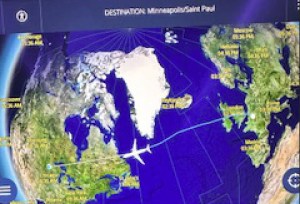
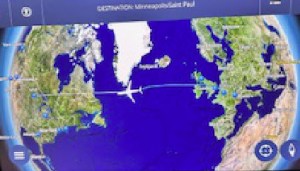
One of the unusual things about flying east I learned was that all flights, no matter where, would course over or just south of Greenland. I wondered why, as my naive self did not understand the difference between flat maps and the curvature of the earth. Even though it looks like we are taking a great arch to get to our destination, we are flying a straight line. (This is also true flying to or from Japan or Asia or New Zealand … from LAX we fly just south of Alaska and over the Aleutians. This too is a straight line.
_____________________
This trip is taking us to Nairobi, Kenya, our ultimate destination a Safari. The trip has been planned by my wife and daughter, and I am just a passenger, an invitee I suppose. I don’t experience the thrill of seeing wild animals from a jeep. Another relative who just made a similar excursion told us (to his regret as he did not know how it would affect me) that when tourists witness a kill by an African predator, they eat their victims while they are still alive. I don’t want to see that.
Others I have talked to about Safaris tell me that the experience is life-changing, a whole new perspective of our journey on this planet. Since none of us know why we are here (is there a “why”?), I could use that perspective. Surely the lions and tigers who bite into the flesh of a living organism have no clue why they are sent here to lead long lives in constant danger or unrelenting boredom. God did them a favor by giving them small brains. To varying degrees we humans are given the same gift, so I sincerely hope that my safari experience is lifechanging and enlightening in line with my cranial limitations.
______________________
Back to the flights going and returning to going to Nairobi. They last, in total, 27 hours. Going, we have five hours of layover, but wait! We are confined to airports during those layovers, and those places offer only limited reprieve from aircraft imprisonment. We can at least walk around. I have experienced resperatory distress in airports, most recently Atlanta, as they are set in the middle of place where aircraft expel great quantities of pollutants, sulfur and nitrogen dioxide for instance. On leaving Atlanta after a long flight delay earlier this year, as I sat in my seat I sneezed maybe ten times in a row. I never do that. The detox was only beginning, and would last a few days into the trip. (“I swear, to this day, it was not just an ordinary cold.”) Maybe an N-90 mask has some practical use after all.)
- The confines: There is no comfortable seating anywhere in airports where one might tilt a chair backwards and fall asleep. It must be done by folding one’s arms and tilting the head down so that we are looking at our thighs. The effect on the neck means that only brief naps can be tolerated. I have seen people stretched out on cold linoleum floors to gain some relief. I’ve not done that myself. (Also, every seat has an armrest, not to rest one’s arms, but to prevent anyone from laying down.)
- Airport food suffers from limitations, one of which is that it can only be heated up. Unless one is seated in an active restaurant, there is no real cooking going on, and even then, cooking is limited to burgers, fries, pasta. There are fancier restaurants that cater to wealthy fliers, maybe even celebrities, but they are hidden from view. There are kiosks all about that offer sandwiches and snacks like three hours worth of MM’s or Jolly Ranchers. There was a time when I could indulge, but now I am limited to coffee and prepared meals that hold a minimum of carbohydrates, which are hard to find. Like grocery stores, airports are carb-intense.
The big fast-food companies are all about airports – Pizza Hut, McDonalds, Burger King, and even sushi, but don’t go there. Raw fish in a place where it takes several days to deliver product to consumer … I do not recommend it. McDonalds revolutionized the industry, and in a good way, one by offering a broad range of menu items, but also by mechanizing the cooking-to-consumer time so that there is a good chance when you order a burger or McMuffin, it is reasonably hot “off-the-grill”. Of course the food has to sit around a while before serving, but Micky D’s has minimized this time. Others have done as well, but without heat lamps, there is no airport food.
But there is coffee, and my favorite, lattes (insert derogatory comment here). They are really as good in airports as in kiosks and shops on the mainland. I often have two coffees during a layover, knowing that it will force that long down-the-aisle journey to an on-board restroom where we must wait outside the door of the tiny lavatory, and where inside people are doing their best to minimize the noise of expelling waste. They leave with eyes downward.
Back to the airliner … they have made great strides in serving palatable meals on long flights, kept warm and offering variety including a main course, a vegetable, some form of potato and something akin to dessert. It’s quite an art. I’ve been asked now five days ahead of our flight to choose my meal. I was offered either chicken and tomato-chickpea stew, or three-cheese manicotti. You decide. But honestly, when imprisoned by limited legroom and close quarters with others over long periods, every little treat takes on new importance. I look forward to peanuts (I do not care for pretzels) and sparkling water (where they often give me the whole can!). Sometimes they give us little sweets, like dry cookies.
After a long overnight flight, attendants come around with water, and then later coffee or tea, which is, on first awakening, delightful. I don’t miss my morning latte (insert derogatory comment here) and am happy to have a good strong Starbucks black coffee. Later they come around with hot breakfasts, usually some form of omelet, by the grace of God still hot after 6-10 hours n storage. They reheat them – they kept them hot all that time, they would shrivel down to cracked tortillas filled with dried eggs.
On arrival at destination, one is faced with jet lag. We have found one way to avoid it – go to New Zealand or Australia (we went to NZ), where after crossing the International Date Line, one has rounded the clock back to within a few hours of Denver, Colorado time. You can also fly north-south, and stay reasonably close to your time zone. Our flight from Paris to Nairobi is only two hours difference, Paris behind Nairobi. All our jet lag to that time will be experienced in the Charles de Gaulle airport, and aboard the aircraft on the eight and one-half hour journey. You do not want to sit next to me, and my wife, bless her heart, has no choice but endures magnificently.
Twelve days later, we rinse and repeat, going the other way. As things stand right now, my clock is topsy-turvy, maybe my body pre-adjusting to jet lag on the other end. I fall asleep around 7:30 to 8:00 pm, sleep until midnight or 1:00 am, read for a while, sometimes take a Temazepam, and sleep until three or 4:00 am hoping on arrival at our African destination that those hours better align with Kenya, nine hours ahead of Denver.
If not, steer clear.






 Piece of Mindful