Introducing Gaia

First of all, an honor and happy to be part of the writing team here.

I have to say that blogging never was my forte, when joining POM almost a year to the day ago, the first comments were my first blog posts ever. I have been at forums since 2000, so there lies my expertise. But the “blogosphere” was virgin terrain.

As with most of us, I found POM via Miles Mathis and although I praise Kevin Starr for his excellent boomerang deconstruction of MM’s family history, I don’t really think he is “a committee”. I may be wrong and stay open to that possibility, but I rather think he went on a rabbit trail (publishing books even) and his ego doesn’t allow him to review his earlier assumptions (especially about “Space Travel”). He has the intelligence level to be able to do it, but he doesn’t. To some that may stink of “spookiness”, to me it more looks like “too proud to swallow earlier words”.
Continue reading “Introducing Gaia”

Some Call it Forest Management, I Call it Racketeering.

When government agencies like the U.S. Forest Service and Bureau of Land Management produce the danger, the propaganda hyping the danger, and the protection against it at a price, that’s racketeering.  The definition of a racketeer is someone who creates a threat and then charges for its reduction.

“War is just a racket. A racket is best described I believe, as something that is not what it seems  to the majority of people. Only a small inside group knows what it is about. It is conducted for the benefit of the very few at the expense of the masses.”  – Smedley Butler

Government land management agencies commonly simulate, fabricate and exaggerate threats in ways common to all other racketeers.  Constantly at war with the forces of nature and the land they manage, this pattern of immoral extractive commerce targeting public land is a microcosm of a vast universe of Government Sponsored Enterprise (GSE).  GSEs generate huge profits for private companies and government, in partnership Continue reading “Some Call it Forest Management, I Call it Racketeering.”

Welcome Gaia!

Our friend Gaia as agreed to come on board as a writer, and will be posting articles soon, perhaps over the weekend. He just emailed me that a monster storm had taken out Internet for his town, but he is back online again. I look forward to his work. I have assured him that I am not looking over his or anyone’s shoulders. I have been so busy that it is a relief to have him and the others aboard.

Blog Appearance: Next week I am going to make sure that Gaia and Annette have their space over on the left side – it is a program called “CSS” that I must use to do that, and I have good instructions from WordPress on how to do it, so both of them will soon be there on the left-hand side. Problem is, every time I have tried it so far, I have made a mess.

In the meantime, a friend of the blog suggested I update the Paul McCartney/John Halliday post and bring it current with comments intact. It is generating a lot of current interest. I will do that. I also have plans to write a post that links every interesting story we have done here over these past few years, a way for new readers to get immersed and caught up. That too will happen soon, and that link will be at the top of the blog.

In the meantime, welcome Gaia!

Jonestown: Not so remote after all

The complete five-part Jonestown series:
Jim Jones: The Fake early years
Jonestown: Introduction
Jonestown: More Questions than answers
Jonestown: Not so remote after all
Jonestown: The end

When I was researching the Waco “massacre,” a light went on – that the buildings were empty, and that the whole thing was just a TV show. I laughed out loud with that realization. With Columbine, the little light told me that the SWAT unit that was mobilized was there to keep people out of the school, and not to interfere with anything inside. It was a made-for-TV-news event.

A light has gone on about Jonestown, but it is faint. Please follow along.

Continue reading “Jonestown: Not so remote after all”

How Mom saved me

I know I have to write about Jonestown, and I will. But my mind has been occupied lately, the class reunion playing a part. I was thinking back on an episode I call “How mom saved my life.”

It was 1960. I was the youngest of four boys, ten years old. I am the only survivor. At that age I did not have a large enough world to know things were wrong. We were a strong Catholic family, and I attended a Catholic school. That’s important to know. We were sitting at the dinner table, and Mom got up and announced “I am not going to mass again until your Dad quits drinking.”

I looked over at Dad at the end of the table, and for the first time in my life realized he was drunk. What Mom was doing was blackmail, of course, and in the subsequent years I would think of it as melodrama. She was telling Dad that he was responsible for her eternal soul, laying the burden on him.

Continue reading “How Mom saved me”

Batter Up

The Montana Green Party is back in federal district court trying one more time to regain access to the November, 2018 general election ballot.  While it is often hard to see the sense of what one does, I remind myself that some 10,000 Montana voters signed the petition to grant us a chance to compete with the corporate-owned parties in this election cycle.  http://www.krtv.com/story/38882281/montana-green-party-files-suit-in-federal-court-to-gain-ballot-access

For me, this will be the third time challenging Montana’s election laws in federal court.  We’re batting 1000, so why stop now?  Both previous victories, however, did not result in placing the name(s) of candidates on the ballot.  This time is a little different.  Green candidates were certified for the election by the Sec. of State and county clerks before being removed in July by a state judge and Democratic Party — the complainant.

My question:  If elections mean nothing, why all the tight sphincters across state and federal agencies and the MSM when a no-name, third-party candidate gains ballot access in a tiny western state like Montana?

I hope to find out the answer in November.

A reunion

Too much time on the highway and in motels results in stuff like this. We are back now – I didn’t want to say anything, but might as well spit it out – I attended my fiftieth high school class reunion. I graduated from Billings Central Catholic High School in 1968. Good lord am I old!

A few reflections:

  • I look pretty good. Most of my classmates have put on pounds and have not stayed in shape. I guess we just reach a point where we give up, but I have not yet gotten there. I still have dark hair, have controlled my weight, and work out often.
  • We were a class of 115. Thirteen have died.
  • My class rank was 87, and I like to joke that for that reason I thought our class size must have been … 87. I was not a good student, and did not light up until later, in college. I was told by teachers that I lacked direction, and that my standardized tests were in the high percentiles, so that I was underachieving.

Continue reading “A reunion”

Jonestown: More questions than answers

The complete five-part Jonestown series:
Jim Jones: The Fake early years
Jonestown: Introduction
Jonestown: More Questions than answers
Jonestown: Not so remote after all
Jonestown: The end

We are off on another trip, and so any work I am doing on Jonestown is on hold. However, I did take time this morning to look into Gaia’s work on this subject, which is still visible at Fakeopedia, here. After reading that I realized that I don’t have to reinvent the wheel, but merely pick up on, highlight, and perhaps expand on work already done.

In reading that work I realized as well that this is a massive undertaking. I have more questions than answers, but am settling on one aspect that makes everything else more poignant:

No one died.

Stop and think about it – the people who supposedly died there were from the lower casts of society, at least that is the story. They were mostly black, and that adds to the unspoken and indelicate attitude that these were not important people, sorry to say. So there are several angles from which we might approach the event:

Continue reading “Jonestown: More questions than answers”

Jim Jones: The fake early years

Jonestown

Note: My only source at this point is the primary source of all lies and false history,  Wikipedia. My thinking is jaded by presupposition – after reading Wiki about Jones and Jonestown, all I could think was “fake, fake, fake.” Therefore be advised that my writing will be riddled with confirmation bias.

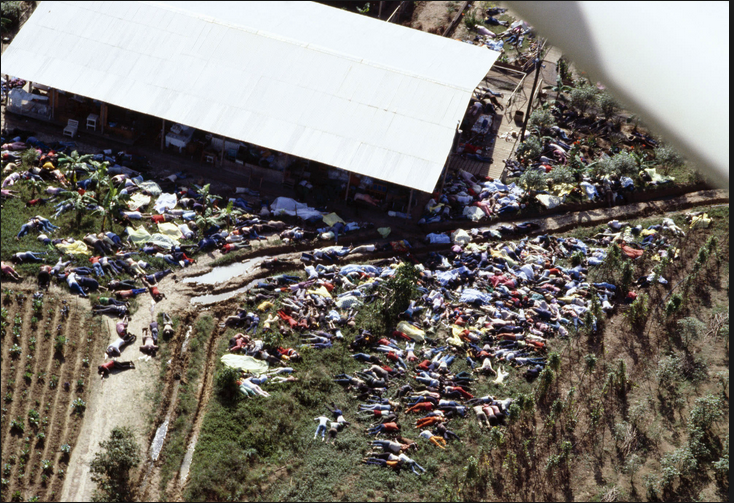
The gruesome image above is an aerial photo of Jonestown in the aftermath of mass suicide by cyanide, the origin of the phrase “drinking the Kool-Aid,” and what was in “fact” we are told Flavor-Aid. We are told that Jim Jones and 918 of his followers died that day. I printed the above photo and used a Sharpie to black out each body as I counted. I came up with about 200, tops.

Continue reading “Jim Jones: The fake early years”

Standing in the midst of whirling snow and blinding mist …

I am prepared now to go forward with the Jim Jones series, starting with his early life. That will come tomorrow or the day after. What has happened so far is good, lots of input which I have not and will not read until my own work, such as it is, is done.

This is, however, a diversion. While in Europe I ran out of reading material, and when we got home found nothing of interest. But while in college I was introduced to two volumes, The American Intellectual Tradition, edited by David A. Hollinger and Charles Capper. They have sat on my bookshelf for years.

My intent was to go back and reread a selection from Thorstein Veblen’s The Theory of the Leisure Class wherein he introduces for the first time the concept of “conspicuous consumption.” When in college (and I told the professor this) the man’s words simply did not penetrate my thick cranium*. I kept losing focus. The professor, a wise man, simply smiled and said don’t worry. My intent yesterday was to read it again to see if the cranium had lost some of its bone mass.

But I stumbled and never got there, instead reading a portion of William James’ The Will to Believe. I am a great admirer of this man and his pristine and probing intellect, first having read about him in Louis Menand’s The Metaphysical Club, and then reading his (very accessible) series of lectures that came to be known as The Varieties of Religious Experience (available as a free download at Gutenberg).

Continue reading “Standing in the midst of whirling snow and blinding mist …”