
(Again, to the other writers, feel free to write over this post.)
Sooner or later I need to get back to the important business at hand, writing about these annoying pests who write stupid regulations whose only purpose is to create super-awareness of a virus not even proven to exist. These are the ones who have littered our entire landscape with plexiglass and signs and pictures of footsteps and warnings to stay away from one another. What was Dante’s ninth level of hell – to be frozen in the center of a lake, unable to move? That seems a good punishment for these officious morons. I urge everyone to do what I have done, to take their idiotic signs, when opportunity allows, to the nearest john, depositing them in the waiting toilet water. Better yet, do so in a vault toilet where there are warnings about how difficult it is to remove trash. That would be perhaps Dante’s fourth level, a perpetual punishment of removing trash from vault toilets. Even this is too good for these medical Nazis. (In Big Sky, Montana, at a public picnic area, when we left there was a social distancing sign greeting the next user of the public restroom. It was too big for the toilet, so I had to put the stick end in and leave it, best available option.)
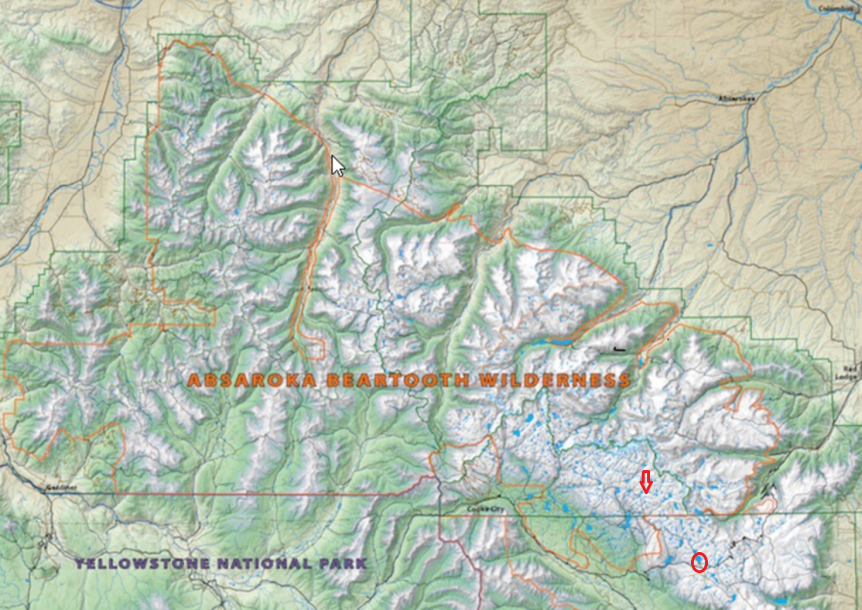 The Beartooth Mountains are part of a large wilderness complex formed in 1978, formerly known as a “primitive area,” since known as the “Absaroka Beartooth Wilderness*,” or “AB.” It sits north and northeast of Yellowstone National Park, and for most of my life has been my preferred destination over the Park. It offers solitude, miles of trails, and often enough, a private lake for backpackers. (There are 944 lakes in the complex. Many have fish in them, not my concern, but an added attraction.)
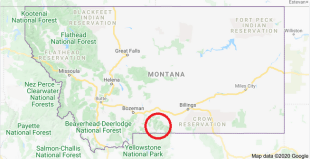 For reference, the AB is the circled area in the Montana map to the left. From the image above you can grasp the enormity of the area, and the number of lakes. From a hiking standpoint, the Beartooth Mountains are an “uplift” forming a high ice plateau. This creates many drainages and basins in which lakes naturally form. While forested, it is not heavily so. Hikers only rarely get lost, as the landscape usually shows the way out – just follow a drainage. But trails are abundant. However, leaving a trial is not in any way dangerous, as the landscape usually offers a good sense of where you are.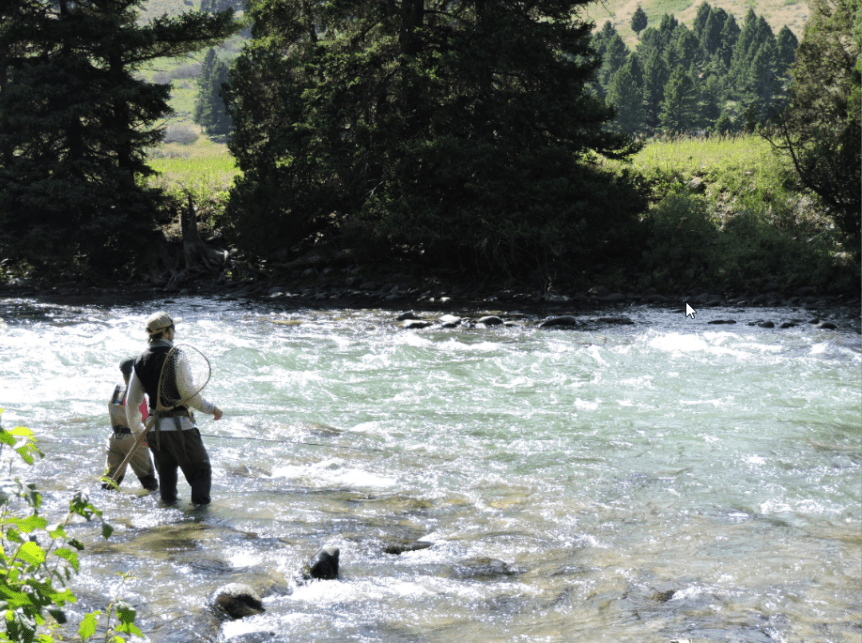
 I went to the Colorado Code Annotated, the

