Jonestown: More questions than answers

The complete five-part Jonestown series:
Jim Jones: The Fake early years
Jonestown: Introduction
Jonestown: More Questions than answers
Jonestown: Not so remote after all
Jonestown: The end

We are off on another trip, and so any work I am doing on Jonestown is on hold. However, I did take time this morning to look into Gaia’s work on this subject, which is still visible at Fakeopedia, here. After reading that I realized that I don’t have to reinvent the wheel, but merely pick up on, highlight, and perhaps expand on work already done.

In reading that work I realized as well that this is a massive undertaking. I have more questions than answers, but am settling on one aspect that makes everything else more poignant:

No one died.

Stop and think about it – the people who supposedly died there were from the lower casts of society, at least that is the story. They were mostly black, and that adds to the unspoken and indelicate attitude that these were not important people, sorry to say. So there are several angles from which we might approach the event:

Continue reading “Jonestown: More questions than answers”

Jim Jones: The fake early years

Jonestown

Note: My only source at this point is the primary source of all lies and false history,  Wikipedia. My thinking is jaded by presupposition – after reading Wiki about Jones and Jonestown, all I could think was “fake, fake, fake.” Therefore be advised that my writing will be riddled with confirmation bias.

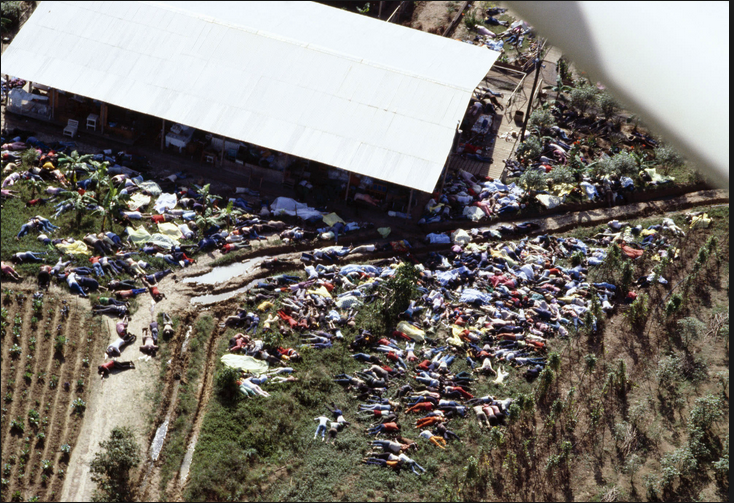
The gruesome image above is an aerial photo of Jonestown in the aftermath of mass suicide by cyanide, the origin of the phrase “drinking the Kool-Aid,” and what was in “fact” we are told Flavor-Aid. We are told that Jim Jones and 918 of his followers died that day. I printed the above photo and used a Sharpie to black out each body as I counted. I came up with about 200, tops.

Continue reading “Jim Jones: The fake early years”

Standing in the midst of whirling snow and blinding mist …

I am prepared now to go forward with the Jim Jones series, starting with his early life. That will come tomorrow or the day after. What has happened so far is good, lots of input which I have not and will not read until my own work, such as it is, is done.

This is, however, a diversion. While in Europe I ran out of reading material, and when we got home found nothing of interest. But while in college I was introduced to two volumes, The American Intellectual Tradition, edited by David A. Hollinger and Charles Capper. They have sat on my bookshelf for years.

My intent was to go back and reread a selection from Thorstein Veblen’s The Theory of the Leisure Class wherein he introduces for the first time the concept of “conspicuous consumption.” When in college (and I told the professor this) the man’s words simply did not penetrate my thick cranium*. I kept losing focus. The professor, a wise man, simply smiled and said don’t worry. My intent yesterday was to read it again to see if the cranium had lost some of its bone mass.

But I stumbled and never got there, instead reading a portion of William James’ The Will to Believe. I am a great admirer of this man and his pristine and probing intellect, first having read about him in Louis Menand’s The Metaphysical Club, and then reading his (very accessible) series of lectures that came to be known as The Varieties of Religious Experience (available as a free download at Gutenberg).

Continue reading “Standing in the midst of whirling snow and blinding mist …”

Jonestown, introduction

The complete five-part Jonestown series:
Jim Jones: The Fake early years
Jonestown: Introduction
Jonestown: More Questions than answers
Jonestown: Not so remote after all
Jonestown: The end

I have long wanted to explore Jonestown and all of the suicide deaths by cyanide poisoning, but have been put off by the massive undertaking, the complexity and surprises that await.  I have two prior projects behind me:

With John Denver’s fake death I was a rookie, and so spent tons of hours in the summer and fall of 2016 putting together all of the data. I was unsure of myself and wanted to nail it. Did I? I am not the jury, but for myself concluded, both with my own writing and research and excellent help in the comments, that the death was fake and (say with  60% possibility) that Denver, whose real name is unknown, decided to live out his life in New Zealand near his adopted daughter. When I presented it, it was a completed package, 7500 words, and comments that followed were intriguing. Not mentioned there, I suspect he and Annie are still a couple.

Continue reading “Jonestown, introduction”

A recycled vicsim?

A Facebook friend put up the following post:

4C57DDE7-9C4D-4318-8B7B-55D097A065EB

First, the photos all look stylized, as if she is modeling differing types of makeup. They have an unnatural quality, too professional to be selfies, and yet … not good enough to really be professional.

Second, the glasses, the eyebrows, the shape of the face … I spent quite a bit of time comparing faces after the Orlando Pulse Nightclub shooting, and while it was not well-received, I convinced myself that the same people with reverse angles and a bit of makeup and a wig or two were used as different victims. “Alex Beltran” resembled a couple of people in the montage below: Continue reading “A recycled vicsim?”

Note from the Hinterland

We have been traveling and I make it a point not to use the blog as a travelogue. Sometimes in our trips I run across pertinent matters … in Paris a couple of years ago I realized that photos of American troops entering that city on Champs Elysees in 1944 were paste-ups, mere war propaganda. No such triumphic march took place. In Copenhagen I realized a shooting in the hippie district of that city was fake, and witnessed a giant and pointless show of police power. I suspected it was a real estate-minded affair, as that part of the city, Freetown Christiana, can probably support high rises and expensive restaurants.  And then there was our trip to Buenos Aires and stumbling on to the grave of Eva Peron, realizing her death was fake, and later learning that she went on to offer her birth canal to the mediocre talent Madonna.

Continue reading “Note from the Hinterland”

Irony

I write here about a personal event, but also one that happened 31 years ago, so time has healed most of the wound. The event was as follows: A man broke into our house and raped our eight-year-old daughter on March 20, 1987. I was asleep in the basement, my then-wife asleep on the couch after having watched March Madness (she followed Notre Dame).

Police were unable to solve the crime, and because of its gruesome nature, had to provide the public with a perpetrator. They settled on a young man, Jimmy Ray Bromgard, and lacking any evidence, forged hair samples and provided an “expert”witness who said those hairs were Jim’s. The kid spent fifteen years in prison. In 2002 the Innocence Project set him free, and because the State of Montana was fraudulent in its case against him, he received a $3.5 million settlement. I imagine he got some of that. I hope he did.

In 2015 the real perpetrator was uncovered, Ronald Dwight Tipton, whose family name appears in the 1988 Billings, Montana phone book as living one block from our home. Why did he choose our daughter? That’s a family matter. I understand it now, though I did not before this year. However, Tipton will walk free now, as the statute has run.

I understand irony. It is a thing quite apart from humor. It cuts deep. Our “justice” system first imprisoned an innocent man. No one cared that Jim Bromgard was innocent. They “solved” the crime. The system worked. The lead detective on the crime landed a nice FBI position!

They have now let the guilty man go free. It cuts no deeper than that.

How not to rebel?

Immanuel Velikovsky died in 1979. The following passage is from his book Mankind in Amnesia, published in 1982. I found it, like him, profoundly insightful. He describes a situation that has not changed in the intervening years. It is, in fact, much, much worse. We are surrounded not just by stagnated and bureaucratic science, but with corrupt science. Warm your globe on that.

Continue reading “How not to rebel?”

What is up with 8, 11 and 33?

Find the next two numbers in this series:

1,2,2,4,8,11,33

The answer, as shown here, is 37 and 148. This has no significance in regard to this post, but I thought it kind of funny that the three numbers I will be discussing, 8,11 and 33, just happened to pop up. That is a coincidence.

I was listening to Ab over at Fakeologist some time ago, one of his call-in podcasts, and in it he said something to the effect that he does not pay much attention to numerology. I tend to agree with him, but only to a degree. I do not think there is any particular significance to any number any more than there is to any one hair on my head. Numbers serve a useful purpose. They help us quantify and measure things.

I know that some numbers have unusual properties, 9 for example – any time two numbers are transposed, 18 for 81 for example, the difference is divisible by nine. There is a such a thing called the “rule of 72”: Divide the rate of return on an investment into 72 and the answer is how many years it will take to double. It works. A 6% return doubles in 12 years, and a 12% return doubles in 6 years.

That is just fun and games, however, and has no cosmic significance. There is, however, something going on with numbers and public hoaxes and fake events. There may be superstition beneath it – if so, I do not care. Numbers still mean nothing. Superstitious people often have odd beliefs.

I am going to go through some numbers here, taken right out of real events, just to demonstrate the importance of what I once heard a man named Michael Parenti say: “Just because we don’t know what they are doing does not mean that they don’t know what they are doing.”

Continue reading “What is up with 8, 11 and 33?”

Taxes Part 2: The Tax on Social Security Benefits

Note to readers: Part one of this two-part essay was about FICA, and how a hidden tax affecting only people who work for wages is used to levy a heavy tax on those workers. Part of the strategy behind that tax is to hide half of it behind the employer, calling it a matching tax.

This part of the essay deals with another tax, this one not so hidden, but its creeping nature slowly taking more and more benefits from Social Security recipients each year. The means by which they accomplished this were diabolically clever.

This essay will be a bit more complicated than the one before, so if you find the calculations incomprehensible, merely skim them, as I will describe the  outcome in understandable terms.

As Johnny Carson used to say of comedy, “If you buy the premise, you buy the bit.” The premises behind taxation of Social Security benefits are two: (1) The program is in dire straits, and will soon run out of money, and (2) Recipients receive a gift in the form of the employer match, so that it is just to levy income tax on half of the benefits paid.

Continue reading “Taxes Part 2: The Tax on Social Security Benefits”