
To say that what I do is compulsive is akin to saying a Marathon runner really enjoys running. He/she doesn’t enjoy the suffering, I don’t imagine, but feels a need to conquer some madness inside, some burning desire to excel at something that most people don’t think or care about, running. I read a lot, but not compulsively, that is, I feel no urge to complete a book start to finish, and if I don’t like what I’m reading, I set it aside. If I really don’t like what I’m reading, I ceremoniously toss the damned thing in the recycle bin. I would easily drop out of the marathon at mile marker 3.0. I don’t suffer that burning desire, and don’t understand those so motivated.
Anyway, when I encounter a book I like, I shortly thereafter forget its contents. I can actually read it again and it will hit me as brand new. So, long ago, I developed the habit of revisiting a book I liked not too long after finishing it, and transcribing passages I had read and flagged. The idea was that manually typing out those passages would seal them inside my cranium with some permanence. It works! Sort of. These days I use transcription software, so typos abound, often comical, often hard to rectify without going back to the page of the crime.
The book I read recently is called “Can You Catch a Cold?”, Untold History of Human Experiments, by Daniel Roytas. (Video link here, Amazon link here.) I’m not big on credentials, but do note that the author lacks a “Dr.” before or a “PhD” after his name. But that does not matter if the only thing that matters is content. I also note that the book is not indexed, a true defect in my mind. Indexing is a time-consuming but worthy exercise. There are also some annoying typos contained within, not uncommon in this time of self-published works. The “Forward by Dr. Samantha Bailey” helps some, as I like her and her husband Mark, but living on the outside of their chosen fields must be degrading, with the resultant preaching while in exile being more like circle jerking than actually reaching anyone. Nonetheless, truth is where it is found, and I tip my hat to those who labor onward.
All that in mind, I am going to cite a long passage from this book on the Spanish flu of the post-World War I era, as I found it revealing and gripping. Read it too if you can, or not. I seldom follow orders, and when someone tells me I need to read this or that, I usually continue on doing what I am doing without heeding the advice. I made it through high school in that manner, and yes, I missed a lot in the process, but agree with Paul Simon that most of it was crap.
So, if you start to read what follows and then say “Ah, fook this,” I get it.
Have fun! Or not. There is a payoff at the end, so skip there if you want. Or skip it all and go to my own brief observations at the very end, and share your own in the comments. I know of one person, not sure who, claiming that the Spanish Flu was a hoax. I do not believe that. I believe it real, and just as with polio and micro encephalitis and God only know what else, was blamed on a virus as a cover-up. That is, really, the true function of viruses.
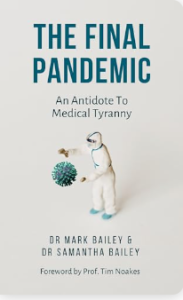 Note to Readers: Last night I read a portion of Drs. Mark and Samantha Bailey’s book,




 Piece of Mindful